• Fri frakt över 249 kr
  • •
  • Snabba leveranser
  • •
  • Billiga böcker
Kundservice

Du är på sajten för privatpersoner.

Företag, bibliotek eller offentlig verksamhet?

Du handlar på classic.bokus.com, där alla dina funktioner finns intakta.
Till classic.bokus.com
Bokus logotyp. Gå till startsidan.
  • Erbjudanden
  • Nyheter
  • Student
  • Topplistor
  • Barn & ungdom
  • Bokus Play
  • E-böcker
  • Pocketböcker
  • Spel & pussel

10% rabatt på allt med kod: NYSTART10 →

Sidfot

Mina sidor

    Hjälp

    • Kundservice
    • Vanliga frågor och svar
    • Frakt och leverans
    • Retur vid ångerrätt
    • Reklamera vara
    • Betalning
    • Köpvillkor
    • Allmänna villkor
    • Information om webbplatsens tillgänglighet

    Om Bokus

    • Om oss
    • Pressrum
    • För studenter
    • För företag
    • För bibliotek och offentlig verksamhet
    • För leverantörer
    • Hållbarhet

    Populärt

    • Aktuella erbjudanden
    • Presentkort
    • Studentlitteratur
    • Nya böcker
    • Topplistor
    • Signerade böcker
    • Engelska böcker

    Inspiration

    • Boktips
    • BookTok
    • Populära bokserier
    • Barnbokskaraktärer
    • Populära författare
    Logotyp för Bokus
    Följ oss på Facebook (extern länk)Följ oss på Instagram (extern länk)Följ oss på YouTube (extern länk)Följ oss på TikTok (extern länk)
    bokus @ CookiesAnpassa cookiesIntegritetspolicyKöpvillkor
    Till Citymail hemsida (extern länk)Till Budbee hemsida (extern länk)Till Postnord hemsida (extern länk)Till Schenker hemsida (extern länk)Till Early Bird hemsida (extern länk)Till Walleys hemsida (extern länk)
    1. Naturvetenskap och teknik
    2. Teknik och industri
    3. Elektronik och kommunikationer

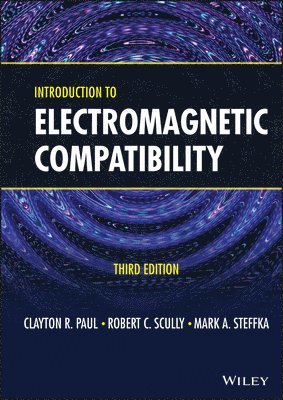
    Introduction to Electromagnetic Compatibility

    AvClayton R. Paul,Robert C. Scully

    Inbunden, Engelska, 2022

    1 529 kr

    Beställningsvara. Skickas inom 5-8 vardagar. Fri frakt över 249 kr.

    Beskrivning

    INTRODUCTION TO ELECTROMAGNETIC COMPATIBILITY The revised new edition of the classic textbook is an essential resource for anyone working with today’s advancements in both digital and analog devices, communications systems, as well as power/energy generation and distribution. Introduction to Electromagnetic Compatibility provides thorough coverage of the techniques and methodologies used to design and analyze electronic systems that function acceptably in their electromagnetic environment. Assuming no prior familiarity with electromagnetic compatibility, this user-friendly textbook first explains fundamental EMC concepts and technologies before moving on to more advanced topics in EMC system design. This third edition reflects the results of an extensive detailed review of the entire second edition, embracing and maintaining the content that has “stood the test of time”, such as from the theory of electromagnetic phenomena and associated mathematics, to the practical background information on U.S. and international regulatory requirements. In addition to converting Dr. Paul’s original SPICE exercises to contemporary utilization of LTSPICE, there is new chapter material on antenna modeling and simulation. This edition will continue to provide invaluable information on computer modeling for EMC, circuit board and system-level EMC design, EMC test practices, EMC measurement procedures and equipment, and more such as: Features fully-worked examples, topic reviews, self-assessment questions, end-of-chapter exercises, and numerous high-quality images and illustrationsContains useful appendices of phasor analysis methods, electromagnetic field equations and waves.The ideal textbook for university courses on EMC, Introduction to Electromagnetic Compatibility, Third Edition is also an invaluable reference for practicing electrical engineers dealing with interference issues or those wanting to learn more about electromagnetic compatibility to become better product designers.

    Produktinformation

    • Utgivningsdatum:2022-11-07
    • Mått:178 x 270 x 36 mm
    • Vikt:1 407 g
    • Format:Inbunden
    • Språk:Engelska
    • Antal sidor:848
    • Upplaga:3
    • Förlag:John Wiley & Sons Inc
    • ISBN:9781119404347

    Utforska kategorier

    • Elektronik och kommunikationer inom Naturvetenskap och teknik

    Mer om författaren

    Clayton R. Paul was Professor and Sam Nunn Chair of Aerospace Systems Engineering at Mercer University and Emeritus Professor of Electrical Engineering at the University of Kentucky, where he served on the faculty for 27 years. Dr. Paul authored twelve textbooks and published numerous technical papers in scientific journals and symposia. He was a Fellow of the IEEE and Honorary Life Member of the IEEE EMC Society. Robert C. Scully a Principal Electromagnetic Compatibility Engineer, practicing at Jet Propulsion Laboratory (JPL) in Pasadena, CA., previously the Johnson Space Center (JSC) Electromagnetic Compatibility Group Lead Engineer for 20 years. He earned his PhD in Electrical Engineering from the University of Texas at Arlington, USA, and is a Fellow of the IEEE. At JSC, he supported NASA’s major space programs including the Space Shuttle, the International Space Station, the Multi-Purpose Crew Vehicle, the Commercial Crew Development Program, and the Gateway Program. At JPL he is currently supporting development of major satellite projects including NISAR and Europa. Mark A. Steffka is a Professor at the University of Detroit-Mercy. He joined the Electrical and Computer Engineering department as a full-time faculty member after his retirement from General Motors, where spent 20 years in the EMC Group. He received his B.S.E.E. from the University of Michigan and his M.S. from Indiana Wesleyan University. He has over 35 years’ experience in the design, development, and testing of military communication systems, aerospace instrumentation, automotive electrical/electronic systems, and vehicle antennas. Steffka is a Senior Member of the IEEE and has co-authored / authored many publications on EMC, Radio Frequency Interference and more.

    Innehållsförteckning

    • Preface xiii1 Introduction to Electromagnetic Compatibility (EMC) 11.1 Aspects of EMC 21.2 Electrical Dimensions and Waves 91.3 Decibels and Common EMC Units 161.4 Summary 302 EMC Requirements for Electronic Systems 352.1 Governmental Requirements 362.2 Additional Product Requirements 622.3 Design Constraints for Products 632.4 Advantages of EMC Design 643 Signal Spectra--the Relationship between the Time Domain and the Frequency Domain 713.1 Periodic Signals 713.2 Spectra of Digital Waveforms 933.3 Spectrum Analyzers 1133.4 Representation of Nonperiodic Waveforms 1183.5 Representation of Random (Data) Signals 1214 Transmission Lines and Signal Integrity 1334.1 The Transmission-Line Equations 1364.2 The Per-Unit-Length Parameters 1394.3 The Time-Domain Solution 1554.4 High-Speed Digital Interconnects and Signal Integrity 1704.5 Sinusoidal Excitation of the Line and the Phasor Solution 1924.6 Lumped-Circuit Approximate Models 2105 Nonideal Behavior of Components 2215.1 Wires 2225.2 Printed Circuit Board (PCB) Lands 2325.3 Effect of Component Leads 2355.4 Resistors 2375.5 Capacitors 2435.6 Inductors 2515.7 Ferromagnetic Materials--Saturation and Frequency Response 2555.8 Ferrite Beads 2585.9 Common-Mode Chokes 2615.10 Electromechanical Devices 2645.11 Digital Circuit Devices 2695.12 Effect of Component Variability 2705.13 Mechanical Switches 2706 Conducted Emissions and Susceptibility 2876.1 Measurement of Conducted Emissions 2886.2 Power Supply Filters 2946.3 Power Supplies 3106.4 Power Supply and Filter Placement 3196.5 Conducted Susceptibility 3217 Antennas 3257.1 Elemental Dipole Antennas 3257.2 The Half-Wave Dipole and Quarter-Wave Monopole Antennas 3327.3 Antenna Arrays 3427.4 Characterization of Antennas 3497.5 The FRIIs Transmission Equation 3657.6 Effects of Reflections 3687.7 Broadband Measurement Antennas 3817.8 Antenna Modeling and Simulation 3888 Radiated Emissions and Susceptibility 3978.1 Simple Emission Models for Wires and PCB Lands 3988.2 Simple Susceptibility Models for Wires and PCB Lands 4239 Crosstalk 4459.1 Three-Conductor Transmission Lines and Crosstalk 4469.2 The Transmission-Line Equations for Lossless Lines 4499.3 The Per-Unit-Length Parameters 4529.4 The Inductive--Capacitive Coupling Approximate Model 4769.5 Shielded Wires 5009.6 Twisted Wires 52910 Shielding 55710.1 Shielding Effectiveness 56110.2 Shielding Effectiveness: Far-Field Sources 56310.3 Shielding Effectiveness: Near-Field Sources 57610.4 Low-Frequency, Magnetic Field Shielding 58110.5 Effects of Apertures 58511 System Design for EMC 59311.1 Changing the Way we Think About Electrical Phenomena 59711.2 What do we Mean by the Term "Ground" 60511.3 Printed Circuit Board (PCB) Design 63611.4 System Configuration and Design 65511.5 Diagnostic Tools 672Appendix A The Phasor Solution Method 683A.1 Solving Differential Equations for their Sinusoidal, Steady-State Solution 683A.2 Solving Electric Circuits for Their Sinusoidal, Steady-State Response 687Appendix B The Electromagnetic Field Equations and Waves 693B.1 Vector Analysis 694B.2 Maxwell’s Equations 701B.3 Boundary Conditions 720B.4 Sinusoidal Steady State 724B.5 Power Flow 725B.6 Uniform Plane Waves 726B.7 Static (DC) Electromagnetic Field Relations--a Special Case 741Appendix C Computer Codes for Calculating the Per-Unit-Length (PUL) Parameters and Crosstalk of Multiconductor Transmission Lines 753C.1 WIDESEP.FOR for Computing the PUL Parameter Matrices of Widely Spaced Wires 754C.2 RIBBON.FOR for Computing the PUL Parameter Matrices of Ribbon Cables 758C.3 PCB.FOR for Computing The PUL Parameter Matrices of Printed Circuit Boards 760C.4 MSTRP.FOR for Computing the PUL Parameter Matrices of Coupled Microstrip Lines 761C.5 STRPLINE.FOR for Computing the PUL Parameter Matrices of Coupled Striplines 762Appendix D A Spice (PSPICE, LTSPICE, etc.) Tutorial and Applications Guide 765D.1 Creating a Spice or Pspice Simulation 766D.2 Creating an Ltspice Simulation 777D.3 Lumped-Circuit Approximate Models 785D.4 An Exact Spice (Pspice) Model for Lossless, Coupled Lines 788D.5 Use of Spice (Pspice) in Fourier Analysis 805D.6 Spicemtl.For for Computing a Spice (Pspice) Subcircuit Model of a Lossless, Multiconductor Transmission Line 815D.7 Spicelpi.For for Computing a Spice (Pspice) Subcircuit of a Lumped-Pi Model of a Lossless, Multiconductor Transmission Line 817Problems 818References 820Appendix E A Brief History of Electromagnetic Compatibility 823E.1 History of EMC 823E.2 Examples 825Index 827