• Fri frakt över 249 kr
  • •
  • Snabba leveranser
  • •
  • Billiga böcker
Kundservice

Du är på sajten för privatpersoner.

Företag, bibliotek eller offentlig verksamhet?

Du handlar på classic.bokus.com, där alla dina funktioner finns intakta.
Till classic.bokus.com
Bokus logotyp. Gå till startsidan.
  • Erbjudanden
  • Nyheter
  • Student
  • Topplistor
  • Barn & ungdom
  • Bokus Play
  • E-böcker
  • Pocketböcker
  • Spel & pussel

10% rabatt på allt med kod: NYSTART10 →

Sidfot

Mina sidor

    Hjälp

    • Kundservice
    • Vanliga frågor och svar
    • Frakt och leverans
    • Retur vid ångerrätt
    • Reklamera vara
    • Betalning
    • Köpvillkor
    • Allmänna villkor
    • Information om webbplatsens tillgänglighet

    Om Bokus

    • Om oss
    • Pressrum
    • För studenter
    • För företag
    • För bibliotek och offentlig verksamhet
    • För leverantörer
    • Hållbarhet

    Populärt

    • Aktuella erbjudanden
    • Presentkort
    • Studentlitteratur
    • Nya böcker
    • Topplistor
    • Signerade böcker
    • Engelska böcker

    Inspiration

    • Boktips
    • BookTok
    • Populära bokserier
    • Barnbokskaraktärer
    • Populära författare
    Logotyp för Bokus
    Följ oss på Facebook (extern länk)Följ oss på Instagram (extern länk)Följ oss på YouTube (extern länk)Följ oss på TikTok (extern länk)
    bokus @ CookiesAnpassa cookiesIntegritetspolicyKöpvillkor
    Till Citymail hemsida (extern länk)Till Budbee hemsida (extern länk)Till Postnord hemsida (extern länk)Till Schenker hemsida (extern länk)Till Early Bird hemsida (extern länk)Till Walleys hemsida (extern länk)
    1. Naturvetenskap och teknik
    2. Geovetenskap
    3. Miljövetenskap och miljöpolitik

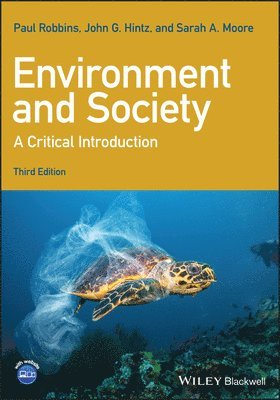
    Environment and Society

    A Critical Introduction

    AvPaul Robbins,John G. Hintz

    Häftad, Engelska, 2022

    Del i serien Critical Introductions to Geography

    609 kr

    Beställningsvara. Skickas inom 5-8 vardagar. Fri frakt över 249 kr.

    Fler format och utgåvor

    Inbunden

    1 347 kr

    Beskrivning

    A comprehensive yet accessible introduction to the conceptual tools used to explore real-world environmental problems Environment and Society: A Critical Introduction, Third Edition demonstrates how theoretical approaches such as environmental ethics, political economy, and social construction work as conceptual tools to identify and clarify contemporary environmental issues. Assuming no background knowledge in the subject, this reader-friendly textbook uses clear language and engaging examples to first describe nine key conceptual tools, and then apply them to a variety of familiar objects—from bottled water and French fries to trees, wolves, and carbon dioxide. Throughout the text, highly accessible chapters provide insight into the relationship between the environment and present-day society. Divided into two parts, the text begins by explaining major theoretical approaches for interpreting the environment-society relationship and discussing different perspectives about environmental problems. Part II examines a series of objects, each viewed through a sample of the theoretical tools from Part I, helping readers think critically about critical environmental topics such as deforestation, climate change, the global water supply, and hazardous e-waste. This fully revised third edition stresses a wider range of competing ways of thinking about environmental issues and features additional cases studies, up-to-date conceptual understandings, and new chapters in Part I on racializd environments and feminist approaches. Environment and Society: A Critical Introduction, Third Edition:  Covers theoretical lenses such as commodities, environmental ethics, and risks and hazards, and applies them to touchstone environment-society objects like wolves, tuna, trees, and carbon dioxide  Uses a conversational narrative to explain key historical events, topical issues and policies, and scientific concepts Features substantial revisions and updates, including new chapters on feminism and race, and improved maps and illustrations Includes a wealth of in-book and online resources, including exercises and boxed discussions, chapter summaries, review questions, references, suggested readings, an online test bank, and internet links Provides additional instructor support such as suggested teaching models, full-color PowerPoint slides, and supplementary teaching material Retaining the innovative approach of its predecessors, Environment and Society: A Critical Introduction, Third Edition remains the ideal textbook for courses in environmental issues, environmental science, and nature and society theory.

    Produktinformation

    • Utgivningsdatum:2022-04-14
    • Mått:175 x 249 x 23 mm
    • Vikt:794 g
    • Format:Häftad
    • Språk:Engelska
    • Serie:Critical Introductions to Geography
    • Antal sidor:400
    • Upplaga:3
    • Förlag:John Wiley and Sons Ltd
    • ISBN:9781119408239

    Utforska kategorier

    • Miljövetenskap och miljöpolitik inom Naturvetenskap och teknik
    • Geografi inom Naturvetenskap och teknik

    Mer om författaren

    Paul Robbins is Professor and Dean of the Nelson Institute for Environmental Studies at the University of Wisconsin-Madison, USA. His research interests focus on understanding human–environment systems, the influence non-humans have on human behavior and organization, and the implications these interactions hold for ecosystem health, local communities, and social justice. He is also author of Political Ecology: A Critical Introduction, now in its third edition (Wiley Blackwell, 2019). John G. Hintz is Professor of Environmental, Geographical, and Geological Sciences at Bloomsburg University of Pennsylvania, USA. His research interests include the politics of public lands management, mapping protected areas, and sustainable agriculture. He has published in several journals, including Capitalism Nature Socialism and Ethics, Place & Environment. Sarah A. Moore is Associate Professor of Geography at the University of Wisconsin-Madison, USA. Her research investigates the political, economic, and social dimensions of waste management at several scales. Her publications include articles in numerous journals including Progress in Human Geography, The Professional Geographer, and Society and Natural Resources.

    Innehållsförteckning

    • List of Figures xList of Tables xvList of Boxes xviAcknowledgments xviiAbout the Companion Website xviii1 Introduction: The View from a Human-Made Wild 1What is This Book? 6The Authors’ Points of View 9Part I Approaches and Perspectives 132 Population and Scarcity 15A Booming China or a Busting One? 16The Problem of Exponential Growth 17Population, Development, and Environment Impact 19The Other Side of the Coin: Population and Innovation 23Limits to Population: An Effect Rather than a Cause? 24Thinking with Population 293 Markets and Commodities 33The Bet 34Managing Environmental Bads: The Coase Theorem 37Market Failure 39Market-Based Solutions to Environmental Problems 40Beyond Market Failure: Gaps between Nature and Economy 45Thinking with Markets 484 Institutions and “The Commons” 51Controlling Carbon? 52The Prisoner’s Dilemma 52The Tragedy of the Commons 54The Evidence and Logic of Collective Action 56Crafting Sustainable Environmental Institutions 58Are All Commoners Equal? Does Scale Matter? 62Thinking with Institutions 645 Environmental Ethics 67The Price of Cheap Meat 68Improving Nature: From Biblical Tradition to John Locke 70Gifford Pinchot vs. John Muir in Yosemite, California 72Aldo Leopold and “The Land Ethic” 74Liberation for Animals! 76CAFOs and Climate Change: Now that You Know, What Should You Do? 78Holism and Other Pitfalls 78Thinking with Ethics 806 Risks and Technology 83The Bt Cotton Revolution 84Environments as Hazard 85The Problem of Risk Perception 87Risk as Culture 90Beyond Risk: The Political Economy of Hazards 92Thinking with Risk and Technology 957 Political Economy 99The Contradictions of COVID-19 100Labor, Accumulation, and Crisis 101Production of Nature 108Global Capitalism and the Ecology of Uneven Development 110Social Reproduction and Nature 112Environments and Economism 114Thinking with Political Economy 1148 Social Construction of Nature 118The Blank Spot on the Map 119So You Say It’s “Natural?” 120Environmental Discourse 124The Limits of Constructivism: Science, Relativism, and the Very Material World 129Thinking with Construction 1329 Feminism and the Environment 136Gender and Environment 138From Earth as Woman to Ecofeminism 140Feminist Approaches to Economies and Nature 142Feminist Approaches to Knowledge and the Environment 146Thinking with Feminism and the Environment 15210 Racialized Environments 156Structural Environmental Racism 158Environmental Justice 159Settler Colonialism 163Whiteness and Nature 169Thinking with Racialized Environments 170Part II Objects of Concern 17511 Carbon Dioxide 177Stuck in Pittsburgh Traffic 178A Short History of CO2 178Institutions: Climate Free-Riders and Carbon Cooperation 184Markets: Trading More Gases, Buying Less Carbon 190Political Economy: Who Killed the Atmosphere? 193The Carbon Puzzle 19612 Trees 200Chained to a Tree in Berkeley, California 201A Short History of Trees 201Population and Markets: The Forest Transition Theory 209Political Economy: Accumulation and Deforestation 212Gender, Trees, and Power: Feminist Insights into Forests 214Ethics, Justice, and Equity: Should Trees Have Standing? 216The Tree Puzzle 21813 Wolves 222Wolves, Be Wary Where You Tread 223A Short History of Wolves 224Ethics: Rewilding and Wolves 229Institutions: Stakeholder Management 232Feminism: Of Wolves and Masculinity 235The Wolf Puzzle 23814 Uranium 242Promise and Peril in Post-Nuclear Worlds 243A Short History of Uranium 244Risk and Hazards: Debating the Fate of High-Level Radioactive Waste 250Race: Environmental Justice and the Navajo Nation 253Social Construction: Discourses at Work in Australia 256The Uranium Puzzle 26015 Tuna 264Big Trouble for Big Tuna 265A Short History of Tuna 265Markets and Commodities: Eco-Labels to the Rescue? 270Political Economy: Re-regulating Fishery Economies 273Ethics: Saving Animals, Conserving Species 276The Tuna Puzzle 27916 Lawns 283How Much Do People Love Lawns? 284A Short History of Lawns 284Risk and Chemical Decision-Making 288Social Construction: Good Lawns Mean Good People 291Political Economy: The Chemical Tail Wags the Turfgrass Dog 292The Lawn Puzzle 29517 Bottled Water 298A Tale of Two Bottles 299A Short History of Bottled Water 300Population: Bottling for Scarcity? 305Risk and Technology: Health and Safety in a Bottle? 307Political Economy: Manufacturing Demand on an Enclosed Commons 309Racialized Environments: The Burden of Bottled Water in the United States 312The Bottled Water Puzzle 31418 French Fries 318Getting Your French Fry Fix 319A Short History of the Fry 319Feminist Approaches: The Body Politics of French Fries 325Political Economy and Racialized Environments: Have it Your Way? 328Ethics: Protecting or Engineering Potato Heritage? 333The French Fry Puzzle 33719 E-Waste 341Digital Divides 342A Short History of E-Waste 343E-Waste and Markets: From Externality to Commodity 348The Political Economy of E-Waste 351E-Waste and Racialized Environments 355The E-Waste Puzzle 359Glossary 362Index 372