• Fri frakt över 249 kr
  • •
  • Snabba leveranser
  • •
  • Billiga böcker
Kundservice

Du är på sajten för privatpersoner.

Företag, bibliotek eller offentlig verksamhet?

Du handlar på classic.bokus.com, där alla dina funktioner finns intakta.
Till classic.bokus.com
Bokus logotyp. Gå till startsidan.
  • Erbjudanden
  • Nyheter
  • Student
  • Topplistor
  • Barn & ungdom
  • Bokus Play
  • E-böcker
  • Pocketböcker
  • Spel & pussel

10% rabatt på allt med kod NYSTART10 →

Sidfot

Mina sidor

    Hjälp

    • Kundservice
    • Vanliga frågor och svar
    • Frakt och leverans
    • Retur vid ångerrätt
    • Reklamera vara
    • Betalning
    • Köpvillkor
    • Allmänna villkor
    • Information om webbplatsens tillgänglighet

    Om Bokus

    • Om oss
    • Pressrum
    • För studenter
    • För företag
    • För bibliotek och offentlig verksamhet
    • För leverantörer
    • Hållbarhet

    Populärt

    • Aktuella erbjudanden
    • Presentkort
    • Studentlitteratur
    • Nya böcker
    • Topplistor
    • Signerade böcker
    • Engelska böcker

    Inspiration

    • Boktips
    • BookTok
    • Populära bokserier
    • Barnbokskaraktärer
    • Populära författare
    Logotyp för Bokus
    Följ oss på Facebook (extern länk)Följ oss på Instagram (extern länk)Följ oss på YouTube (extern länk)Följ oss på TikTok (extern länk)
    bokus @ CookiesAnpassa cookiesIntegritetspolicyKöpvillkor
    Till Citymail hemsida (extern länk)Till Budbee hemsida (extern länk)Till Postnord hemsida (extern länk)Till Schenker hemsida (extern länk)Till Early Bird hemsida (extern länk)Till Walleys hemsida (extern länk)
    1. Ekonomi och Ledarskap
    2. Nationalekonomi
    3. Mikroekonomi

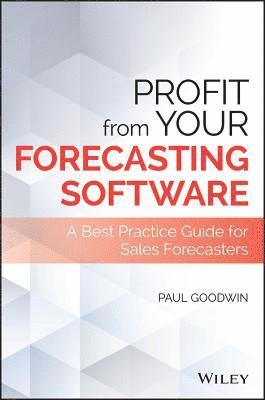
    Profit From Your Forecasting Software

    A Best Practice Guide for Sales Forecasters

    AvPaul Goodwin

    Inbunden, Engelska, 2018

    Del i serien Wiley and SAS Business Series

    360 kr

    Tillfälligt slut

    Fler format och utgåvor

    E-bok

    450 kr

    E-bok

    450 kr

    Beskrivning

    Go beyond technique to master the difficult judgement calls of forecastingA variety of software can be used effectively to achieve accurate forecasting, but no software can replace the essential human component. You may be new to forecasting, or you may have mastered the statistical theory behind the software’s predictions, and even more advanced “power user” techniques for the software itself—but your forecasts will never reach peak accuracy unless you master the complex judgement calls that the software cannot make. Profit From Your Forecasting Software addresses the issues that arise regularly, and shows you how to make the correct decisions to get the most out of your software.Taking a non-mathematical approach to the various forecasting models, the discussion covers common everyday decisions such as model choice, forecast adjustment, product hierarchies, safety stock levels, model fit, testing, and much more. Clear explanations help you better understand seasonal indices, smoothing coefficients, mean absolute percentage error, and r-squared, and an exploration of psychological biases provides insight into the decision to override the software’s forecast. With a focus on choice, interpretation, and judgement, this book goes beyond the technical manuals to help you truly grasp the more intangible skills that lead to better accuracy. Explore the advantages and disadvantages of alternative forecasting methods in different situationsMaster the interpretation and evaluation of your software’s outputLearn the subconscious biases that could affect your judgement toward intervention Find expert guidance on testing, planning, and configuration to help you get the most out of your softwareRelevant to sales forecasters, demand planners, and analysts across industries, Profit From Your Forecasting Software is the much sought-after “missing piece” in forecasting reference.

    Produktinformation

    • Utgivningsdatum:2018-06-01
    • Mått:155 x 231 x 24 mm
    • Vikt:408 g
    • Format:Inbunden
    • Språk:Engelska
    • Serie:Wiley and SAS Business Series
    • Antal sidor:240
    • Förlag:John Wiley & Sons Inc
    • ISBN:9781119414575

    Utforska kategorier

    • Mikroekonomi inom Ekonomi och Ledarskap
    • Affärsapplikationer inom Data och IT
    • Försäljning och marknadsföring inom Ekonomi och Ledarskap

    Mer om författaren

    PAUL GOODWIN, PHD, is Professor Emeritus at University of Bath, Bath, UK, where he teaches courses on Management Science, business forecasting, and decision analysis. He regularly conducts workshops at forecasting events around the world. A Fellow of the International Institute of Forecasters, he is a well-known keynote speaker at SAS.

    Innehållsförteckning

    • Acknowledgments xvPrologue xviiChapter 1 Profit from Accurate Forecasting 11.1 The Importance of Demand Forecasting 21.2 When Is a Forecast Not a Forecast? 21.3 Ways of Presenting Forecasts 31.3.1 Forecasts as Probability Distributions 31.3.2 Point Forecasts 41.3.3 Prediction Intervals 61.4 The Advantages of Using Dedicated Demand Forecasting Software 71.5 Getting Your Data Ready for Forecasting 81.6 Trading-Day Adjustments 101.7 Overview of the Rest of the Book 111.8 Summary of Key Terms 121.9 References 13Chapter 2 How Your Software Finds Patterns in Past Demand Data 152.1 Introduction 162.2 Key Features of Sales Histories 162.2.1 An Underlying Trend 162.2.2 A Seasonal Pattern 172.2.3 Noise 222.3 Autocorrelation 232.4 Intermittent Demand 252.5 Outliers and Special Events 252.6 Correlation 272.7 Missing Values 302.8 Wrap-Up 312.9 Summary of Key Terms 31Chapter 3 Understanding Your Software’s Bias and Accuracy Measures 333.1 Introduction 343.2 Fitting and Forecasting 343.2.1 Fixed-Origin Evaluations 363.2.2 Rolling-Origin Evaluations 363.3 Forecast Errors and Bias Measures 383.3.1 The Mean Error (ME) 393.3.2 The Mean Percentage Error (MPE) 403.4 Direct Accuracy Measures 403.4.1 The Mean Absolute Error (MAE) 403.4.2 The Mean Squared Error (MSE) 413.5 Percentage Accuracy Measures 423.5.1 The Mean Absolute Percentage Error (MAPE) 423.5.2 The Median Absolute Percentage Error (MDAPE) 443.5.3 The Symmetric Mean Absolute Percentage Error (SMAPE) 443.5.4 The MAD/MEAN Ratio 453.5.5 Percentage Error Measures When There Is a Trend or Seasonal Pattern 463.6 Relative Accuracy Measures 463.6.1 Geometric Mean Relative Absolute Error (GMRAE) 473.6.2 The Mean Absolute Scaled Error (MASE) 483.6.3 Bayesian Information Criterion (BIC) 493.7 Comparing the Different Accuracy Measures 503.8 Exception Reporting 523.9 Forecast Value-Added Analysis (FVA) 523.10 Wrap-Up 553.11 Summary of Key Terms 563.12 References 57Chapter 4 Curve Fitting and Exponential Smoothing 594.1 Introduction 604.2 Curve Fitting 604.2.1 Common Types of Curve 604.2.2 Assessing How Well the Curve Fits the Sales History 634.2.3 Strengths and Limitations of Forecasts Based on Curve Fitting 644.3 Exponential Smoothing Methods 654.3.1 Simple (or Single) Exponential Smoothing 654.3.2 Exponential Smoothing When There Is a Trend: Holt’s Method 684.3.3 The Damped Holt’s Method 704.3.4 Holt’s Method with an Exponential Trend 724.3.5 Exponential Smoothing Where There Is a Trend and Seasonal Pattern: The Holt-Winters Method 734.3.6 Overview of Exponential Smoothing Methods 744.4 Forecasting Intermittent Demand 744.5 Wrap-Up 774.6 Summary of Key Terms 78Chapter 5 Box-Jenkins ARIMA Models 815.1 Introduction 825.2 Stationarity 825.3 Models of Stationary Time Series: Autoregressive Models 855.4 Models of Stationary Time Series: Moving Average Models 875.5 Models of Stationary Time Series: Mixed Models 885.6 Fitting a Model to a Stationary Time Series 895.7 Diagnostic Checks 915.7.1 Check 1: Are the Coefficients of the Model Statistically Significant? 915.7.2 Check 2: Overfitting—Should We Be Using a More Complex Model? 925.7.3 Check 3: Are the Residuals of the Model White Noise? 925.7.4 Check 4: Are the Residuals Normally Distributed? 935.8 Models of Nonstationary Time Series: Differencing 945.9 Should You Include a Constant in Your Model of a Nonstationary Time Series? 965.10 What If a Series Is Nonstationary in the Variance? 975.11 ARIMA Notation 975.12 Seasonal ARIMA Models 985.13 Example of Fitting a Seasonal ARIMA Model 1015.14 Wrap-Up 1045.15 Summary of Key Terms 105Chapter 6 Regression Models 1096.1 Introduction 1106.2 Bivariate Regression 1106.2.1 Should You Drop the Constant? 1136.2.2 Spurious Regression 1146.3 Multiple Regression 1156.3.1 Interpreting Computer Output for Multiple Regression 1156.3.2 Refitting the Model 1196.3.3 Multicollinearity 1196.3.4 Using Dummy Predictor Variables in Your Regression Model 1236.3.5 Outliers and Influential Observations 1276.4 Regression Versus Univariate Methods 1296.5 Dynamic Regression 1316.6 Wrap-Up 1326.7 Summary of Key Terms 1326.8 Appendix: Assumptions of Regression Analysis 1346.9 Reference 136Chapter 7 Inventory Control, Aggregation, and Hierarchies 1377.1 Introduction 1387.2 Identifying Reorder Levels and Safety Stocks 1397.3 Estimating the Probability Distribution of Demand 1427.3.1 Using Prediction Intervals to Determine Safety Stocks 1447.4 What If the Probability Distribution of Demand Is Not Normal? 1467.4.1 The Log-Normal Distribution 1467.4.2 Using the Poisson and Negative Binomial Distributions 1487.5 Temporal Aggregation 1517.6 Dealing with Product Hierarchies and Reconciling Forecasts 1547.6.1 Bottom-Up Forecasting 1547.6.2 Top-Down Forecasting 1557.6.3 Middle-Out Forecasting 1577.6.4 Hybrid Methods 1577.6.5 Issues and Future Developments 1587.7 Wrap-Up 1597.8 Summary of Key Terms 1607.9 References 161Chapter 8 Automation and Choice 1638.1 Introduction 1648.2 How Much Past Data Do You Need to Apply Different Forecasting Methods? 1658.3 Are More Complex Forecasting Methods Likely to Be More Accurate? 1688.4 When It’s Best to Automate Forecasts 1698.5 The Downside of Automation 1738.6 Wrap-Up 1748.7 References 175Chapter 9 Judgmental Interventions: When Are They Appropriate? 1779.1 Introduction 1789.2 Psychological Biases That Might Catch You Out 1799.2.1 Seeing Patterns in Randomness 1799.2.2 Recency Bias 1809.2.3 Hindsight Bias 1819.2.4 Optimism Bias 1819.3 Restrict Your Interventions 1839.3.1 Large Adjustments Perform Better 1839.3.2 Focus Your Efforts Where They’ll Count 1849.4 Making Effective Interventions 1859.4.1 Divide and Conquer 1859.4.2 Using Analogies 1869.4.3 Counteracting Optimism Bias 1879.4.4 Harnessing the Power of Groups of Managers 1899.4.5 Record Your Rationale 1929.5 Combining Judgment and Statistical Forecasts 1929.6 Wrap-Up 1949.7 Reference 194Chapter 10 New Product Forecasting 19510.1 Introduction 19610.2 Dangers of Using Unstructured Judgment in New Product Forecasting 19710.3 Forecasting by Analogy 19810.3.1 Structured Analogies 19810.3.2 Applying Structured Analogies 19910.4 The Bass Diffusion Model 20310.4.1 Innovators and Imitators 20310.4.2 Estimating a Bass Model 20410.4.3 Limitations of the Basic Bass Model 20610.5 Wrap-Up 20710.6 Summary of Key Terms 20810.7 References 209Chapter 11 Summary: A Best Practice Blueprint for Using Your Software 21111.1 Introduction 21211.2 Desirable Characteristics of Forecasting Software 21211.2.1 Data Preparation 21211.2.2 Graphical Displays 21211.2.3 Method Selection 21411.2.4 Implementing Methods 21511.2.5 Hierarchies 21511.2.6 Forecasting with Probabilities 21511.2.7 Support for Judgment 21611.2.8 Presentation of Forecasts 21611.3 A Blueprint for Best Practice 21711.4 References 218Index 219