• Fri frakt över 249 kr
  • •
  • Snabba leveranser
  • •
  • Billiga böcker
Kundservice

Du är på sajten för privatpersoner.

Företag, bibliotek eller offentlig verksamhet?

Du handlar på classic.bokus.com, där alla dina funktioner finns intakta.
Till classic.bokus.com
Bokus logotyp. Gå till startsidan.
  • Erbjudanden
  • Nyheter
  • Student
  • Topplistor
  • Barn & ungdom
  • Bokus Play
  • E-böcker
  • Pocketböcker
  • Spel & pussel

10% rabatt på allt med kod: NYSTART10 →

Sidfot

Mina sidor

    Hjälp

    • Kundservice
    • Vanliga frågor och svar
    • Frakt och leverans
    • Retur vid ångerrätt
    • Reklamera vara
    • Betalning
    • Köpvillkor
    • Allmänna villkor
    • Information om webbplatsens tillgänglighet

    Om Bokus

    • Om oss
    • Pressrum
    • För studenter
    • För företag
    • För bibliotek och offentlig verksamhet
    • För leverantörer
    • Hållbarhet

    Populärt

    • Aktuella erbjudanden
    • Presentkort
    • Studentlitteratur
    • Nya böcker
    • Topplistor
    • Signerade böcker
    • Engelska böcker

    Inspiration

    • Boktips
    • BookTok
    • Populära bokserier
    • Barnbokskaraktärer
    • Populära författare
    Logotyp för Bokus
    Följ oss på Facebook (extern länk)Följ oss på Instagram (extern länk)Följ oss på YouTube (extern länk)Följ oss på TikTok (extern länk)
    bokus @ CookiesAnpassa cookiesIntegritetspolicyKöpvillkor
    Till Citymail hemsida (extern länk)Till Budbee hemsida (extern länk)Till Postnord hemsida (extern länk)Till Schenker hemsida (extern länk)Till Early Bird hemsida (extern länk)Till Walleys hemsida (extern länk)
    1. Naturvetenskap och teknik
    2. Teknik och industri
    3. Elektronik och kommunikationer

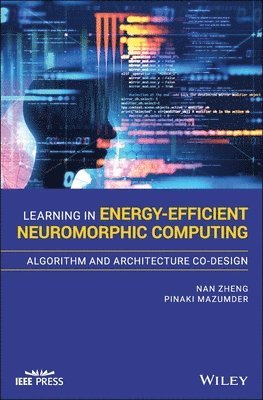
    Learning in Energy-Efficient Neuromorphic Computing: Algorithm and Architecture Co-Design

    AvNan Zheng,Pinaki Mazumder

    Inbunden, Engelska, 2019

    Del i serien IEEE Press

    1 409 kr

    Beställningsvara. Skickas inom 5-8 vardagar. Fri frakt över 249 kr.

    Beskrivning

    Explains current co-design and co-optimization methodologies for building hardware neural networks and algorithms for machine learning applications This book focuses on how to build energy-efficient hardware for neural networks with learning capabilities—and provides co-design and co-optimization methodologies for building hardware neural networks that can learn. Presenting a complete picture from high-level algorithm to low-level implementation details, Learning in Energy-Efficient Neuromorphic Computing: Algorithm and Architecture Co-Design also covers many fundamentals and essentials in neural networks (e.g., deep learning), as well as hardware implementation of neural networks.The book begins with an overview of neural networks. It then discusses algorithms for utilizing and training rate-based artificial neural networks. Next comes an introduction to various options for executing neural networks, ranging from general-purpose processors to specialized hardware, from digital accelerator to analog accelerator. A design example on building energy-efficient accelerator for adaptive dynamic programming with neural networks is also presented. An examination of fundamental concepts and popular learning algorithms for spiking neural networks follows that, along with a look at the hardware for spiking neural networks. Then comes a chapter offering readers three design examples (two of which are based on conventional CMOS, and one on emerging nanotechnology) to implement the learning algorithm found in the previous chapter. The book concludes with an outlook on the future of neural network hardware. Includes cross-layer survey of hardware accelerators for neuromorphic algorithmsCovers the co-design of architecture and algorithms with emerging devices for much-improved computing efficiencyFocuses on the co-design of algorithms and hardware, which is especially critical for using emerging devices, such as traditional memristors or diffusive memristors, for neuromorphic computingLearning in Energy-Efficient Neuromorphic Computing: Algorithm and Architecture Co-Design is an ideal resource for researchers, scientists, software engineers, and hardware engineers dealing with the ever-increasing requirement on power consumption and response time. It is also excellent for teaching and training undergraduate and graduate students about the latest generation neural networks with powerful learning capabilities.

    Produktinformation

    • Utgivningsdatum:2019-12-26
    • Mått:175 x 246 x 20 mm
    • Vikt:680 g
    • Format:Inbunden
    • Språk:Engelska
    • Serie:IEEE Press
    • Antal sidor:296
    • Förlag:John Wiley & Sons Inc
    • ISBN:9781119507383

    Utforska kategorier

    • Elektronik och kommunikationer inom Naturvetenskap och teknik

    Mer om författaren

    NAN ZHENG, PhD, received a B. S. degree in Information Engineering from Shanghai Jiao Tong University, China, in 2011, and an M. S. and PhD in Electrical Engineering from the University of Michigan, Ann Arbor, USA, in 2014 and 2018, respectively. His research interests include low-power hardware architectures, algorithms and circuit techniques with an emphasis on machine-learning applications. PINAKI MAZUMDER, PhD, is a professor in the Department of Electrical Engineering and Computer Science at The University of Michigan, USA. His research interests include CMOS VLSI design, semiconductor memory systems, CAD tools and circuit designs for emerging technologies including quantum MOS, spintronics, spoof plasmonics, and resonant tunneling devices.

    Innehållsförteckning

    • Preface xiAcknowledgment xix1 Overview 11.1 History of Neural Networks 11.2 Neural Networks in Software 21.2.1 Artificial Neural Network 21.2.2 Spiking Neural Network 31.3 Need for Neuromorphic Hardware 31.4 Objectives and Outlines of the Book 5References 82 Fundamentals and Learning of Artificial Neural Networks 112.1 Operational Principles of Artificial Neural Networks 112.1.1 Inference 112.1.2 Learning 132.2 Neural Network Based Machine Learning 162.2.1 Supervised Learning 172.2.2 Reinforcement Learning 202.2.3 Unsupervised Learning 222.2.4 Case Study: Action-Dependent Heuristic Dynamic Programming 232.2.4.1 Actor-Critic Networks 242.2.4.2 On-Line Learning Algorithm 252.2.4.3 Virtual Update Technique 272.3 Network Topologies 312.3.1 Fully Connected Neural Networks 312.3.2 Convolutional Neural Networks 322.3.3 Recurrent Neural Networks 352.4 Dataset and Benchmarks 382.5 Deep Learning 412.5.1 Pre-Deep-Learning Era 412.5.2 The Rise of Deep Learning 412.5.3 Deep Learning Techniques 422.5.3.1 Performance-Improving Techniques 422.5.3.2 Energy-Efficiency-Improving Techniques 462.5.4 Deep Neural Network Examples 50References 533 Artificial Neural Networks in Hardware 613.1 Overview 613.2 General-Purpose Processors 623.3 Digital Accelerators 633.3.1 A Digital ASIC Approach 633.3.1.1 Optimization on Data Movement and Memory Access 633.3.1.2 Scaling Precision 713.3.1.3 Leveraging Sparsity 763.3.2 FPGA-Based Accelerators 803.4 Analog/Mixed-Signal Accelerators 823.4.1 Neural Networks in Conventional Integrated Technology 823.4.1.1 In/Near-Memory Computing 823.4.1.2 Near-Sensor Computing 853.4.2 Neural Network Based on Emerging Non-volatile Memory 883.4.2.1 Crossbar as a Massively Parallel Engine 893.4.2.2 Learning in a Crossbar 913.4.3 Optical Accelerator 933.5 Case Study: An Energy-Efficient Accelerator for Adaptive Dynamic Programming 943.5.1 Hardware Architecture 953.5.1.1 On-Chip Memory 953.5.1.2 Datapath 973.5.1.3 Controller 993.5.2 Design Examples 101References 1084 Operational Principles and Learning in Spiking Neural Networks 1194.1 Spiking Neural Networks 1194.1.1 Popular Spiking Neuron Models 1204.1.1.1 Hodgkin-Huxley Model 1204.1.1.2 Leaky Integrate-and-Fire Model 1214.1.1.3 Izhikevich Model 1214.1.2 Information Encoding 1224.1.3 Spiking Neuron versus Non-Spiking Neuron 1234.2 Learning in Shallow SNNs 1244.2.1 ReSuMe 1244.2.2 Tempotron 1254.2.3 Spike-Timing-Dependent Plasticity 1274.2.4 Learning Through Modulating Weight-Dependent STDP in Two-Layer Neural Networks 1314.2.4.1 Motivations 1314.2.4.2 Estimating Gradients with Spike Timings 1314.2.4.3 Reinforcement Learning Example 1354.3 Learning in Deep SNNs 1464.3.1 SpikeProp 1464.3.2 Stack of Shallow Networks 1474.3.3 Conversion from ANNs 1484.3.4 Recent Advances in Backpropagation for Deep SNNs 1504.3.5 Learning Through Modulating Weight-Dependent STDP in Multilayer Neural Networks 1514.3.5.1 Motivations 1514.3.5.2 Learning Through Modulating Weight-Dependent STDP 1514.3.5.3 Simulation Results 158References 1675 Hardware Implementations of Spiking Neural Networks 1735.1 The Need for Specialized Hardware 1735.1.1 Address-Event Representation 1735.1.2 Event-Driven Computation 1745.1.3 Inference with a Progressive Precision 1755.1.4 Hardware Considerations for Implementing the Weight-Dependent STDP Learning Rule 1815.1.4.1 Centralized Memory Architecture 1825.1.4.2 Distributed Memory Architecture 1835.2 Digital SNNs 1865.2.1 Large-Scale SNN ASICs 1865.2.1.1 SpiNNaker 1865.2.1.2 TrueNorth 1875.2.1.3 Loihi 1915.2.2 Small/Moderate-Scale Digital SNNs 1925.2.2.1 Bottom-Up Approach 1925.2.2.2 Top-Down Approach 1935.2.3 Hardware-Friendly Reinforcement Learning in SNNs 1945.2.4 Hardware-Friendly Supervised Learning in Multilayer SNNs 1995.2.4.1 Hardware Architecture 1995.2.4.2 CMOS Implementation Results 2055.3 Analog/Mixed-Signal SNNs 2105.3.1 Basic Building Blocks 2105.3.2 Large-Scale Analog/Mixed-Signal CMOS SNNs 2115.3.2.1 CAVIAR 2115.3.2.2 BrainScaleS 2145.3.2.3 Neurogrid 2155.3.3 Other Analog/Mixed-Signal CMOS SNN ASICs 2165.3.4 SNNs Based on Emerging Nanotechnologies 2165.3.4.1 Energy-Efficient Solutions 2175.3.4.2 Synaptic Plasticity 2185.3.5 Case Study: Memristor Crossbar Based Learning in SNNs 2205.3.5.1 Motivations 2205.3.5.2 Algorithm Adaptations 2225.3.5.3 Non-idealities 2315.3.5.4 Benchmarks 238References 2386 Conclusions 2476.1 Outlooks 2476.1.1 Brain-Inspired Computing 2476.1.2 Emerging Nanotechnologies 2496.1.3 Reliable Computing with Neuromorphic Systems 2506.1.4 Blending of ANNs and SNNs 2516.2 Conclusions 252References 253A Appendix 257A.1 Hopfield Network 257A.2 Memory Self-Repair with Hopfield Network 258References 266Index 269