• Fri frakt över 249 kr
  • •
  • Snabba leveranser
  • •
  • Billiga böcker
Kundservice

Du är på sajten för privatpersoner.

Företag, bibliotek eller offentlig verksamhet?

Du handlar på classic.bokus.com, där alla dina funktioner finns intakta.
Till classic.bokus.com
Bokus logotyp. Gå till startsidan.
  • Erbjudanden
  • Nyheter
  • Student
  • Topplistor
  • Barn & ungdom
  • Bokus Play
  • E-böcker
  • Pocketböcker
  • Spel & pussel

10% rabatt på allt med kod: NYSTART10 →

Sidfot

Mina sidor

    Hjälp

    • Kundservice
    • Vanliga frågor och svar
    • Frakt och leverans
    • Retur vid ångerrätt
    • Reklamera vara
    • Betalning
    • Köpvillkor
    • Allmänna villkor
    • Information om webbplatsens tillgänglighet

    Om Bokus

    • Om oss
    • Pressrum
    • För studenter
    • För företag
    • För bibliotek och offentlig verksamhet
    • För leverantörer
    • Hållbarhet

    Populärt

    • Aktuella erbjudanden
    • Presentkort
    • Studentlitteratur
    • Nya böcker
    • Topplistor
    • Signerade böcker
    • Engelska böcker

    Inspiration

    • Boktips
    • BookTok
    • Populära bokserier
    • Barnbokskaraktärer
    • Populära författare
    Logotyp för Bokus
    Följ oss på Facebook (extern länk)Följ oss på Instagram (extern länk)Följ oss på YouTube (extern länk)Följ oss på TikTok (extern länk)
    bokus @ CookiesAnpassa cookiesIntegritetspolicyKöpvillkor
    Till Citymail hemsida (extern länk)Till Budbee hemsida (extern länk)Till Postnord hemsida (extern länk)Till Schenker hemsida (extern länk)Till Early Bird hemsida (extern länk)Till Walleys hemsida (extern länk)
    1. Psykologi och pedagogik
    2. Psykologi

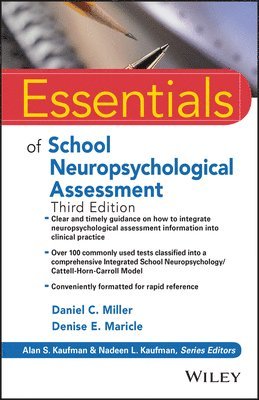
    Essentials of School Neuropsychological Assessment

    AvDaniel C. Miller,Denise E. Maricle

    Häftad, Engelska, 2019

    Del i serien Essentials of Psychological Assessment

    631 kr

    Beställningsvara. Skickas inom 5-8 vardagar. Fri frakt över 249 kr.

    Fler format och utgåvor

    E-bok

    765 kr

    E-bok

    731 kr

    Beskrivning

    A concise, up-to-date review of school neuropsychological assessment that covers effective treatment planningThe third edition of Essentials of School Neuropsychological Assessment offers a practical and concise overview of neuropsychological practice in schools and other pediatric clinical settings and clearly explains how to identify the need for testing. The book shows how to collect a neurodevelopmental history, choose appropriate assessment instruments, effectively evaluate students, and accurately interpret results. The third edition has been revised and updated to include the most recent advances in the field such as major neuropsychological test batteries for children, including NEPSY-II, Wechsler Intelligence Scale for Children, Fifth Edition integrated, and Delis-Kaplan Executive Function System. In addition, the new edition contains updated online tools, including sample case studies, searchable databases of neuropsychological tests classified by processing area and conceptual model, a neuropsychological processing concerns checklist in both English and Spanish, and sample report shells with tables.Like all the volumes in the Essentials of Psychological Assessment series, this book is designed to help busy practitioners and school psychologists quickly acquire the knowledge and skills they need to make optimal use of major psychological assessment instruments. Each concise chapter features numerous callout boxes highlighting key concepts, bulleted points, and extensive illustrative material, as well as test questions that help you gauge and reinforce your grasp of the information covered.Essentials of School Neuropsychological Assessment, Third Edition contains unmatched guidance and direction for school psychologists and other mental health professionals who serve educators, school children, and their families.

    Produktinformation

    • Utgivningsdatum:2019-03-26
    • Mått:140 x 213 x 43 mm
    • Vikt:612 g
    • Format:Häftad
    • Språk:Engelska
    • Serie:Essentials of Psychological Assessment
    • Antal sidor:640
    • Upplaga:3
    • Förlag:John Wiley & Sons Inc
    • ISBN:9781119533207

    Utforska kategorier

    • Psykologi inom Psykologi och pedagogik
    • Pedagogik inom Psykologi och pedagogik

    Mer om författaren

    DR. DANIEL C. MILLER is the President and Owner of KIDS, Inc., and he is the Director of the School of Neuropsychology Post-Graduate Certification Program. He is also the Executive Director of the Woodcock Institute for Neurocognitive Research and Applied Practice at Texas Woman’s University in Denton, Texas. DR. DENISE E. MARICLE is a Professor in the School Psychology Program, and an affiliated faculty member with the Woodcock Institute for the Advancement of Neurocognitive Research and Applied Practice, at Texas Woman’s University in Denton, Texas.

    Innehållsförteckning

    • Foreword xxiSeries Preface xxvAcknowledgments xxviiOne The Specialization of School Neuropsychology 1Reasons Why There is a Growing Interest in School Neuropsychology 3The Need for Neuropsychological Assessment in the Schools 11Definition of School Neuropsychology 15Roles and Functions of a School Neuropsychologist 16List of Recent School Neuropsychological Books 18List of Journals that Publish School Neuropsychological Research 18Chapter Summary 23Test Yourself 25Answers 25Two Historical Influences of Clinical Neuropsychology and School Psychology 27Historical Influences of Clinical Neuropsychology on School Neuropsychology 27Historical Influences of School Psychology on School Neuropsychology 42History of the Specialty of School Neuropsychology 54Chapter Summary 62Test Yourself 62Answers 63Three Training and Credentialing in School Neuropsychology 65How Does the Integration of Neuropsychological Principles Fit Within the Broader Field of School Psychology? 65Training and Credentialing Standards 67Proposed Professional Guidelines to Train School Neuropsychologists 75Chapter Summary 82Test Yourself 83Answers 84Four When to Incorporate Neuropsychological Principles into a Comprehensive Individual Assessment 85Common Referral Reasons for a School Neuropsychological Evaluation 85Chapter Summary 116Test Yourself 118Answers 118Five School Neuropsychology Assessment Models 119Models of School Neuropsychological Assessment 119Levels of Assessment Model 140Chapter Summary 143Test Yourself 144Answers 144Six School Neuropsychology Report Writing 145Basic Principles of School Neuropsychological Assessment and Report Writing 145Components of a School Neuropsychological Report 155Chapter Summary 177Test Yourself 179Answers 180Seven Major School Neuropsychological Test Batteries for Children 181NEPSY-II: a Developmental Neuropsychological Assessment 181Wechsler Intelligence Scale for Children— Fifth Edition Integrated 192Delis-Kaplan Executive Function System (D-KEFS) 198Repeatable Battery for the Assessment of Neuropsychological Status Update (RBANS Update) 200Chapter Summary 202Test Yourself 202Answers 203Eight Clinical Interpretation Guidelines 205Selecting a Test or Assessment Battery 206Data Analyses and Interpretations 213Clinical Interpretation Examples 221Chapter Summary 234Test Yourself 234Answers 235Nine Use of Technology in Assessment, Scoring, and Report Writing 237Pros and Cons of Computer-Based Assessment 237Comprehensive Report Writers 247Chapter Summary 264Ten Sensorimotor Functions 265Sensory Functions 265Motor Functions 269When to Assess Sensorimotor Functions 274Identifying Sensorimotor Concerns 274Assessing Sensorimotor Functions 276Chapter Summary 290Test Yourself 291Answers 292Eleven Visuospatial and Auditory Cognitive Processes 293Visuospatial Processes 293Auditory Processes 305Chapter Summary 313Test Yourself 314Answers 314Twelve Learning and Memory Cognitive Processes 315Theories of Learning and Memory 315A Conceptual Model of Learning and Memory for School Neuropsychologists 318Neuroanatomy of Learning and Memory Processes 321Summary of Learning and Memory Processes 322When to Assess for Learning and Memory Functions 322Identifying Learning and Memory Concerns 325Assessing Learning and Memory 325Chapter Summary 348Test Yourself 349Answers 350Thirteen Executive Functions 351What Are Executive Functions? 351Neuroanatomy of Executive Functions 353When to Assess for Executive Functions 362Identifying Executive Dysfunctions 362Assessing Executive Functions 363Chapter Summary 387Test Yourself 389Answers 390Fourteen Attention and Working Memory Facilitators/Inhibitors 391Allocating and Maintaining Attention Facilitator/Inhibitor 391Theories of Attention 392Neuroanatomy of Attentional Processes 394When to Assess Attentional Processes 397Identifying Attentional Processing Concerns 398Assessing Attentional Processes 399Working Memory Facilitator/Inhibitor 408Neuroanatomy of Working Memory 409Identifying Working Memory Concerns 410Assessing Working Memory 411Chapter Summary 416Test Yourself 417Answers 418Fifteen Speed, Fluency, and Efficiency of Processing Facilitators/Inhibitors 419Definitions 419Neuroanatomy of Speed of Information Processing 424When to Assess for Speed, Fluency, and Efficiency of Processing 426Identifying Speed and Efficiency of Cognitive Processing Deficits 427Assessing Speed and Efficiency of Cognitive Processing 427Identifying Acquired Knowledge Fluency Deficits 439Chapter Summary 448Test Yourself 449Answers 450Sixteen Acquired Knowledge: Acculturation Knowledge and Language Abilities 451Acculturation Knowledge 451Language Abilities 454Chapter Summary 475Test Yourself 476Answers 477Seventeen Acquired Knowledge: Academic Achievement 479When to Assess for Academic Functioning 479Written Language Disorders 496Mathematics Disorder 506Chapter Summary 516Test Yourself 518Answers 519Eighteen Future Directions in School Neuropsychological Assessment 521Continued Refinement of the School Neuropsychology Conceptual Model 522Neuroeducation and School Psychology 523Neuroimaging and School Neuropsychology 525Future Trends in School Neuropsychological Assessment 526Training Issues in School Neuropsychological Assessment 529Chapter Summary 531Test Yourself 532Answers 532Appendix: Referenced Tests, Abbreviations, and Publishers 533References 545About the Authors 581Index 583