• Fri frakt över 249 kr
  • •
  • Snabba leveranser
  • •
  • Billiga böcker
Kundservice

Du är på sajten för privatpersoner.

Företag, bibliotek eller offentlig verksamhet?

Du handlar på classic.bokus.com, där alla dina funktioner finns intakta.
Till classic.bokus.com
Bokus logotyp. Gå till startsidan.
  • Erbjudanden
  • Nyheter
  • Student
  • Topplistor
  • Barn & ungdom
  • Bokus Play
  • E-böcker
  • Pocketböcker
  • Spel & pussel

10% studentrabatt med kod TERM26

Sidfot

Mina sidor

    Hjälp

    • Kundservice
    • Vanliga frågor och svar
    • Frakt och leverans
    • Retur vid ångerrätt
    • Reklamera vara
    • Betalning
    • Köpvillkor
    • Allmänna villkor
    • Information om webbplatsens tillgänglighet

    Om Bokus

    • Om oss
    • Pressrum
    • För studenter
    • För företag
    • För bibliotek och offentlig verksamhet
    • För leverantörer
    • Hållbarhet

    Populärt

    • Aktuella erbjudanden
    • Presentkort
    • Studentlitteratur
    • Nya böcker
    • Topplistor
    • Signerade böcker
    • Engelska böcker

    Inspiration

    • Boktips
    • BookTok
    • Populära bokserier
    • Barnbokskaraktärer
    • Populära författare

    Mina sidor

      Hjälp

      • Kundservice
      • Vanliga frågor och svar
      • Frakt och leverans
      • Retur vid ångerrätt
      • Reklamera vara
      • Betalning
      • Köpvillkor
      • Allmänna villkor
      • Information om webbplatsens tillgänglighet

      Om Bokus

      • Om oss
      • Pressrum
      • För studenter
      • För företag
      • För bibliotek och offentlig verksamhet
      • För leverantörer
      • Hållbarhet

      Populärt

      • Aktuella erbjudanden
      • Presentkort
      • Studentlitteratur
      • Nya böcker
      • Topplistor
      • Signerade böcker
      • Engelska böcker

      Inspiration

      • Boktips
      • BookTok
      • Populära bokserier
      • Barnbokskaraktärer
      • Populära författare
      Logotyp för Bokus
      Följ oss på Facebook (extern länk)Följ oss på Instagram (extern länk)Följ oss på YouTube (extern länk)Följ oss på TikTok (extern länk)
      bokus @ CookiesAnpassa cookiesIntegritetspolicyKöpvillkor
      Till Citymail hemsida (extern länk)Till Budbee hemsida (extern länk)Till Postnord hemsida (extern länk)Till Schenker hemsida (extern länk)Till Early Bird hemsida (extern länk)Till Walleys hemsida (extern länk)
      1. Naturvetenskap och teknik
      2. Teknik och industri
      3. Maskinteknik och material

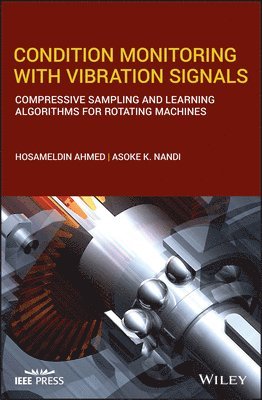
      Condition Monitoring with Vibration Signals

      Compressive Sampling and Learning Algorithms for Rotating Machines

      AvHosameldin Ahmed,Asoke K. Nandi

      Inbunden, Engelska, 2020

      Del i serien IEEE Press

      1 470 kr

      Beställningsvara. Skickas inom 11-20 vardagar. Fri frakt över 249 kr.

      Beskrivning

      Provides an extensive, up-to-date treatment of techniques used for machine condition monitoringClear and concise throughout, this accessible book is the first to be wholly devoted to the field of condition monitoring for rotating machines using vibration signals. It covers various feature extraction, feature selection, and classification methods as well as their applications to machine vibration datasets. It also presents new methods including machine learning and compressive sampling, which help to improve safety, reliability, and performance. Condition Monitoring with Vibration Signals: Compressive Sampling and Learning Algorithms for Rotating Machines starts by introducing readers to Vibration Analysis Techniques and Machine Condition Monitoring (MCM). It then offers readers sections covering: Rotating Machine Condition Monitoring using Learning Algorithms; Classification Algorithms; and New Fault Diagnosis Frameworks designed for MCM. Readers will learn signal processing in the time-frequency domain, methods for linear subspace learning, and the basic principles of the learning method Artificial Neural Network (ANN). They will also discover recent trends of deep learning in the field of machine condition monitoring, new feature learning frameworks based on compressive sampling, subspace learning techniques for machine condition monitoring, and much more. Covers the fundamental as well as the state-of-the-art approaches to machine condition monitoring�guiding readers from the basics of rotating machines to the generation of knowledge using vibration signalsProvides new methods, including machine learning and compressive sampling, which offer significant improvements in accuracy with reduced computational costsFeatures learning algorithms that can be used for fault diagnosis and prognosisIncludes previously and recently developed dimensionality reduction techniques and classification algorithmsCondition Monitoring with Vibration Signals: Compressive Sampling and Learning Algorithms for Rotating Machines is an excellent book for research students, postgraduate students, industrial practitioners, and researchers.

      Produktinformation

      • Utgivningsdatum:2020-01-02
      • Mått:178 x 246 x 28 mm
      • Vikt:975 g
      • Format:Inbunden
      • Språk:Engelska
      • Serie:IEEE Press
      • Antal sidor:448
      • Förlag:John Wiley & Sons Inc
      • ISBN:9781119544623

      Utforska kategorier

      • Maskinteknik och material inom Naturvetenskap och teknik

      Mer om författaren

      HOSAMELDIN AHMED, Ph.D., has recently completed his Ph.D. degree in Electronic and Computer Engineering under the supervision of Professor Nandi at Brunel University London, UK. His research interests lie in the areas of signal processing, compressive sampling, and machine learning with applications to vibration-based machine condition monitoring.ASOKE K. NANDI, Ph.D., is the Chair and Head of Electronic and Computer Engineering at Brunel University London, UK. He has held academic positions at Oxford, Imperial College London, Strathclyde, and Liverpool, as well as a Finland Distinguished Professorship in Jyvaskyla (Finland). Professor Nandi co-discovered the three particles known as W+, W- and Z0 which verified the unification of the electromagnetic force and the nuclear weak force and led to the award of the 1984 Nobel Prize for Physics to his two team leaders. He has authored over 600 technical publications, including 240 journal papers as well as five books. Professor Nandi is a Fellow of The Royal Academy of Engineering (UK).

      Innehållsförteckning

      • Preface xviiAbout the Authors xxiList of Abbreviations xxiiiPart I Introduction 11 Introduction to Machine Condition Monitoring 31.1 Background 31.2 Maintenance Approaches for Rotating Machines Failures 41.2.1 Corrective Maintenance 41.2.2 Preventive Maintenance 51.2.2.1 Time-Based Maintenance (TBM) 51.2.2.2 Condition-Based Maintenance (CBM) 51.3 Applications of MCM 51.3.1 Wind Turbines 51.3.2 Oil and Gas 61.3.3 Aerospace and Defence Industry 61.3.4 Automotive 71.3.5 Marine Engines 71.3.6 Locomotives 71.4 Condition Monitoring Techniques 71.4.1 Vibration Monitoring 71.4.2 Acoustic Emission 81.4.3 Fusion of Vibration and Acoustic 81.4.4 Motor Current Monitoring 81.4.5 Oil Analysis and Lubrication Monitoring 81.4.6 Thermography 91.4.7 Visual Inspection 91.4.8 Performance Monitoring 91.4.9 Trend Monitoring 101.5 Topic Overview and Scope of the Book 101.6 Summary 11References 112 Principles of Rotating Machine Vibration Signals 172.1 Introduction 172.2 Machine Vibration Principles 172.3 Sources of Rotating Machines Vibration Signals 202.3.1 Rotor Mass Unbalance 212.3.2 Misalignment 212.3.3 Cracked Shafts 212.3.4 Rolling Element Bearings 232.3.5 Gears 252.4 Types of Vibration Signals 252.4.1 Stationary 262.4.2 Nonstationary 262.5 Vibration Signal Acquisition 262.5.1 Displacement Transducers 262.5.2 Velocity Transducers 262.5.3 Accelerometers 272.6 Advantages and Limitations of Vibration Signal Monitoring 272.7 Summary 28References 28Part II Vibration Signal Analysis Techniques 313 Time Domain Analysis 333.1 Introduction 333.1.1 Visual Inspection 333.1.2 Features-Based Inspection 353.2 Statistical Functions 353.2.1 Peak Amplitude 363.2.2 Mean Amplitude 363.2.3 Root Mean Square Amplitude 363.2.4 Peak-to-Peak Amplitude 363.2.5 Crest Factor (CF) 363.2.6 Variance and Standard Deviation 373.2.7 Standard Error 373.2.8 Zero Crossing 383.2.9 Wavelength 393.2.10 Willison Amplitude 393.2.11 Slope Sign Change 393.2.12 Impulse Factor 393.2.13 Margin Factor 403.2.14 Shape Factor 403.2.15 Clearance Factor 403.2.16 Skewness 403.2.17 Kurtosis 403.2.18 Higher-Order Cumulants (HOCs) 413.2.19 Histograms 423.2.20 Normal/Weibull Negative Log-Likelihood Value 423.2.21 Entropy 423.3 Time Synchronous Averaging 443.3.1 TSA Signals 443.3.2 Residual Signal (RES) 443.3.2.1 NA4 443.3.2.2 NA4* 453.3.3 Difference Signal (DIFS) 453.3.3.1 FM4 463.3.3.2 M6A 463.3.3.3 M8A 463.4 Time Series Regressive Models 463.4.1 AR Model 473.4.2 MA Model 483.4.3 ARMA Model 483.4.4 ARIMA Model 483.5 Filter-Based Methods 493.5.1 Demodulation 493.5.2 Prony Model 523.5.3 Adaptive Noise Cancellation (ANC) 533.6 Stochastic Parameter Techniques 543.7 Blind Source Separation (BSS) 543.8 Summary 55References 564 Frequency Domain Analysis 634.1 Introduction 634.2 Fourier Analysis 644.2.1 Fourier Series 644.2.2 Discrete Fourier Transform 664.2.3 Fast Fourier Transform (FFT) 674.3 Envelope Analysis 714.4 Frequency Spectrum Statistical Features 734.4.1 Arithmetic Mean 734.4.2 Geometric Mean 734.4.3 Matched Filter RMS 734.4.4 The RMS of Spectral Difference 744.4.5 The Sum of Squares Spectral Difference 744.4.6 High-Order Spectra Techniques 744.5 Summary 75References 765 Time-Frequency Domain Analysis 795.1 Introduction 795.2 Short-Time Fourier Transform (STFT) 795.3 Wavelet Analysis 825.3.1 Wavelet Transform (WT) 825.3.1.1 Continuous Wavelet Transform (CWT) 835.3.1.2 Discrete Wavelet Transform (DWT) 855.3.2 Wavelet Packet Transform (WPT) 895.4 Empirical Mode Decomposition (EMD) 915.5 Hilbert-Huang Transform (HHT) 945.6 Wigner-Ville Distribution 965.7 Local Mean Decomposition (LMD) 985.8 Kurtosis and Kurtograms 1005.9 Summary 105References 106Part III Rotating Machine Condition Monitoring Using Machine Learning 1156 Vibration-Based Condition Monitoring Using Machine Learning 1176.1 Introduction 1176.2 Overview of the Vibration-Based MCM Process 1186.2.1 Fault-Detection and -Diagnosis Problem Framework 1186.3 Learning from Vibration Data 1226.3.1 Types of Learning 1236.3.1.1 Batch vs. Online Learning 1236.3.1.2 Instance-Based vs. Model-Based Learning 1236.3.1.3 Supervised Learning vs. Unsupervised Learning 1236.3.1.4 Semi-Supervised Learning 1236.3.1.5 Reinforcement Learning 1246.3.1.6 Transfer Learning 1246.3.2 Main Challenges of Learning from Vibration Data 1256.3.2.1 The Curse of Dimensionality 1256.3.2.2 Irrelevant Features 1266.3.2.3 Environment and Operating Conditions of a Rotating Machine 1266.3.3 Preparing Vibration Data for Analysis 1266.3.3.1 Normalisation 1266.3.3.2 Dimensionality Reduction 1276.4 Summary 128References 1287 Linear Subspace Learning 1317.1 Introduction 1317.2 Principal Component Analysis (PCA) 1327.2.1 PCA Using Eigenvector Decomposition 1327.2.2 PCA Using SVD 1337.2.3 Application of PCA in Machine Fault Diagnosis 1347.3 Independent Component Analysis (ICA) 1377.3.1 Minimisation of Mutual Information 1387.3.2 Maximisation of the Likelihood 1387.3.3 Application of ICA in Machine Fault Diagnosis 1397.4 Linear Discriminant Analysis (LDA) 1417.4.1 Application of LDA in Machine Fault Diagnosis 1427.5 Canonical Correlation Analysis (CCA) 1437.6 Partial Least Squares (PLS) 1457.7 Summary 146References 1478 Nonlinear Subspace Learning 1538.1 Introduction 1538.2 Kernel Principal Component Analysis (KPCA) 1538.2.1 Application of KPCA in Machine Fault Diagnosis 1568.3 Isometric Feature Mapping (ISOMAP) 1568.3.1 Application of ISOMAP in Machine Fault Diagnosis 1588.4 Diffusion Maps (DMs) and Diffusion Distances 1598.4.1 Application of DMs in Machine Fault Diagnosis 1608.5 Laplacian Eigenmap (LE) 1618.5.1 Application of the LE in Machine Fault Diagnosis 1618.6 Local Linear Embedding (LLE) 1628.6.1 Application of LLE in Machine Fault Diagnosis 1638.7 Hessian-Based LLE 1638.7.1 Application of HLLE in Machine Fault Diagnosis 1648.8 Local Tangent Space Alignment Analysis (LTSA) 1658.8.1 Application of LTSA in Machine Fault Diagnosis 1658.9 Maximum Variance Unfolding (MVU) 1668.9.1 Application of MVU in Machine Fault Diagnosis 1678.10 Stochastic Proximity Embedding (SPE) 1688.10.1 Application of SPE in Machine Fault Diagnosis 1688.11 Summary 169References 1709 Feature Selection 1739.1 Introduction 1739.2 Filter Model-Based Feature Selection 1759.2.1 Fisher Score (FS) 1769.2.2 Laplacian Score (LS) 1779.2.3 Relief and Relief-F Algorithms 1789.2.3.1 Relief Algorithm 1789.2.3.2 Relief-F Algorithm 1799.2.4 Pearson Correlation Coefficient (PCC) 1809.2.5 Information Gain (IG) and Gain Ratio (GR) 1809.2.6 Mutual Information (MI) 1819.2.7 Chi-Squared (Chi-2) 1819.2.8 Wilcoxon Ranking 1819.2.9 Application of Feature Ranking in Machine Fault Diagnosis 1829.3 Wrapper Model–Based Feature Subset Selection 1859.3.1 Sequential Selection Algorithms 1859.3.2 Heuristic-Based Selection Algorithms 1859.3.2.1 Ant Colony Optimisation (ACO) 1859.3.2.2 Genetic Algorithms (GAs) and Genetic Programming 1879.3.2.3 Particle Swarm Optimisation (PSO) 1889.3.3 Application of Wrapper Model–Based Feature Subset Selection in Machine Fault Diagnosis 1899.4 Embedded Model–Based Feature Selection 1929.5 Summary 193References 194Part IV Classification Algorithms 19910 Decision Trees and Random Forests 20110.1 Introduction 20110.2 Decision Trees 20210.2.1 Univariate Splitting Criteria 20410.2.1.1 Gini Index 20510.2.1.2 Information Gain 20610.2.1.3 Distance Measure 20710.2.1.4 Orthogonal Criterion (ORT) 20710.2.2 Multivariate Splitting Criteria 20710.2.3 Tree-Pruning Methods 20810.2.3.1 Error-Complexity Pruning 20810.2.3.2 Minimum-Error Pruning 20910.2.3.3 Reduced-Error Pruning 20910.2.3.4 Critical-Value Pruning 21010.2.3.5 Pessimistic Pruning 21010.2.3.6 Minimum Description Length (MDL) Pruning 21010.2.4 Decision Tree Inducers 21110.2.4.1 CART 21110.2.4.2 ID3 21110.2.4.3 C4.5 21110.2.4.4 CHAID 21210.3 Decision Forests 21210.4 Application of Decision Trees/Forests in Machine Fault Diagnosis 21310.5 Summary 217References 21711 Probabilistic Classification Methods 22511.1 Introduction 22511.2 Hidden Markov Model 22511.2.1 Application of Hidden Markov Models in Machine Fault Diagnosis 22811.3 Logistic Regression Model 23011.3.1 Logistic Regression Regularisation 23211.3.2 Multinomial Logistic Regression Model (MLR) 23211.3.3 Application of Logistic Regression in Machine Fault Diagnosis 23311.4 Summary 234References 23512 Artificial Neural Networks (ANNs) 23912.1 Introduction 23912.2 Neural Network Basic Principles 24012.2.1 The Multilayer Perceptron 24112.2.2 The Radial Basis Function Network 24312.2.3 The Kohonen Network 24412.3 Application of Artificial Neural Networks in Machine Fault Diagnosis 24512.4 Summary 253References 25413 Support Vector Machines (SVMs) 25913.1 Introduction 25913.2 Multiclass SVMs 26213.3 Selection of Kernel Parameters 26313.4 Application of SVMs in Machine Fault Diagnosis 26313.5 Summary 274References 27414 Deep Learning 27914.1 Introduction 27914.2 Autoencoders 28014.3 Convolutional Neural Networks (CNNs) 28314.4 Deep Belief Networks (DBNs) 28414.5 Recurrent Neural Networks (RNNs) 28514.6 Overview of Deep Learning in MCM 28614.6.1 Application of AE-based DNNs in Machine Fault Diagnosis 28614.6.2 Application of CNNs in Machine Fault Diagnosis 29214.6.3 Application of DBNs in Machine Fault Diagnosis 29614.6.4 Application of RNNs in Machine Fault Diagnosis 29814.7 Summary 299References 30115 Classification Algorithm Validation 30715.1 Introduction 30715.2 The Hold-Out Technique 30815.2.1 Three-Way Data Split 30915.3 Random Subsampling 30915.4 K-Fold Cross-Validation 31015.5 Leave-One-Out Cross-Validation 31115.6 Bootstrapping 31115.7 Overall Classification Accuracy 31215.8 Confusion Matrix 31315.9 Recall and Precision 31415.10 ROC Graphs 31515.11 Summary 317References 318Part V New Fault Diagnosis Frameworks Designed for MCM 32116 Compressive Sampling and Subspace Learning (CS-SL) 32316.1 Introduction 32316.2 Compressive Sampling for Vibration-Based MCM 32516.2.1 Compressive Sampling Basics 32516.2.2 CS for Sparse Frequency Representation 32816.2.3 CS for Sparse Time-Frequency Representation 32916.3 Overview of CS in Machine Condition Monitoring 33016.3.1 Compressed Sensed Data Followed by Complete Data Construction 33016.3.2 Compressed Sensed Data Followed by Incomplete Data Construction 33116.3.3 Compressed Sensed Data as the Input of a Classifier 33216.3.4 Compressed Sensed Data Followed by Feature Learning 33316.4 Compressive Sampling and Feature Ranking (CS-FR) 33316.4.1 Implementations 33416.4.1.1 CS-LS 33616.4.1.2 CS-FS 33616.4.1.3 CS-Relief-F 33716.4.1.4 CS-PCC 33816.4.1.5 CS-Chi-2 33816.5 CS and Linear Subspace Learning-Based Framework for Fault Diagnosis 33916.5.1 Implementations 33916.5.1.1 CS-PCA 33916.5.1.2 CS-LDA 34016.5.1.3 CS-CPDC 34116.6 CS and Nonlinear Subspace Learning-Based Framework for Fault Diagnosis 34316.6.1 Implementations 34416.6.1.1 CS-KPCA 34416.6.1.2 CS-KLDA 34516.6.1.3 CS-CMDS 34616.6.1.4 CS-SPE 34616.7 Applications 34816.7.1 Case Study 1 34816.7.1.1 The Combination of MMV-CS and Several Feature-Ranking Techniques 35016.7.1.2 The Combination of MMV-CS and Several Linear and Nonlinear Subspace Learning Techniques 35216.7.2 Case Study 2 35416.7.2.1 The Combination of MMV-CS and Several Feature-Ranking Techniques 35416.7.2.2 The Combination of MMV-CS and Several Linear and Nonlinear Subspace Learning Techniques 35516.8 Discussion 355References 35717 Compressive Sampling and Deep Neural Network (CS-DNN) 36117.1 Introduction 36117.2 Related Work 36117.3 CS-SAE-DNN 36217.3.1 Compressed Measurements Generation 36217.3.2 CS Model Testing Using the Flip Test 36317.3.3 DNN-Based Unsupervised Sparse Overcomplete Feature Learning 36317.3.4 Supervised Fine Tuning 36717.4 Applications 36717.4.1 Case Study 1 36717.4.2 Case Study 2 37217.5 Discussion 375References 37518 Conclusion 37918.1 Introduction 37918.2 Summary and Conclusion 380Appendix Machinery Vibration Data Resources and Analysis Algorithms 389References 394Index 395
      Hoppa över listan

      Mer från samma författare

      Asoke K. Nandi, Hosameldin Ahmed - Condition Monitoring with Vibration Signals, E-bok

      Condition Monitoring with Vibration Signals

      Asoke K. Nandi, Hosameldin Ahmed

      E-bok
      2019

      1 719 kr

      Asoke K. Nandi, Hosameldin Ahmed - Condition Monitoring with Vibration Signals, E-bok

      Condition Monitoring with Vibration Signals

      Asoke K. Nandi, Hosameldin Ahmed

      E-bok
      2019

      1 719 kr

      Hoppa över listan

      Mer från samma serie

      Zhijun Zhang - Antenna Design for Mobile Devices, Inbunden
      • -10% student

      Antenna Design for Mobile Devices

      Zhijun Zhang

      Inbunden, 2017

      1 796 kr

      Ryan Kuo-Lung Lian, Ramadhani Kurniawan Subroto, Victor Andrean, Bing Hao Lin - Harmonic Modeling of Voltage Source Converters using Basic Numerical Methods, Inbunden

      Harmonic Modeling of Voltage Source Converters using Basic Numerical Methods

      Ryan Kuo-Lung Lian, Ramadhani Kurniawan Subroto, Victor Andrean, Bing Hao Lin

      Inbunden, 2021

      1 717 kr

      Bogdan Adamczyk - Principles of Electromagnetic Compatibility, Inbunden

      Principles of Electromagnetic Compatibility

      Bogdan Adamczyk

      Inbunden, 2023

      1 493 kr

      Andreas F. Molisch - Wireless Communications, Häftad
      • -10% student

      Wireless Communications

      Andreas F. Molisch

      Häftad, 2022

      1 475 kr

      Steve Kilts - Advanced FPGA Design, Inbunden

      Advanced FPGA Design

      Steve Kilts

      Inbunden, 2007

      5,0 utav 5 stjärnor. Totalt antal röster:(1)

      1 557 kr

      Stephen H. Hall, Howard L. Heck - Advanced Signal Integrity for High-Speed Digital Designs, Inbunden

      Advanced Signal Integrity for High-Speed Digital Designs

      Stephen H. Hall, Howard L. Heck

      Inbunden, 2009

      1 846 kr

      Robert C. Hansen, Robert E. Collin - Small Antenna Handbook, Inbunden

      Small Antenna Handbook

      Robert C. Hansen, Robert E. Collin

      Inbunden, 2011

      1 722 kr

      Clayton R. Paul - Analysis of Multiconductor Transmission Lines, Inbunden

      Analysis of Multiconductor Transmission Lines

      Clayton R. Paul

      Inbunden, 2007

      2 614 kr

      Nadav Levanon, Eli Mozeson - Radar Signals, Inbunden

      Radar Signals

      Nadav Levanon, Eli Mozeson

      Inbunden, 2004

      1 851 kr

      Pong P. Chu - RTL Hardware Design Using VHDL, Inbunden

      RTL Hardware Design Using VHDL

      Pong P. Chu

      Inbunden, 2006

      1 914 kr

      Hoppa över listan

      Du kanske också är intresserad av

      Asoke K. Nandi, Hosameldin Ahmed - Condition Monitoring with Vibration Signals, E-bok

      Condition Monitoring with Vibration Signals

      Asoke K. Nandi, Hosameldin Ahmed

      E-bok
      2019

      1 719 kr

      Asoke K. Nandi, Hosameldin Ahmed - Condition Monitoring with Vibration Signals, E-bok

      Condition Monitoring with Vibration Signals

      Asoke K. Nandi, Hosameldin Ahmed

      E-bok
      2019

      1 719 kr

      Tao Lei, Asoke K. Nandi - Image Segmentation, Inbunden

      Image Segmentation

      Tao Lei, Asoke K. Nandi

      Inbunden, 2022

      1 531 kr

      Basel Abu-Jamous, Rui Fa, Asoke K. Nandi - Integrative Cluster Analysis in Bioinformatics, Inbunden

      Integrative Cluster Analysis in Bioinformatics

      Basel Abu-Jamous, Rui Fa, Asoke K. Nandi

      Inbunden, 2015

      1 428 kr

      Asoke K. Nandi, Tao Lei - Image Segmentation, E-bok

      Image Segmentation

      Asoke K. Nandi, Tao Lei

      E-bok
      2022

      1 783 kr

      Asoke K. Nandi, N Sujatha, R Menaka, John Sahaya Rani Alex - Computational Signal Processing and Analysis, Inbunden
      Del 490

      Computational Signal Processing and Analysis

      Asoke K. Nandi, N Sujatha, R Menaka, John Sahaya Rani Alex

      Inbunden, 2018

      2 177 kr

      Asoke K. Nandi, Zhechen Zhu - Automatic Modulation Classification, E-bok

      Automatic Modulation Classification

      Asoke K. Nandi, Zhechen Zhu

      E-bok
      2014

      1 451 kr

      John Sahaya Rani Alex, R Menaka, N Sujatha, Asoke K. Nandi - Computational Signal Processing and Analysis, E-bok

      Computational Signal Processing and Analysis

      John Sahaya Rani Alex, R Menaka, N Sujatha, Asoke K. Nandi

      E-bok
      2018

      2 517 kr

      Asoke K. Nandi, Rui Fa, Basel Abu-Jamous - Integrative Cluster Analysis in Bioinformatics, E-bok

      Integrative Cluster Analysis in Bioinformatics

      Asoke K. Nandi, Rui Fa, Basel Abu-Jamous

      E-bok
      2015

      1 625 kr

      Asoke K. Nandi, Tao Lei - Image Segmentation, E-bok

      Image Segmentation

      Asoke K. Nandi, Tao Lei

      E-bok
      2022

      1 783 kr