• Fri frakt över 249 kr
  • •
  • Snabba leveranser
  • •
  • Billiga böcker
Kundservice

Du är på sajten för privatpersoner.

Företag, bibliotek eller offentlig verksamhet?

Du handlar på classic.bokus.com, där alla dina funktioner finns intakta.
Till classic.bokus.com
Bokus logotyp. Gå till startsidan.
  • Erbjudanden
  • Nyheter
  • Student
  • Topplistor
  • Barn & ungdom
  • Bokus Play
  • E-böcker
  • Pocketböcker
  • Spel & pussel

10% rabatt på allt med kod: NYSTART10 →

Sidfot

Mina sidor

    Hjälp

    • Kundservice
    • Vanliga frågor och svar
    • Frakt och leverans
    • Retur vid ångerrätt
    • Reklamera vara
    • Betalning
    • Köpvillkor
    • Allmänna villkor
    • Information om webbplatsens tillgänglighet

    Om Bokus

    • Om oss
    • Pressrum
    • För studenter
    • För företag
    • För bibliotek och offentlig verksamhet
    • För leverantörer
    • Hållbarhet

    Populärt

    • Aktuella erbjudanden
    • Presentkort
    • Studentlitteratur
    • Nya böcker
    • Topplistor
    • Signerade böcker
    • Engelska böcker

    Inspiration

    • Boktips
    • BookTok
    • Populära bokserier
    • Barnbokskaraktärer
    • Populära författare
    Logotyp för Bokus
    Följ oss på Facebook (extern länk)Följ oss på Instagram (extern länk)Följ oss på YouTube (extern länk)Följ oss på TikTok (extern länk)
    bokus @ CookiesAnpassa cookiesIntegritetspolicyKöpvillkor
    Till Citymail hemsida (extern länk)Till Budbee hemsida (extern länk)Till Postnord hemsida (extern länk)Till Schenker hemsida (extern länk)Till Early Bird hemsida (extern länk)Till Walleys hemsida (extern länk)
    1. Naturvetenskap och teknik
    2. Teknik och industri
    3. Elektronik och kommunikationer

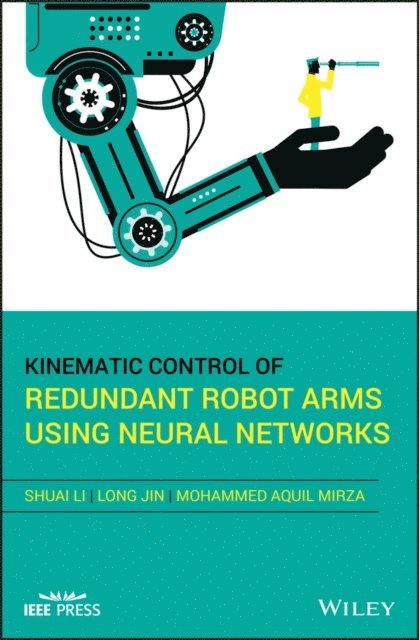
    Kinematic Control of Redundant Robot Arms Using Neural Networks

    AvShuai Li,Long Jin

    Inbunden, Engelska, 2019

    Del i serien IEEE Press

    1 423 kr

    Beställningsvara. Skickas inom 5-8 vardagar. Fri frakt över 249 kr.

    Beskrivning

    Presents pioneering and comprehensive work on engaging movement in robotic arms, with a specific focus on neural networksThis book presents and investigates different methods and schemes for the control of robotic arms whilst exploring the field from all angles. On a more specific level, it deals with the dynamic-neural-network based kinematic control of redundant robot arms by using theoretical tools and simulations.Kinematic Control of Redundant Robot Arms Using Neural Networks is divided into three parts: Neural Networks for Serial Robot Arm Control; Neural Networks for Parallel Robot Control; and Neural Networks for Cooperative Control. The book starts by covering zeroing neural networks for control, and follows up with chapters on adaptive dynamic programming neural networks for control; projection neural networks for robot arm control; and neural learning and control co-design for robot arm control. Next, it looks at robust neural controller design for robot arm control and teaches readers how to use neural networks to avoid robot singularity. It then instructs on neural network based Stewart platform control and neural network based learning and control co-design for Stewart platform control. The book finishes with a section on zeroing neural networks for robot arm motion generation. Provides comprehensive understanding on robot arm control aided with neural networksPresents neural network-based control techniques for single robot arms, parallel robot arms (Stewart platforms), and cooperative robot armsProvides a comparison of, and the advantages of, using neural networks for control purposes rather than traditional control based methodsIncludes simulation and modelling tasks (e.g., MATLAB) for onward application for research and engineering developmentBy focusing on robot arm control aided by neural networks whilst examining central topics surrounding the field, Kinematic Control of Redundant Robot Arms Using Neural Networks is an excellent book for graduate students and academic and industrial researchers studying neural dynamics, neural networks, analog and digital circuits, mechatronics, and mechanical engineering.

    Produktinformation

    • Utgivningsdatum:2019-04-19
    • Mått:173 x 239 x 15 mm
    • Vikt:476 g
    • Format:Inbunden
    • Språk:Engelska
    • Serie:IEEE Press
    • Antal sidor:224
    • Förlag:John Wiley & Sons Inc
    • ISBN:9781119556961

    Utforska kategorier

    • Elektronik och kommunikationer inom Naturvetenskap och teknik

    Mer om författaren

    SHUAI LI, PhD, is Assistant Professor in the Department of Computing at the Hong Kong Polytechnic University. LONG JIN, PhD, is Postdoctoral Fellow in the Department of Computing at the Hong Kong Polytechnic University. MOHAMMED AQUIL MIRZA, M.S., is a Doctorate Research Scholar with Hong Kong Polytechnic University.

    Innehållsförteckning

    • List of Figures xiiiList of Tables xixPreface xxiAcknowledgments xxvPart I Neural Networks for Serial Robot Arm Control 11 Zeroing Neural Networks for Control 31.1 Introduction 31.2 Scheme Formulation and ZNN Solutions 41.2.1 ZNN Model 41.2.2 Nonconvex Function Activated ZNN Model 81.3 Theoretical Analyses 91.4 Computer Simulations and Verifications 121.4.1 ZNN for Solving (1.13) at t = 1 121.4.2 ZNN for Solving (1.13) with Different Bounds 151.5 Summary 162 Adaptive Dynamic Programming Neural Networks for Control 172.1 Introduction 172.2 Preliminaries on Variable Structure Control of the Sensor–Actuator System 182.3 Problem Formulation 192.4 Model-Free Control of the Euler–Lagrange System 202.4.1 Optimality Condition 212.4.2 Approximating the Action Mapping and the Critic Mapping 212.5 Simulation Experiment 232.5.1 The Model 232.5.2 Experiment Setup and Results 242.6 Summary 253 Projection Neural Networks for Robot Arm Control 273.1 Introduction 273.2 Problem Formulation 293.3 A Modified Controller without Error Accumulation 303.3.1 Existing RNN Solutions 303.3.2 Limitations of Existing RNN Solutions 323.3.3 The Presented Algorithm 333.3.4 Stability 343.4 Performance Improvement Using Velocity Compensation 363.4.1 A Control Law with Velocity Compensation 363.4.2 Stability 373.5 Simulations 413.5.1 Regulation to a Fixed Position 413.5.2 Tracking of Time-Varying References 423.5.3 Comparisons 473.6 Summary 504 Neural Learning and Control Co-Design for Robot Arm Control 514.1 Introduction 514.2 Problem Formulation 524.3 Nominal Neural Controller Design 534.4 A Novel Dual Neural Network Model 544.4.1 Neural Network Design 544.4.2 Stability 564.5 Simulations 624.5.1 Simulation Setup 624.5.2 Simulation Results 634.5.2.1 Tracking Performance 634.5.2.2 With vs.Without Excitation Noises 644.6 Summary 665 Robust Neural Controller Design for Robot Arm Control 675.1 Introduction 675.2 Problem Formulation 685.3 Dual Neural Networks for the Nominal System 695.3.1 Neural Network Design 695.3.2 Convergence Analysis 715.4 Neural Design in the Presence of Noises 725.4.1 Polynomial Noises 725.4.1.1 Neural Dynamics 735.4.1.2 Practical Considerations 775.4.2 Special Cases 785.4.2.1 Constant Noises 785.4.2.2 Linear Noises 805.5 Simulations 815.5.1 Simulation Setup 815.5.2 Nominal Situation 815.5.3 Constant Noises 825.5.4 Time-Varying Polynomial Noises 865.6 Summary 866 Using Neural Networks to Avoid Robot Singularity 876.1 Introduction 876.2 Preliminaries 896.3 Problem Formulation 906.3.1 Manipulator Kinematics 906.3.2 Manipulability 906.3.3 Optimization Problem Formulation 916.4 Reformulation as a Constrained Quadratic Program 916.4.1 Equation Constraint: Speed Level Resolution 916.4.2 Redefinition of the Objective Function 926.4.3 Set Constraint 936.4.4 Reformulation and Convexification 946.5 Neural Networks for Redundancy Resolution 956.5.1 Conversion to a Nonlinear Equation Set 956.5.2 Neural Dynamics for Real-Time Redundancy Resolution 966.5.3 Convergence Analysis 966.6 Illustrative Examples 986.6.1 Manipulability Optimization via Self Motion 986.6.2 Manipulability Optimization in Circular Path Tracking 996.6.3 Comparisons 1026.6.4 Summary 104Part II Neural Networks for Parallel Robot Control 1057 Neural Network Based Stewart Platform Control 1077.1 Introduction 1077.2 Preliminaries 1087.3 Robot Kinematics 1097.3.1 Geometric Relation 1097.3.2 Velocity Space Resolution 1117.4 Problem Formulation as Constrained Optimization 1127.5 Dynamic Neural Network Model 1137.5.1 Neural Network Design 1137.6 Theoretical Results 1157.6.1 Optimality 1157.6.2 Stability 1167.6.3 Comparison with Other Control Schemes 1177.7 Numerical Investigation 1187.7.1 Simulation Setups 1187.7.2 Circular Trajectory 1227.7.3 Infinity-Sign Trajectory 1277.7.4 Square Trajectory 1277.8 Summary 1298 Neural Network Based Learning and Control Co-Design for Stewart Platform Control 1318.1 Introduction 1318.2 Kinematic Modeling of Stewart Platforms 1338.2.1 Geometric Relation 1338.2.2 Velocity Space Resolution 1358.3 Recurrent Neural Network Design 1368.3.1 Problem Formulation from an Optimization Perspective 1368.3.2 Neural Network Dynamics 1388.3.3 Stability 1388.3.4 Optimality 1398.4 Numerical Investigation 1428.4.1 Setups 1428.4.2 Circular Trajectory 1438.4.3 Square Trajectory 1438.5 Summary 145Part III Neural Networks for Cooperative Control 1479 Zeroing Neural Networks for Robot Arm Motion Generation 1499.1 Introduction 1499.2 Preliminaries 1519.2.1 Problem Definition and Assumption 1519.2.1.1 Assumption 1519.2.2 Manipulator Kinematics 1519.3 Problem Formulation and Distributed Scheme 1529.3.1 Problem Formulation and Neural-Dynamic Design 1529.3.2 Distributed Scheme 1539.4 NTZNN Solver and Theoretical Analyses 1539.4.1 ZNN for Real-Time Redundancy Resolution 1549.4.2 Theoretical Analyses and Results 1579.5 Illustrative Examples 1609.5.1 Consensus to a Fixed Configuration 1609.5.2 Cooperative Motion Generation Perturbed by Noises 1619.5.3 ZNN-Based Solution Perturbed by Noises 1629.6 Summary 16510 Zeroing Neural Networks for Robot Arm Motion Generation 16710.1 Introduction 16710.2 Preliminaries, Problem Formulation, and Distributed Scheme 16810.2.1 Definition and Robot Arm Kinematics 16810.2.2 Problem Formulation 16810.2.3 Distributed Scheme 16910.3 NANTZNN Solver and Theoretical Analyses 16910.3.1 NANTZNN for Real-Time Redundancy Resolution 17010.3.2 Theoretical Analyses and Results 17110.4 Illustrative Examples 17210.4.1 Cooperative Motion Planning without Noises 17410.4.2 Cooperative Motion Planning with Noises 17410.5 Summary 175Reference 177Index 185