Long Jin – författare
1 391 kr
Skickas inom 11-20 vardagar
1 572 kr
Läs direkt efter köp
Introduces a revolutionary, quadratic-programming based approach to solving long-standing problems in motion planning and control of redundant manipulators
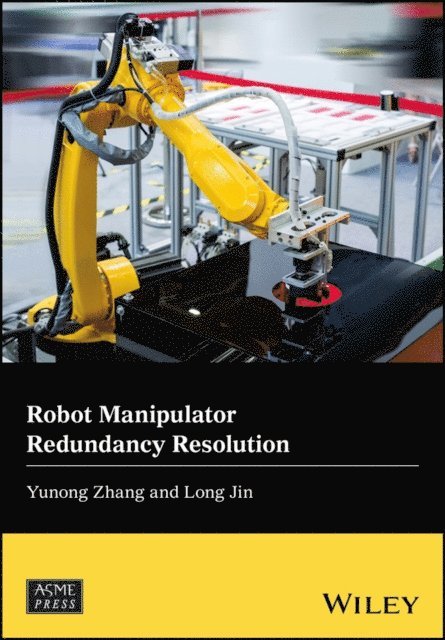
This book describes a novel quadratic programming approach to solving redundancy resolutions problems with redundant manipulators. Known as ``QP-unified motion planning and control of redundant manipulators'''' theory, it systematically solves difficult optimization problems of inequality-constrained motion planning and control of redundant manipulators that have plagued robotics engineers and systems designers for more than a quarter century.
An example of redundancy resolution could involve a robotic limb with six joints, or degrees of freedom (DOFs), with which to position an object. As only five numbers are required to specify the position and orientation of the object, the robot can move with one remaining DOF through practically infinite poses while performing a specified task. In this case redundancy resolution refers to the process of choosing an optimal pose from among that infinite set. A critical issue in robotic systems control, the redundancy resolution problem has been widely studied for decades, and numerous solutions have been proposed. This book investigates various approaches to motion planning and control of redundant robot manipulators and describes the most successful strategy thus far developed for resolving redundancy resolution problems.
Provides a fully connected, systematic, methodological, consecutive, and easy approach to solving redundancy resolution problems Describes a new approach to the time-varying Jacobian matrix pseudoinversion, applied to the redundant-manipulator kinematic control Introduces The QP-based unification of robots'' redundancy resolution Illustrates the effectiveness of the methods presented using a large number of computer simulation results based on PUMA560, PA10, and planar robot manipulators Provides technical details for all schemes and solvers presented, for readers to adopt and customize them for specific industrial applicationsRobot Manipulator Redundancy Resolution is must-reading for advanced undergraduates and graduate students of robotics, mechatronics, mechanical engineering, tracking control, neural dynamics/neural networks, numerical algorithms, computation and optimization, simulation and modelling, analog, and digital circuits. It is also a valuable working resource for practicing robotics engineers and systems designers and industrial researchers.
1 629 kr
Läs direkt efter köp
Introduces a revolutionary, quadratic-programming based approach to solving long-standing problems in motion planning and control of redundant manipulators
This book describes a novel quadratic programming approach to solving redundancy resolutions problems with redundant manipulators. Known as ``QP-unified motion planning and control of redundant manipulators'''' theory, it systematically solves difficult optimization problems of inequality-constrained motion planning and control of redundant manipulators that have plagued robotics engineers and systems designers for more than a quarter century.
An example of redundancy resolution could involve a robotic limb with six joints, or degrees of freedom (DOFs), with which to position an object. As only five numbers are required to specify the position and orientation of the object, the robot can move with one remaining DOF through practically infinite poses while performing a specified task. In this case redundancy resolution refers to the process of choosing an optimal pose from among that infinite set. A critical issue in robotic systems control, the redundancy resolution problem has been widely studied for decades, and numerous solutions have been proposed. This book investigates various approaches to motion planning and control of redundant robot manipulators and describes the most successful strategy thus far developed for resolving redundancy resolution problems.
Provides a fully connected, systematic, methodological, consecutive, and easy approach to solving redundancy resolution problems Describes a new approach to the time-varying Jacobian matrix pseudoinversion, applied to the redundant-manipulator kinematic control Introduces The QP-based unification of robots'' redundancy resolution Illustrates the effectiveness of the methods presented using a large number of computer simulation results based on PUMA560, PA10, and planar robot manipulators Provides technical details for all schemes and solvers presented, for readers to adopt and customize them for specific industrial applicationsRobot Manipulator Redundancy Resolution is must-reading for advanced undergraduates and graduate students of robotics, mechatronics, mechanical engineering, tracking control, neural dynamics/neural networks, numerical algorithms, computation and optimization, simulation and modelling, analog, and digital circuits. It is also a valuable working resource for practicing robotics engineers and systems designers and industrial researchers.
1 426 kr
Skickas inom 5-8 vardagar
1 661 kr
Läs direkt efter köp
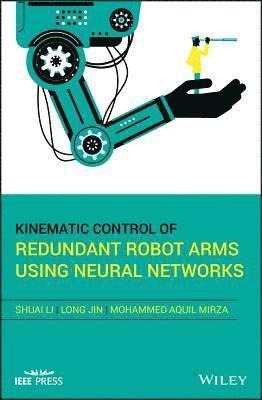
Presents pioneering and comprehensive work on engaging movement in robotic arms, with a specific focus on neural networks
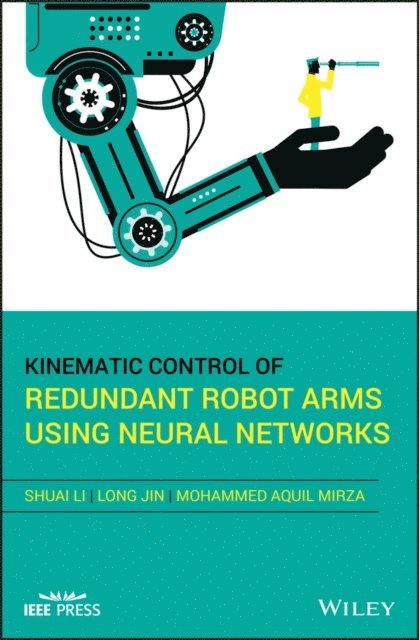
This book presents and investigates different methods and schemes for the control of robotic arms whilst exploring the field from all angles. On a more specific level, it deals with the dynamic-neural-network based kinematic control of redundant robot arms by using theoretical tools and simulations.
Kinematic Control of Redundant Robot Arms Using Neural Networks is divided into three parts: Neural Networks for Serial Robot Arm Control; Neural Networks for Parallel Robot Control; and Neural Networks for Cooperative Control. The book starts by covering zeroing neural networks for control, and follows up with chapters on adaptive dynamic programming neural networks for control; projection neural networks for robot arm control; and neural learning and control co-design for robot arm control. Next, it looks at robust neural controller design for robot arm control and teaches readers how to use neural networks to avoid robot singularity. It then instructs on neural network based Stewart platform control and neural network based learning and control co-design for Stewart platform control. The book finishes with a section on zeroing neural networks for robot arm motion generation.
Provides comprehensive understanding on robot arm control aided with neural networks Presents neural network-based control techniques for single robot arms, parallel robot arms (Stewart platforms), and cooperative robot arms Provides a comparison of, and the advantages of, using neural networks for control purposes rather than traditional control based methods Includes simulation and modelling tasks (e.g., MATLAB) for onward application for research and engineering developmentBy focusing on robot arm control aided by neural networks whilst examining central topics surrounding the field, Kinematic Control of Redundant Robot Arms Using Neural Networks is an excellent book for graduate students and academic and industrial researchers studying neural dynamics, neural networks, analog and digital circuits, mechatronics, and mechanical engineering.
1 661 kr
Läs direkt efter köp
Presents pioneering and comprehensive work on engaging movement in robotic arms, with a specific focus on neural networks
This book presents and investigates different methods and schemes for the control of robotic arms whilst exploring the field from all angles. On a more specific level, it deals with the dynamic-neural-network based kinematic control of redundant robot arms by using theoretical tools and simulations.
Kinematic Control of Redundant Robot Arms Using Neural Networks is divided into three parts: Neural Networks for Serial Robot Arm Control; Neural Networks for Parallel Robot Control; and Neural Networks for Cooperative Control. The book starts by covering zeroing neural networks for control, and follows up with chapters on adaptive dynamic programming neural networks for control; projection neural networks for robot arm control; and neural learning and control co-design for robot arm control. Next, it looks at robust neural controller design for robot arm control and teaches readers how to use neural networks to avoid robot singularity. It then instructs on neural network based Stewart platform control and neural network based learning and control co-design for Stewart platform control. The book finishes with a section on zeroing neural networks for robot arm motion generation.
Provides comprehensive understanding on robot arm control aided with neural networks Presents neural network-based control techniques for single robot arms, parallel robot arms (Stewart platforms), and cooperative robot arms Provides a comparison of, and the advantages of, using neural networks for control purposes rather than traditional control based methods Includes simulation and modelling tasks (e.g., MATLAB) for onward application for research and engineering developmentBy focusing on robot arm control aided by neural networks whilst examining central topics surrounding the field, Kinematic Control of Redundant Robot Arms Using Neural Networks is an excellent book for graduate students and academic and industrial researchers studying neural dynamics, neural networks, analog and digital circuits, mechatronics, and mechanical engineering.
1 995 kr
Skickas inom 10-15 vardagar
2 607 kr
Läs direkt efter köp
This book mainly presents methods based on neural dynamics for the time-varying problems with applications, together with the corresponding theoretical analysis, simulative examples, and physical experiments. Based on these methods, their applications include motion planning of redundant manipulators, filter design, winner-take-all operation, multiple-input multiple-output system configuration, multi-linear tensor equation solving, and manipulability optimization are also presented. In this book, we present the design, proposal, development, analysis, modeling, and simulation of various neural dynamic models, along with their respective applications including motion planning of redundant manipulators, filter design, winner-take-all operation, multiple-input multiple-output system configuration, multi-linear tensor equation solving, and manipulability optimization. Specifically, starting from the top-level considerations of hardware implementation, we integrate computational intelligence methods and control theory to design a series of dynamic and noise-resistant discrete neural dynamic methods. The research work not only owns the theoretical guarantee on its convergence, noise resistance, and accuracy, but demonstrate the effectiveness and robustness in solving various optimization and equation solving problems, particularly in handling time-varying problems and noise perturbations. Moreover, by reducing complexity and avoiding matrix inversion operations, the models’ feasibility and practicality are further enhanced.
1 995 kr
Skickas inom 10-15 vardagar
543 kr
Skickas inom 10-15 vardagar
697 kr
Läs direkt efter köp
Focused on solving competition-based problems, this book designs, proposes, develops, analyzes and simulates various neural network models depicted in centralized and distributed manners. Specifically, it defines four different classes of centralized models for investigating the resultant competition in a group of multiple agents. With regard to distributed competition with limited communication among agents, the book presents the first distributed WTA (Winners Take All) protocol, which it subsequently extends to the distributed coordination control of multiple robots.
Illustrations, tables, and various simulative examples, as well as a healthy mix of plain and professional language, are used to explain the concepts and complex principles involved. Thus, the book provides readers in neurocomputing and robotics with a deeper understanding of the neural network approach to competition-based problem-solving, offers them an accessible introduction to modeling technology and the distributed coordination control of redundant robots, and equips them to use these technologies and approaches to solve concrete scientific and engineering problems.
Advances in Neural Networks – ISNN 2025
19th International Symposium on Neural Networks, Zhangye, China, August 22–24, 2025, Proceedings
1 401 kr
Skickas inom 5-8 vardagar
1 733 kr
Läs direkt efter köp
543 kr
Skickas inom 10-15 vardagar
712 kr
Läs direkt efter köp
This book mainly shows readers how to calibrate and control robots. In this regard, it proposes three control schemes: an error-summation enhanced Newton algorithm for model predictive control; RNN for solving perturbed time-varying underdetermined linear systems; and a new joint-drift-free scheme aided with projected ZNN, which can effectively improve robot control accuracy. Moreover, the book develops four advanced algorithms for robot calibration – Levenberg-Marquarelt with diversified regularizations; improved covariance matrix adaptive evolution strategy; quadratic interpolated beetle antennae search algorithm; and a novel variable step-size Levenberg-Marquardt algorithm – which can effectively enhance robot positioning accuracy.
In addition, it is exceedingly difficult for experts in other fields to conduct robot arm calibration studies without calibration data. Thus, this book provides a publicly available dataset to assist researchers from other fields in conductingcalibration experiments and validating their ideas. The book also discusses six regularization schemes based on its robot error models, i.e., L1, L2, dropout, elastic, log, and swish. Robots’ positioning accuracy is significantly improved after calibration. Using the control and calibration methods developed here, readers will be ready to conduct their own research and experiments.