• Fri frakt över 249 kr
  • •
  • Snabba leveranser
  • •
  • Billiga böcker
Kundservice

Du är på sajten för privatpersoner.

Företag, bibliotek eller offentlig verksamhet?

Du handlar på classic.bokus.com, där alla dina funktioner finns intakta.
Till classic.bokus.com
Bokus logotyp. Gå till startsidan.
  • Erbjudanden
  • Nyheter
  • Student
  • Topplistor
  • Barn & ungdom
  • Bokus Play
  • E-böcker
  • Pocketböcker
  • Spel & pussel

10% rabatt på allt med kod: NYSTART10 →

Sidfot

Mina sidor

    Hjälp

    • Kundservice
    • Vanliga frågor och svar
    • Frakt och leverans
    • Retur vid ångerrätt
    • Reklamera vara
    • Betalning
    • Köpvillkor
    • Allmänna villkor
    • Information om webbplatsens tillgänglighet

    Om Bokus

    • Om oss
    • Pressrum
    • För studenter
    • För företag
    • För bibliotek och offentlig verksamhet
    • För leverantörer
    • Hållbarhet

    Populärt

    • Aktuella erbjudanden
    • Presentkort
    • Studentlitteratur
    • Nya böcker
    • Topplistor
    • Signerade böcker
    • Engelska böcker

    Inspiration

    • Boktips
    • BookTok
    • Populära bokserier
    • Barnbokskaraktärer
    • Populära författare
    Logotyp för Bokus
    Följ oss på Facebook (extern länk)Följ oss på Instagram (extern länk)Följ oss på YouTube (extern länk)Följ oss på TikTok (extern länk)
    bokus @ CookiesAnpassa cookiesIntegritetspolicyKöpvillkor
    Till Citymail hemsida (extern länk)Till Budbee hemsida (extern länk)Till Postnord hemsida (extern länk)Till Schenker hemsida (extern länk)Till Early Bird hemsida (extern länk)Till Walleys hemsida (extern länk)
    1. Naturvetenskap och teknik
    2. Teknik och industri
    3. Maskinteknik och material

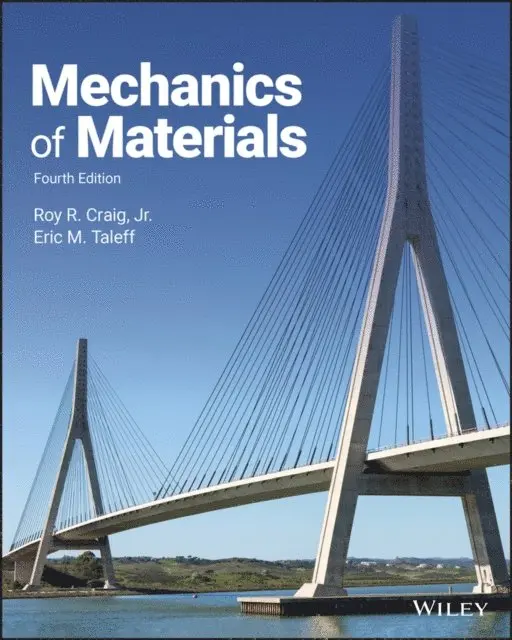
    Mechanics of Materials, International Adaptation

    AvRoy R. Craig Jr.,Eric M. Taleff

    Häftad, Engelska, 2021

    805 kr

    Beställningsvara. Skickas inom 5-8 vardagar. Fri frakt över 249 kr.

    Beskrivning

    Mechanics of Materials provides an in-depth yet accessible introduction to the behavior of solid materials under various stresses and strains. Emphasizing the three key concepts of deformable-body mechanics—equilibrium, material behavior, and geometry of deformation—this popular textbook covers the fundamental concepts of the subject while helping students strengthen their problem-solving skills. Throughout the text, students are taught to apply an effective four-step methodology to solve numerous example problems and understand the underlying principles of each application. Focusing primarily on the behavior of solids under static-loading conditions, the text thoroughly prepares students for subsequent courses in solids and structures involving more complex engineering analyses and Computer-Aided Engineering (CAE). The text provides ample, fully solved practice problems, real-world engineering examples, the equations that correspond to each concept, chapter summaries, procedure lists, illustrations, flow charts, diagrams, and more. This International adaptation has been thoroughly updated to use SI units. In addition to the new and updated materials, this updated edition includes new Python computer code examples, problems, and homework assignments that require only basic programming knowledge.

    Produktinformation

    • Utgivningsdatum:2021-06-10
    • Mått:10 x 10 x 10 mm
    • Vikt:454 g
    • Format:Häftad
    • Språk:Engelska
    • Antal sidor:864
    • Upplaga:4
    • Förlag:John Wiley & Sons Inc
    • ISBN:9781119676294

    Utforska kategorier

    • Maskinteknik och material inom Naturvetenskap och teknik

    Mer om författaren

    Roy R. Craig, Jr., is the John J. McKetta Energy Professor Emeritus in Engineering in the Department of Aerospace Engineering and Engineering Mechanics at the University of Texas at Austin. He received his BS degree in Civil Engineering from the University of Oklahoma and his MS and PhD degrees in Theoretical and Applied Mechanics from the University of Illinois at Urbana-Champaign. From 1961 until 2001 he was on the faculty of the University of Texas at Austin. Dr. Craig received numerous teaching awards and faculty leadership awards, and he is the author of one other textbook, Fundamentals of Structural Dynamics.Eric M. Taleff is the Charlotte Maer Patton Centennial Fellow in Engineering in the Department of Mechanical Engineering at the University of Texas at Austin. He received his BS degrees in Mechanical Engineering and in Materials Science from Rice University, an MS degree in Materials Science and Engineering from Stanford University, and a PhD in Mechanical Engineering from Stanford University. He has been on the faculty at the University of Texas at Austin since 1995. He is a fellow of ASM International and a Brimacombe Medalist of The Minerals, Metals&Materials Society. He received the Champion H. Mathewson Medal Award from the American Institute of Mining, Metallurgical, and Petroleum Engineers and the Minerals, Metals & Materials Society. He holds a Most Valuable Colleague Award, associated with the John M. Campbell Award, from General Motors.

    Innehållsförteckning

    • 1 INTRODUCTION1.1 What Is Mechanics of Materials?1.2 The Fundamental Equations of Deformable-Body Mechanics1.3 Problem-Solving Procedures1.4 Review of Static Equilibrium; Equilibrium of Deformable BodiesChapter 1 ReviewProblems2 STRESS AND STRAIN2.1 Introduction2.2 Normal Stress2.3 Extensional Strain; Thermal Strain2.4 Stress-Strain Diagrams; Mechanical Properties of Materials2.5 Elasticity and Plasticity; Temperature Effects2.6 Linear Elasticity; Hooke's Law and Poisson's Ratio2.7 Shear Stress and Shear Strain; Shear Modulus2.8 Introduction to Design-Axial Loads and Direct Shear2.9 Stresses on an Inclined Plane in an Axially Loaded Member2.10 Saint-Venant's Principle2.11 Hooke's Law for Plane Stress; the Relationship Between E and G2.12 General Definitions of Stress and Strain*2.13 Cartesian Components of Stress; Generalized Hooke's Law for Isotropic MaterialsChapter 2 ReviewProblems3 AXIAL DEFORMATION3.1 Introduction3.2 Basic Theory of Axial Deformation3.3 Examples of Nonuniform Axial Deformation3.4 Statically Determinate Structures3.5 Statically Indeterminate Structures3.6 Thermal Effects on Axial Deformation3.7 Geometric "Misfits"3.8 Displacement-Method Solution of Axial-Deformation Problems*3.9 Force-Method Solution of Axial-Deformation Problems*3.10 Introduction to the Analysis of Planar TrussesChapter 3 ReviewProblems4 TORSION4.1 Introduction4.2 Torsional Deformation of Circular Bars4.3 Torsion of Linearly Elastic Circular Bars4.4 Stress Distribution in Circular Torsion Bars; Torsion Testing4.5 Statically Determinate Assemblages of Uniform Torsion Members4.6 Statically Indeterminate Assemblages of Uniform Torsion Members*4.7 Displacement-Method Solution of Torsion Problems4.8 Power-Transmission Shafts*4.9 Thin-Wall Torsion Members*4.10 Torsion of Noncircular Prismatic BarsChapter 4 ReviewProblems5 TRANSFORMATION OF STRESS AND STRAIN5.1 Introduction5.2 Plane Stress5.3 Stress Transformation for Plane Stress5.4 Principal Stresses and Maximum Shear Stress5.5 Mohr's Circle for Plane Stress5.6 Triaxial Stress; Absolute Maximum Shear Stress5.7 Plane Strain5.8 Transformation of Strains in a Plane5.9 Mohr's Circle for Strain5.10 Measurement of Strain; Strain RosettesChapter 5 ReviewProblems6 EQUILIBRIUM OF BEAMS6.1 Introduction6.2 Equilibrium of Beams Using Finite Free-Body Diagrams6.3 Equilibrium Relationships Among Loads, Shear Force, and Bending Moment6.4 Shear-Force and Bending-Moment Diagrams: Equilibrium Method6.5 Shear-Force and Bending-Moment Diagrams: Graphical Method*6.6 Discontinuity Functions to Represent Loads, Shear, and MomentChapter 6 ReviewProblems7 STRESSES IN BEAMS7.1 Introduction7.2 Strain-Displacement Analysis7.3 Flexural Stress in Linearly Elastic Beams7.4 Design of Beams for Strength7.5 Flexural Stress in Nonhomogeneous Beams*7.6 Unsymmetric Bending*7.7 Inelastic Bending of Beams7.8 Shear Stress and Shear Flow in Beams7.9 Limitations on the Shear-Stress Formula7.10 Shear Stress in Thin-Wall Beams7.11 Shear in Built-up Beams*7.12 Shear CenterChapter 7 ReviewProblems8 DEFLECTION OF BEAMS8.1 Introduction8.2 Differential Equations of the Deflection Curve8.3 Slope and Deflection by Integration-Statically Determinate Beams8.4 Slope and Deflection by Integration-Statically Indeterminate Beams*8.5 Use of Discontinuity Functions to Determine Beam Deflections8.6 Slope and Deflection of Beams: Superposition Method*8.7 Slope and Deflection of Beams: Displacement MethodChapter 8 ReviewProblems9 PRESSURE VESSELS; STRESSES DUE TO COMBINED LOADING9.1 Introduction9.2 Thin-Wall Pressure Vessels9.3 Thick-Wall Pressure Vessels9.4 Stress Distribution in Beams9.5 Stresses Due to Combined LoadsChapter 9 ReviewProblems10 BUCKLING OF COLUMNS10.1 Introduction10.2 The Ideal Pin-Ended Column; Euler Buckling Load10.3 The Effect of End Conditions on Column Buckling*10.4 Eccentric Loading; the Secant Formula*10.5 Imperfections in Columns*10.6 Inelastic Buckling of Ideal Columns10.7 Design of Centrally Loaded ColumnsChapter 10 ReviewProblems11 ENERGY METHODS11.1 Introduction11.2 Work and Strain Energy11.3 Elastic Strain Energy for Various Types of Loading11.4 Work-Energy Principle for Calculating Deflections11.5 Castigliano's Second Theorem; the Unit-Load Method*11.6 Virtual Work*11.7 Strain-Energy Methods*11.8 Complementary-Energy MethodsChapter 11 ReviewProblems12 SPECIAL TOPICS RELATED TO DESIGN12.1 Introduction12.2 Stress Concentrations*12.3 Failure Theories*12.4 Fatigue and FractureChapter 12 ReviewProblemsA NUMERICAL ACCURACY; APPROXIMATIONSA.1 Numerical Accuracy; Significant DigitsA.2 ApproximationsB SYSTEMS OF UNITSB.1 IntroductionB.2 SI UnitsB.4 Useful Physical PropertiesC GEOMETRIC PROPERTIES OF PLANE AREASC.1 First Moments of Area; CentroidC.2 Moments of Inertia of an AreaC.3 Product of Inertia of an AreaC.4 Area Moments of Inertia about Inclined Axes; Principal Moments of InertiaC.5 Geometric Properties of Plane AreasD SECTION PROPERTIES OF SELECTED STRUCTURAL SHAPESE DEFLECTIONS AND SLOPES OF BEAMS; FIXED-END ACTIONSF MECHANICAL PROPERTIES OF SELECTED ENGINEERING MATERIALSG MECHANICAL PROPERTIES OF COMPOSITE MATERIALSH POISSON'S RATIO VALUES FOR VARIOUS MATERIALSANSWERS TO SELECTED ODD-NUMBERED PROBLEMSREFERENCESINDEX