• Fri frakt över 249 kr
  • •
  • Snabba leveranser
  • •
  • Billiga böcker
Kundservice

Du är på sajten för privatpersoner.

Företag, bibliotek eller offentlig verksamhet?

Du handlar på classic.bokus.com, där alla dina funktioner finns intakta.
Till classic.bokus.com
Bokus logotyp. Gå till startsidan.
  • Erbjudanden
  • Nyheter
  • Student
  • Topplistor
  • Barn & ungdom
  • Bokus Play
  • E-böcker
  • Pocketböcker
  • Spel & pussel

10% rabatt på allt med kod: NYSTART10 →

Sidfot

Mina sidor

    Hjälp

    • Kundservice
    • Vanliga frågor och svar
    • Frakt och leverans
    • Retur vid ångerrätt
    • Reklamera vara
    • Betalning
    • Köpvillkor
    • Allmänna villkor
    • Information om webbplatsens tillgänglighet

    Om Bokus

    • Om oss
    • Pressrum
    • För studenter
    • För företag
    • För bibliotek och offentlig verksamhet
    • För leverantörer
    • Hållbarhet

    Populärt

    • Aktuella erbjudanden
    • Presentkort
    • Studentlitteratur
    • Nya böcker
    • Topplistor
    • Signerade böcker
    • Engelska böcker

    Inspiration

    • Boktips
    • BookTok
    • Populära bokserier
    • Barnbokskaraktärer
    • Populära författare
    Logotyp för Bokus
    Följ oss på Facebook (extern länk)Följ oss på Instagram (extern länk)Följ oss på YouTube (extern länk)Följ oss på TikTok (extern länk)
    bokus @ CookiesAnpassa cookiesIntegritetspolicyKöpvillkor
    Till Citymail hemsida (extern länk)Till Budbee hemsida (extern länk)Till Postnord hemsida (extern länk)Till Schenker hemsida (extern länk)Till Early Bird hemsida (extern länk)Till Walleys hemsida (extern länk)
    1. Ekonomi och Ledarskap
    2. Företagsekonomi
    3. Redovisning och finansiering
    4. Finansiering

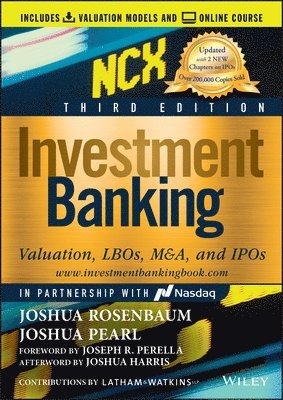
    Investment Banking

    Valuation, LBOs, M&A, and IPOs

    AvJoshua Rosenbaum,Joshua Pearl

    Inbunden, Engelska, 2020

    Del i serien Wiley Finance

    1 371 kr

    Beställningsvara. Skickas inom 5-8 vardagar. Fri frakt över 249 kr.

    Fler format och utgåvor

    Inbunden

    1 006 kr

    Häftad

    1 106 kr

    E-bok

    1 057 kr

    E-bok

    1 057 kr

    Beskrivning

    A timely update to the global bestselling book on investment banking and valuation – this new edition reflects valuable contributions from Nasdaq and the global law firm Latham & Watkins LLP plus access to the online valuation models and course.In the constantly evolving world of finance, a solid technical foundation is an essential tool for success. Due to the fast-paced nature of this world, however, no one was able to take the time to properly codify its lifeblood--namely, valuation and dealmaking. Rosenbaum and Pearl originally responded to this need in 2009 by writing the first edition of the book that they wish had existed when they were trying to break into Wall Street. Investment Banking: Valuation, LBOs, M&A, and IPOs, 3rd Edition is a highly accessible and authoritative book written by investment bankers that explains how to perform the valuation work and financial analysis at the core of Wall Street – comparable companies, precedent transactions, DCF, LBO, M&A analysis...and now IPO analytics and valuation. Using a step-by-step, how-to approach for each methodology, the authors build a chronological knowledge base and define key terms, financial concepts, and processes throughout the book. The genesis for the original book stemmed from the authors' personal experiences as students interviewing for investment banking positions. As they both independently went through the rigorous process, they realized that their classroom experiences were a step removed from how valuation and financial analysis were performed in real-world situations. Consequently, they created this book to provide a leg up to those individuals seeking or beginning careers on Wall Street – from students at undergraduate universities and graduate schools to "career changers" looking to break into finance. Now, over 10 years after the release of the first edition, the book is more relevant and topical than ever. It is used in over 200 universities globally and has become a go-to resource for investment banks, private equity, investment firms, and corporations undertaking M&A transactions, LBOs, IPOs, restructurings, and investment decisions. While the fundamentals haven't changed, the environment must adapt to changing market developments and conditions. As a result, Rosenbaum and Pearl have updated their widely adopted book accordingly, turning the latest edition of Investment Banking: Valuation, LBOs, M&A, and IPOs into a unique and comprehensive training package, which includes: Two new chapters covering IPOs plus insightful contributions from Nasdaq, the leading U.S. exchange and technology provider for IPOs and new listings, and global law firm Latham & Watkins LLPAccess to six downloadable valuation model templates, including Comparable Companies Analysis, Precedent Transactions Analysis, Discounted Cash Flow Analysis, Leveraged Buyout Analysis, M&A Analysis, and IPO ValuationSix-month access to online Wiley Investment Banking Valuation Course featuring bite-sized lessons, over five hours of video lectures, 100+ practice questions, and other investment banking study toolsLaunch your career on Wall Street and hone your financial expertise with Rosenbaum and Pearl’s real-world knowledge and forward-looking guidance in the latest edition of Investment Banking: Valuation, LBOs, M&A, and IPOs.

    Produktinformation

    • Utgivningsdatum:2020-05-20
    • Mått:185 x 257 x 36 mm
    • Vikt:1 202 g
    • Format:Inbunden
    • Språk:Engelska
    • Serie:Wiley Finance
    • Antal sidor:512
    • Upplaga:3
    • Förlag:John Wiley & Sons Inc
    • ISBN:9781119706182

    Utforska kategorier

    • Finansiering inom Ekonomi och Ledarskap

    Mer om författaren

    JOSHUA ROSENBAUM is a Managing Director and Head of the Industrials & Diversified Services Group at RBC Capital Markets. He originates, structures, and advises on M&A, corporate finance, and capital markets transactions. Previously, he worked at UBS Investment Bank and the International Finance Corporation, the direct investment division of the World Bank. He received his AB from Harvard and his MBA with Baker Scholar honors from Harvard Business School. JOSHUA PEARL has served as a Managing Director at Brahman Capital, a long/short equity asset manager. He focuses on public equity investments and special situations utilizing a fundamentals-based approach. Previously, he structured high yield financings, leveraged buyouts, and restructurings as a Director at UBS Investment Bank. Prior to UBS, he worked at Moelis & Company and Deutsche Bank. He received his BS in Business from Indiana University's Kelley School of Business.

    Innehållsförteckning

    • Additional Resources xvAbout the Authors xviiForeword xxiAcknowledgments xxiiiDisclaimer xxxiIntroduction 1Structure of the Book 3Part One: Valuation (Chapters 1–3) 3Part Two: Leveraged Buyouts (Chapters 4 & 5) 5Part Three: Mergers & Acquisitions (Chapters 6 & 7) 6Part Four: Initial Public Offerings (Chapters 8 & 9) 8ValueCo Summary Financial Information 9Part One Valuation 11Chapter 1 Comparable Companies Analysis 13Summary of Comparable Companies Analysis Steps 14Step I. Select the Universe of Comparable Companies 17Study the Target 17Identify Key Characteristics of the Target for Comparison Purposes 18Screen for Comparable Companies 22Step II. Locate The Necessary Financial Information 23SEC Filings: 10-K, 10-Q, 8-K, and Proxy Statement 24Equity Research 25Press Releases and News Runs 26Financial Information Services 26Summary of Financial Data Primary Sources 27Step III. Spread Key Statistics, Ratios, and Trading Multiples 28Calculation of Key Financial Statistics and Ratios 28Supplemental Financial Concepts and Calculations 42Calculation of Key Trading Multiples 47Step IV. Benchmark the Comparable Companies 50Benchmark the Financial Statistics and Ratios 50Benchmark the Trading Multiples 50Step V. Determine Valuation 51Valuation Implied by EV/EBITDA 52Valuation Implied by P/E 52Key Pros and Cons 54Illustrative Comparable Companies Analysis for ValueCo 55Step I. Select the Universe of Comparable Companies 55Step II. Locate the Necessary Financial Information 57Step III. Spread Key Statistics, Ratios, and Trading Multiples 57Step IV. Benchmark the Comparable Companies 69Step V. Determine Valuation 74Chapter 2 Precedent Transactions Analysis 75Summary of Precedent Transactions Analysis Steps 76Step I. Select the Universe of Comparable Acquisitions 79Screen for Comparable Acquisitions 79Examine Other Considerations 80Step II. Locate the Necessary Deal-Related and Financial Information 82Public Targets 82Private Targets 85Summary of Primary SEC Filings in M&A Transactions 86Step III. Spread Key Statistics, Ratios, and Transaction Multiples 88Calculation of Key Financial Statistics and Ratios 88Calculation of Key Transaction Multiples 94Step IV. Benchmark the Comparable Acquisitions 98Step V. Determine Valuation 98Key Pros and Cons 99Illustrative Precedent Transaction Analysis for ValueCo 100Step I. Select the Universe of Comparable Acquisitions 100Step II. Locate the Necessary Deal-Related and Financial Information 101Step III. Spread Key Statistics, Ratios, and Transaction Multiples 103Step IV. Benchmark the Comparable Acquisitions 111Step V. Determine Valuation 113Chapter 3 Discounted Cash Flow Analysis 115Summary of Discounted Cash Flow Analysis Steps 116Step I. Study the Target and Determine Key Performance Drivers 120Study the Target 120Determine Key Performance Drivers 120Step II. Project Free Cash Flow 121Considerations for Projecting Free Cash Flow 121Projection of Sales, EBITDA, and EBIT 123Projection of Free Cash Flow 125Step III. Calculate Weighted Average Cost of Capital 131Step III(a): Determine Target Capital Structure 132Step III(b): Estimate Cost of Debt (rd) 133Step III(c): Estimate Cost of Equity (re) 134Step III(d): Calculate WACC 138Step IV. Determine Terminal Value 138Exit Multiple Method 139Perpetuity Growth Method 139Step V. Calculate Present Value and Determine Valuation 141Calculate Present Value 141Determine Valuation 143Perform Sensitivity Analysis 145Key Pros and Cons 146Illustrative Discounted Cash Flow Analysis for ValueCo 147Step I. Study the Target and Determine Key Performance Drivers 147Step II. Project Free Cash Flow 147Projection of Sales, EBITDA, and EBIT 149Step III. Calculate Weighted Average Cost of Capital 154Step IV. Determine Terminal Value 159Step V. Calculate Present Value and Determine Valuation 161Part Two Leveraged Buyouts 167Chapter 4 Leveraged Buyouts 169Key Participants 171Financial Sponsors 171Investment Banks 172Bank and Institutional Lenders 174Bond Investors 175Private Credit Funds 176Target Management 176Characteristics of a Strong LBO Candidate 177Strong Cash Flow Generation 178Leading and Defensible Market Positions 178Growth Opportunities 178Efficiency Enhancement Opportunities 179Low Capex Requirements 179Strong Asset Base 180Proven Management Team 180Economics of LBOs 181Returns Analysis—Internal Rate of Return 181Returns Analysis—Cash Return 182How LBOs Generate Returns 182How Leverage Is Used to Enhance Returns 184Primary Exit/Monetization Strategies 187Sale of Business 187Initial Public Offering 188Dividends / Dividend Recapitalization 188Below Par Debt Repurchase 188LBO Financing: Structure 189LBO Financing: Primary Sources 192Secured Debt 192High Yield Bonds 196Mezzanine Debt 198Equity Contribution 199LBO Financing: Selected Key Terms 202Security 202Seniority 202Maturity 203Coupon 204Call Protection 205Covenants 206Term Sheets 209LBO Financing: Determining Financing Structure 212Chapter 5 LBO Analysis 217Financing Structure 217Valuation 218Step I. Locate and Analyze the Necessary Information 220Step II. Build the Pre-LBO Model 220Step II(a): Build Historical and Projected Income Statement through EBIT 221Step II(b): Input Opening Balance Sheet and Project Balance Sheet Items 224Step II(c): Build Cash Flow Statement through Investing Activities 226Operating Activities 226Step III. Input Transaction Structure 229Step III(a): Enter Purchase Price Assumptions 229Step III(b): Enter Financing Structure into Sources and Uses 231Step III(c): Link Sources and Uses to Balance Sheet Adjustments Columns 232Uses of Funds Links 235Step IV. Complete the Post-LBO Model 238Step IV(a): Build Debt Schedule 238Step IV(b): Complete Pro Forma Income Statement from EBIT to Net Income 247Step IV(c): Complete Pro Forma Balance Sheet 250Step IV(d): Complete Pro Forma Cash Flow Statement 252Step V. Perform LBO Analysis 254Step V(a): Analyze Financing Structure 254Step V(b): Perform Returns Analysis 256Step V(c): Determine Valuation 260Step V(d): Create Transaction Summary Page 261Illustrative LBO Analysis for ValueCo 262Part Three Mergers & Acquisitions 273Chapter 6 Sell-Side M&A 275Auctions 276Auction Structure 279Organization and Preparation 279Identify Seller Objectives and Determine Appropriate Sale Process 279Perform Sell-Side Advisor Due Diligence and Preliminary Valuation Analysis 281Select Buyer Universe 281Prepare Marketing Materials 282Prepare Confidentiality Agreement 285First Round 286Contact Prospective Buyers 286Negotiate and Execute Confidentiality Agreement with Interested Parties 286Distribute Confidential Information Memorandum and Initial Bid Procedures Letter 287Prepare Management Presentation 288Set Up Data Room 289Prepare Stapled Financing Package (if applicable) 291Receive Initial Bids and Select Buyers to Proceed to Second Round 291Second Round 293Conduct Management Presentations 293Facilitate Site Visits 294Provide Data Room Access and Respond to Diligence Requests 294Distribute Final Bid Procedures Letter and Draft Definitive Agreement 295Receive Final Bids 296Negotiations 300Evaluate Final Bids 300Negotiate with Preferred Buyer(s) 300Select Winning Bidder 300Render Fairness Opinion (if required) 301Receive Board/Owner Approval and Execute Definitive Agreement 301Closing 302Obtain Necessary Approvals 302Shareholder Approval 303Financing and Closing 305Negotiated Sale 306Chapter 7 Buy-Side M&A 309Buyer Motivation 310Synergies 311Cost Synergies 312Revenue Synergies 312Acquisition Strategies 313Horizontal Integration 313Vertical Integration 313Conglomeration 314Form of Financing 315Cash on Hand 316Debt Financing 316Equity Financing 317Debt vs. Equity Financing Summary—Acquirer Perspective 318Deal Structure 318Stock Sale 318Asset Sale 321Stock Sales Treated as Asset Sales for Tax Purposes 324Buy-Side Valuation 327Football Field 327Analysis at Various Prices 330Contribution Analysis 331Merger Consequences Analysis 333Purchase Price Assumptions 333Balance Sheet Effects 338Accretion/(Dilution) Analysis 343Acquisition Scenarios—I) 50% Stock/50% Cash; II) 100% Cash; and III) 100% Stock 346Illustrative Merger Consequences Analysis for the BuyerCo/ValueCo Transaction 351Part Four Initial Public Offerings 373Chapter 8 Initial Public Offerings 375Why Do Companies Go Public? 376Characteristics of a Strong IPO Candidate 378Attractive Industry 378Strong Competitive Position 378Growth Opportunities 379Moat & Barriers to Entry 380Healthy Financial Profile 380Disruptive & Differentiated Solutions 381Favorable Risk Profile 381Proven Management Team 382Key Participants 383Investment Banks 383Company Management 386Current Owners/Investors 387IPO Investors 387Lawyers 388Accountants 388Exchange Partner 389IPO Advisors 390Vendors 390Selected Key Terms 391Offering Size 392Primary/Secondary 393Overallotment Option, a.k.a. “Greenshoe” 394Syndicate Structure 395Lock-up Provision 396Listing Exchange 396Gross Spread 397Dual-Track Process 398Special Purpose Acquisition Companies (SPACs) 401Direct Listings 403Post-IPO Equity Offerings 406IPO Considerations 407Nasdaq Appendix 409Chapter 9 The IPO Process 413Organization and Preparation 415Select IPO Team, Exchange Partner and Assign Responsibilities 415Manage Corporate Housekeeping 418C Corp vs. Up-C Structure 423Determine IPO Timing 425Determine Offering Structure and Preliminary IPO Valuation 426Host Organizational Meeting 429`Due Diligence, Drafting, and Filing 430Perform Underwriter Due Diligence 430Draft and File the Registration Statement 431Prepare Other Key Transaction and Corporate Governance Documents 436Coordinate with Equity Research 437Respond to SEC Comments and File Amended Registration Statement 437Marketing and Roadshow 438Prepare Marketing Materials 438Salesforce Teach-in 439Conduct Roadshow 440Build Order Book 443Pricing and Allocation 445Price the Offering 445Allocate Shares to Investors 447Closing 447Afterword 449Bibliography and Recommended Reading 451Index 457