• Fri frakt över 249 kr
  • •
  • Snabba leveranser
  • •
  • Billiga böcker
Kundservice

Du är på sajten för privatpersoner.

Företag, bibliotek eller offentlig verksamhet?

Du handlar på classic.bokus.com, där alla dina funktioner finns intakta.
Till classic.bokus.com
Bokus logotyp. Gå till startsidan.
  • Erbjudanden
  • Student
  • Topplistor
  • Barn & ungdom
  • Bokus Play
  • E-böcker
  • Ljudböcker
  • Pocketböcker
  • Spel och pussel

Skapa nya rutiner – hälsoböcker upp till 50% →

Sidfot

Mina sidor

    Hjälp

    • Kundservice
    • Vanliga frågor och svar
    • Frakt och leverans
    • Retur vid ångerrätt
    • Reklamera vara
    • Betalning
    • Köpvillkor
    • Allmänna villkor
    • Information om webbplatsens tillgänglighet

    Om Bokus

    • Om oss
    • Pressrum
    • För studenter
    • För företag
    • För bibliotek och offentlig verksamhet
    • För leverantörer
    • Hållbarhet

    Populärt

    • Aktuella erbjudanden
    • Presentkort
    • Studentlitteratur
    • Nya böcker
    • Topplistor
    • Signerade böcker
    • Engelska böcker

    Inspiration

    • Boktips
    • BookTok
    • Barnbokskaraktärer
    • Populära författare
    Logotyp för Bokus
    Följ oss på Facebook (extern länk)Följ oss på Instagram (extern länk)Följ oss på YouTube (extern länk)Följ oss på TikTok (extern länk)
    bokus @ CookiesAnpassa cookiesIntegritetspolicyKöpvillkor
    Till Citymail hemsida (extern länk)Till Budbee hemsida (extern länk)Till Postnord hemsida (extern länk)Till Schenker hemsida (extern länk)Till Early Bird hemsida (extern länk)Till Walleys hemsida (extern länk)
    1. Naturvetenskap och teknik
    2. Teknik och industri
    3. Elektronik och kommunikationer

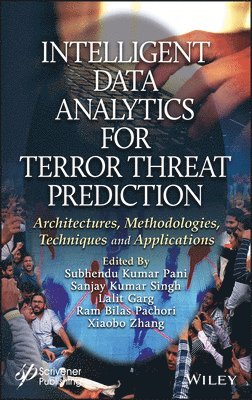
    Intelligent Data Analytics for Terror Threat Prediction

    Architectures, Methodologies, Techniques, and Applications

    AvSubhendu Kumar Pani,Sanjay Kumar Singh

    Inbunden, Engelska, 2021

    2 534 kr

    Beställningsvara. Skickas inom 5-8 vardagar. Fri frakt över 249 kr.

    Beskrivning

    Intelligent data analytics for terror threat prediction is an emerging field of research at the intersection of information science and computer science, bringing with it a new era of tremendous opportunities and challenges due to plenty of easily available criminal data for further analysis.This book provides innovative insights that will help obtain interventions to undertake emerging dynamic scenarios of criminal activities. Furthermore, it presents emerging issues, challenges and management strategies in public safety and crime control development across various domains. The book will play a vital role in improvising human life to a great extent. Researchers and practitioners working in the fields of data mining, machine learning and artificial intelligence will greatly benefit from this book, which will be a good addition to the state-of-the-art approaches collected for intelligent data analytics. It will also be very beneficial for those who are new to the field and need to quickly become acquainted with the best performing methods. With this book they will be able to compare different approaches and carry forward their research in the most important areas of this field, which has a direct impact on the betterment of human life by maintaining the security of our society. No other book is currently on the market which provides such a good collection of state-of-the-art methods for intelligent data analytics-based models for terror threat prediction, as intelligent data analytics is a newly emerging field and research in data mining and machine learning is still in the early stage of development.

    Produktinformation

    • Utgivningsdatum:2021-02-09
    • Mått:10 x 10 x 10 mm
    • Vikt:454 g
    • Format:Inbunden
    • Språk:Engelska
    • Antal sidor:352
    • Förlag:John Wiley & Sons Inc
    • ISBN:9781119711094

    Utforska kategorier

    • Elektronik och kommunikationer inom Naturvetenskap och teknik
    • Artificiell intelligens inom Data och IT

    Mer om författaren

    Subhendu Kumar Pani received his PhD from Utkal University Odisha, India in 2013. He is a professor in the Department of Computer Science & Engineering, Orissa Engineering College (OEC), Bhubaneswar, India. He has published more than 50 articles in international journals, authored 5 books and edited 2 volumes. Sanjay Kumar Singh is a professor in the Department of Computer Science and Engineering at the Indian Institute of Technology, Varanasi. He has published more than 130 international publications, 4 edited books and 2 patents. Lalit Garg received his PhD from the University of Ulster, UK in Computing and Information Engineering. He is a senior lecturer in Computer Information Systems, University of Malta, Malta. Ram Bilas Pachori received his PhD degree in Electrical Engineering from the Indian Institute of Technology (IIT) Kanpur, India in 2008. He is now a professor of Electrical Engineering, IIT Indore, India. He has more than 170 publications which include journal papers, conference papers, books, and book chapters. Xiaobo Zhang obtained his Master of Computer Science, Doctor of Engineering (Control Theory and Control Engineering) and is now working in the Internet of Things Department of Automation, Guangdong University of Technology, China. He has published more than 30 journal articles, edited 3 books, and has applied for more than 40 invention patents and obtained 6 software copyrights.

    Innehållsförteckning

    • Preface xv1 Rumor Detection and Tracing its Source to Prevent Cyber-Crimes on Social Media 1Ravi Kishore Devarapalli and Anupam Biswas1.1 Introduction 21.2 Social Networks 41.2.1 Types of Social Networks 41.3 What is Cyber-Crime? 71.3.1 Definition 71.3.2 Types of Cyber-Crimes 71.3.2.1 Hacking 71.3.2.2 Cyber Bullying 71.3.2.3 Buying Illegal Things 81.3.2.4 Posting Videos of Criminal Activity 81.3.3 Cyber-Crimes on Social Networks 81.4 Rumor Detection 91.4.1 Models 91.4.1.1 Naïve Bayes Classifier 101.4.1.2 Support Vector Machine 131.4.2 Combating Misinformation on Instagram 141.5 Factors to Detect Rumor Source 151.5.1 Network Structure 151.5.1.1 Network Topology 161.5.1.2 Network Observation 161.5.2 Diffusion Models 181.5.2.1 SI Model 181.5.2.2 SIS Model 191.5.2.3 SIR Model 191.5.2.4 SIRS Model 201.5.3 Centrality Measures 211.5.3.1 Degree Centrality 211.5.3.2 Closeness Centrality 211.5.3.3 Betweenness Centrality 221.6 Source Detection in Network 221.6.1 Single Source Detection 231.6.1.1 Network Observation 231.6.1.2 Query-Based Approach 251.6.1.3 Anti-Rumor-Based Approach 261.6.2 Multiple Source Detection 261.7 Conclusion 27References 282 Internet of Things (IoT) and Machine to Machine (M2M) Communication Techniques for Cyber Crime Prediction 31Jaiprakash Narain Dwivedi2.1 Introduction 322.2 Advancement of Internet 332.3 Internet of Things (IoT) and Machine to Machine (M2M) Communication 342.4 A Definition of Security Frameworks 382.5 M2M Devices and Smartphone Technology 392.6 Explicit Hazards to M2M Devices Declared by Smartphone Challenges 412.7 Security and Privacy Issues in IoT 432.7.1 Dynamicity and Heterogeneity 432.7.2 Security for Integrated Operational World with Digital World 442.7.3 Information Safety with Equipment Security 442.7.4 Data Source Information 442.7.5 Information Confidentiality 442.7.6 Trust Arrangement 442.8 Protection in Machine to Machine Communication 482.9 Use Cases for M2M Portability 522.10 Conclusion 53References 543 Crime Predictive Model Using Big Data Analytics 57Hemanta Kumar Bhuyan and Subhendu Kumar Pani3.1 Introduction 583.1.1 Geographic Information System (GIS) 593.2 Crime Data Mining 603.2.1 Different Methods for Crime Data Analysis 623.3 Visual Data Analysis 633.4 Technological Analysis 653.4.1 Hadoop and MapReduce 653.4.1.1 Hadoop Distributed File System (HDFS) 653.4.1.2 MapReduce 653.4.2 Hive 673.4.2.1 Analysis of Crime Data using Hive 673.4.2.2 Data Analytic Module With Hive 683.4.3 Sqoop 683.4.3.1 Pre-Processing and Sqoop 683.4.3.2 Data Migration Module With Sqoop 683.4.3.3 Partitioning 683.4.3.4 Bucketing 683.4.3.5 R-Tool Analyse Crime Data 693.4.3.6 Correlation Matrix 693.5 Big Data Framework 693.6 Architecture for Crime Technical Model 723.7 Challenges 733.8 Conclusions 74References 754 The Role of Remote Sensing and GIS in Military Strategy to Prevent Terror Attacks 79Sushobhan Majumdar4.1 Introduction 804.2 Database and Methods 814.3 Discussion and Analysis 824.4 Role of Remote Sensing and GIS 834.5 Cartographic Model 834.5.1 Spatial Data Management 854.5.2 Battlefield Management 854.5.3 Terrain Analysis 864.6 Mapping Techniques Used for Defense Purposes 874.7 Naval Operations 884.7.1 Air Operations 894.7.2 GIS Potential in Military 894.8 Future Sphere of GIS in Military Science 894.8.1 Defense Site Management 904.8.2 Spatial Data Management 904.8.3 Intelligence Capability Approach 904.8.4 Data Converts Into Information 904.8.5 Defense Estate Management 914.9 Terrain Evolution 914.9.1 Problems Regarding the Uses of Remote Sensing and GIS 914.9.2 Recommendations 924.10 Conclusion 92References 935 Text Mining for Secure Cyber Space 95Supriya Raheja and Geetika Munjal5.1 Introduction 955.2 Literature Review 975.2.1 Text Mining With Latent Semantic Analysis 1005.3 Latent Semantic Analysis 1015.4 Proposed Work 1025.5 Detailed Work Flow of Proposed Approach 1045.5.1 Defining the Stop Words 1065.5.2 Stemming 1075.5.3 Proposed Algorithm: A Hybrid Approach 1095.6 Results and Discussion 1115.6.1 Analysis Using Hybrid Approach 1115.7 Conclusion 115References 1156 Analyses on Artificial Intelligence Framework to Detect Crime Pattern 119R. Arshath Raja, N. Yuvaraj and N.V. Kousik6.1 Introduction 1206.2 Related Works 1216.3 Proposed Clustering for Detecting Crimes 1226.3.1 Data Pre-Processing 1236.3.2 Object-Oriented Model 1246.3.3 MCML Classification 1246.3.4 GAA 1246.3.5 Consensus Clustering 1246.4 Performance Evaluation 1246.4.1 Precision 1256.4.2 Sensitivity 1256.4.3 Specificity 1316.4.4 Accuracy 1316.5 Conclusions 131References 1327 A Biometric Technology-Based Framework for Tackling and Preventing Crimes 133Ebrahim A.M. Alrahawe, Vikas T. Humbe and G.N. Shinde7.1 Introduction 1347.2 Biometrics 1357.2.1 Biometric Systems Technologies 1377.2.2 Biometric Recognition Framework 1417.2.3 Biometric Applications/Usages 1427.3 Surveillance Systems (CCTV) 1447.3.1 CCTV Goals 1467.3.2 CCTV Processes 1467.3.3 Fusion of Data From Multiple Cameras 1497.3.4 Expanding the Use of CCTV 1497.3.5 CCTV Effectiveness 1507.3.6 CCTV Limitations 1507.3.7 Privacy and CCTV 1507.4 Legality to Surveillance and Biometrics vs. Privacy and Human Rights 1517.5 Proposed Work (Biometric-Based CCTV System) 1537.5.1 Biometric Surveillance System 1547.5.1.1 System Component and Flow Diagram 1547.5.2 Framework 1567.6 Conclusion 158References 1598 Rule-Based Approach for Botnet Behavior Analysis 161Supriya Raheja, Geetika Munjal, Jyoti Jangra and Rakesh Garg8.1 Introduction 1618.2 State-of-the-Art 1638.3 Bots and Botnets 1668.3.1 Botnet Life Cycle 1668.3.2 Botnet Detection Techniques 1678.3.3 Communication Architecture 1688.4 Methodology 1718.5 Results and Analysis 1758.6 Conclusion and Future Scope 177References 1779 Securing Biometric Framework with Cryptanalysis 181Abhishek Goel, Siddharth Gautam, Nitin Tyagi, Nikhil Sharma and Martin Sagayam9.1 Introduction 1829.2 Basics of Biometric Systems 1849.2.1 Face 1859.2.2 Hand Geometry 1869.2.3 Fingerprint 1879.2.4 Voice Detection 1879.2.5 Iris 1889.2.6 Signature 1899.2.7 Keystrokes 1899.3 Biometric Variance 1929.3.1 Inconsistent Presentation 1929.3.2 Unreproducible Presentation 1929.3.3 Fault Signal/Representational Accession 1939.4 Performance of Biometric System 1939.5 Justification of Biometric System 1959.5.1 Authentication (“Is this individual really the authenticate user or not?”) 1959.5.2 Recognition (“Is this individual in the database?”) 1969.5.3 Concealing (“Is this a needed person?”) 1969.6 Assaults on a Biometric System 1969.6.1 Zero Effort Attacks 1979.6.2 Adversary Attacks 1989.6.2.1 Circumvention 1989.6.2.2 Coercion 1989.6.2.3 Repudiation 1989.6.2.4 DoB (Denial of Benefit) 1999.6.2.5 Collusion 1999.7 Biometric Cryptanalysis: The Fuzzy Vault Scheme 1999.8 Conclusion & Future Work 203References 20510 The Role of Big Data Analysis in Increasing the Crime Prediction and Prevention Rates 209Galal A. AL-Rummana, Abdulrazzaq H. A. Al-Ahdal and G.N. Shinde10.1 Introduction: An Overview of Big Data and Cyber Crime 21010.2 Techniques for the Analysis of BigData 21110.3 Important Big Data Security Techniques 21610.4 Conclusion 219References 21911 Crime Pattern Detection Using Data Mining 221Dipalika Das and Maya Nayak11.1 Introduction 22111.2 Related Work 22211.3 Methods and Procedures 22411.4 System Analysis 22711.5 Analysis Model and Architectural Design 23011.6 Several Criminal Analysis Methods in Use 23311.7 Conclusion and Future Work 235References 23512 Attacks and Security Measures in Wireless Sensor Network 237Nikhil Sharma, Ila Kaushik, Vikash Kumar Agarwal, Bharat Bhushan and Aditya Khamparia12.1 Introduction 23812.2 Layered Architecture of WSN 23912.2.1 Physical Layer 23912.2.2 Data Link Layer 23912.2.3 Network Layer 24012.2.4 Transport Layer 24012.2.5 Application Layer 24112.3 Security Threats on Different Layers in WSN 24112.3.1 Threats on Physical Layer 24112.3.1.1 Eavesdropping Attack 24112.3.1.2 Jamming Attack 24212.3.1.3 Imperil or Compromised Node Attack 24212.3.1.4 Replication Node Attack 24212.3.2 Threats on Data Link Layer 24212.3.2.1 Collision Attack 24312.3.2.2 Denial of Service (DoS) Attack 24312.3.2.3 Intelligent Jamming Attack 24312.3.3 Threats on Network Layer 24312.3.3.1 Sybil Attack 24312.3.3.2 Gray Hole Attack 24312.3.3.3 Sink Hole Attack 24412.3.3.4 Hello Flooding Attack 24412.3.3.5 Spoofing Attack 24412.3.3.6 Replay Attack 24412.3.3.7 Black Hole Attack 24412.3.3.8 Worm Hole Attack 24512.3.4 Threats on Transport Layer 24512.3.4.1 De-Synchronization Attack 24512.3.4.2 Flooding Attack 24512.3.5 Threats on Application Layer 24512.3.5.1 Malicious Code Attack 24512.3.5.2 Attack on Reliability 24612.3.6 Threats on Multiple Layer 24612.3.6.1 Man-in-the-Middle Attack 24612.3.6.2 Jamming Attack 24612.3.6.3 Dos Attack 24612.4 Threats Detection at Various Layers in WSN 24612.4.1 Threat Detection on Physical Layer 24712.4.1.1 Compromised Node Attack 24712.4.1.2 Replication Node Attack 24712.4.2 Threat Detection on Data Link Layer 24712.4.2.1 Denial of Service Attack 24712.4.3 Threat Detection on Network Layer 24812.4.3.1 Black Hole Attack 24812.4.3.2 Worm Hole Attack 24812.4.3.3 Hello Flooding Attack 24912.4.3.4 Sybil Attack 24912.4.3.5 Gray Hole Attack 25012.4.3.6 Sink Hole Attack 25012.4.4 Threat Detection on the Transport Layer 25112.4.4.1 Flooding Attack 25112.4.5 Threat Detection on Multiple Layers 25112.4.5.1 Jamming Attack 25112.5 Various Parameters for Security Data Collection in WSN 25212.5.1 Parameters for Security of Information Collection 25212.5.1.1 Information Grade 25212.5.1.2 Efficacy and Proficiency 25312.5.1.3 Reliability Properties 25312.5.1.4 Information Fidelity 25312.5.1.5 Information Isolation 25412.5.2 Attack Detection Standards in WSN 25412.5.2.1 Precision 25412.5.2.2 Germane 25512.5.2.3 Extensibility 25512.5.2.4 Identifiability 25512.5.2.5 Fault Forbearance 25512.6 Different Security Schemes in WSN 25612.6.1 Clustering-Based Scheme 25612.6.2 Cryptography-Based Scheme 25612.6.3 Cross-Checking-Based Scheme 25612.6.4 Overhearing-Based Scheme 25712.6.5 Acknowledgement-Based Scheme 25712.6.6 Trust-Based Scheme 25712.6.7 Sequence Number Threshold-Based Scheme 25812.6.8 Intrusion Detection System-Based Scheme 25812.6.9 Cross-Layer Collaboration-Based Scheme 25812.7 Conclusion 264References 26413 Large Sensing Data Flows Using Cryptic Techniques 269Hemanta Kumar Bhuyan13.1 Introduction 27013.2 Data Flow Management 27113.2.1 Data Flow Processing 27113.2.2 Stream Security 27213.2.3 Data Privacy and Data Reliability 27213.2.3.1 Security Protocol 27213.3 Design of Big Data Stream 27313.3.1 Data Stream System Architecture 27313.3.1.1 Intrusion Detection Systems (IDS) 27413.3.2 Malicious Model 27513.3.3 Threat Approaches for Attack Models 27613.4 Utilization of Security Methods 27713.4.1 System Setup 27813.4.2 Re-Keying 27913.4.3 New Node Authentication 27913.4.4 Cryptic Techniques 28013.5 Analysis of Security on Attack 28013.6 Artificial Intelligence Techniques for Cyber Crimes 28113.6.1 Cyber Crime Activities 28213.6.2 Artificial Intelligence for Intrusion Detection 28213.6.3 Features of an IDPS 28413.7 Conclusions 284References 28514 Cyber-Crime Prevention Methodology 291Chandra Sekhar Biswal and Subhendu Kumar Pani14.1 Introduction 29214.1.1 Evolution of Cyber Crime 29414.1.2 Cybercrime can be Broadly Defined as Two Types 29614.1.3 Potential Vulnerable Sectors of Cybercrime 29614.2 Credit Card Frauds and Skimming 29714.2.1 Matrimony Fraud 29714.2.2 Juice Jacking 29814.2.3 Technicality Behind Juice Jacking 29914.3 Hacking Over Public WiFi or the MITM Attacks 29914.3.1 Phishing 30014.3.2 Vishing/Smishing 30214.3.3 Session Hijacking 30314.3.4 Weak Session Token Generation/Predictable Session Token Generation 30414.3.5 IP Spoofing 30414.3.6 Cross-Site Scripting (XSS) Attack 30514.4 SQLi Injection 30614.5 Denial of Service Attack 30714.6 Dark Web and Deep Web Technologies 30914.6.1 The Deep Web 30914.6.2 The Dark Web 31014.7 Conclusion 311References 312Index 313
    Hoppa över listan

    Du kanske också är intresserad av

    Xiaobo Zhang, Ram Bilas Pachori, Lalit Garg, Sanjay Kumar Singh, Subhendu Kumar Pani - Intelligent Data Analytics for Terror Threat Prediction, E-bok

    Intelligent Data Analytics for Terror Threat Prediction

    Xiaobo Zhang, Ram Bilas Pachori, Lalit Garg, Sanjay Kumar Singh, Subhendu Kumar Pani

    E-bok
    2020

    3 119 kr

    Xiaobo Zhang, Ram Bilas Pachori, Lalit Garg, Sanjay Kumar Singh, Subhendu Kumar Pani - Intelligent Data Analytics for Terror Threat Prediction, E-bok

    Intelligent Data Analytics for Terror Threat Prediction

    Xiaobo Zhang, Ram Bilas Pachori, Lalit Garg, Sanjay Kumar Singh, Subhendu Kumar Pani

    E-bok
    2021

    3 119 kr

    Lalit Garg, Ram Bilas Pachori, Dilip Singh Sisodia - Handbook of Research on Advancements of Artificial Intelligence in Healthcare Engineering, E-bok

    Handbook of Research on Advancements of Artificial Intelligence in Healthcare Engineering

    Lalit Garg, Ram Bilas Pachori, Dilip Singh Sisodia

    E-bok
    2020

    6 599 kr

    Dilip Singh Sisodia, Lalit Garg, Ram Bilas Pachori, M. Tanveer - Machine Intelligence Techniques for Data Analysis and Signal Processing, Inbunden
    Del 997

    Machine Intelligence Techniques for Data Analysis and Signal Processing

    Dilip Singh Sisodia, Lalit Garg, Ram Bilas Pachori, M. Tanveer

    Inbunden, 2023

    4 210 kr

    M. Tanveer, Ram Bilas Pachori, Lalit Garg, Dilip Singh Sisodia - Machine Intelligence Techniques for Data Analysis and Signal Processing, E-bok

    Machine Intelligence Techniques for Data Analysis and Signal Processing

    M. Tanveer, Ram Bilas Pachori, Lalit Garg, Dilip Singh Sisodia

    E-bok
    2023

    5 354 kr

    Dilip Singh Sisodia, Ram Bilas Pachori, Lalit Garg - Advancement of Artificial Intelligence in Healthcare Engineering, Inbunden

    Advancement of Artificial Intelligence in Healthcare Engineering

    Dilip Singh Sisodia, Ram Bilas Pachori, Lalit Garg

    Inbunden, 2020

    5 540 kr

    Dilip Singh Sisodia, Lalit Garg, Ram Bilas Pachori, M. Tanveer - Machine Intelligence Techniques for Data Analysis and Signal Processing, Häftad
    Del 997

    Machine Intelligence Techniques for Data Analysis and Signal Processing

    Dilip Singh Sisodia, Lalit Garg, Ram Bilas Pachori, M. Tanveer

    Häftad, 2024

    4 210 kr

    Xiaobo Zhang - Virus Infection and Tumorigenesis, Inbunden

    Virus Infection and Tumorigenesis

    Xiaobo Zhang

    Inbunden, 2019

    1 666 kr

    Xiaobo Zhang, Sachi Nandan Mohanty, Suneeta Satpathy, Tanupriya Choudhury, Rabinarayan Satpathy - Data Analytics in Bioinformatics, E-bok

    Data Analytics in Bioinformatics

    Xiaobo Zhang, Sachi Nandan Mohanty, Suneeta Satpathy, Tanupriya Choudhury, Rabinarayan Satpathy

    E-bok
    2021

    3 029 kr

    Ravi Kanbur, Xiaobo Zhang - Governing Rapid Growth in China, Inbunden

    Governing Rapid Growth in China

    Ravi Kanbur, Xiaobo Zhang

    Inbunden, 2009

    1 507 kr