• Fri frakt över 249 kr
  • •
  • Snabba leveranser
  • •
  • Billiga böcker
Kundservice

Du är på sajten för privatpersoner.

Företag, bibliotek eller offentlig verksamhet?

Du handlar på classic.bokus.com, där alla dina funktioner finns intakta.
Till classic.bokus.com
Bokus logotyp. Gå till startsidan.
  • Erbjudanden
  • Student
  • Topplistor
  • Barn & ungdom
  • Bokus Play
  • E-böcker
  • Ljudböcker
  • Pocketböcker
  • Spel och pussel

Skapa nya rutiner – hälsoböcker upp till 50% →

Sidfot

Mina sidor

    Hjälp

    • Kundservice
    • Vanliga frågor och svar
    • Frakt och leverans
    • Retur vid ångerrätt
    • Reklamera vara
    • Betalning
    • Köpvillkor
    • Allmänna villkor
    • Information om webbplatsens tillgänglighet

    Om Bokus

    • Om oss
    • Pressrum
    • För studenter
    • För företag
    • För bibliotek och offentlig verksamhet
    • För leverantörer
    • Hållbarhet

    Populärt

    • Aktuella erbjudanden
    • Presentkort
    • Studentlitteratur
    • Nya böcker
    • Topplistor
    • Signerade böcker
    • Engelska böcker

    Inspiration

    • Boktips
    • BookTok
    • Barnbokskaraktärer
    • Populära författare
    Logotyp för Bokus
    Följ oss på Facebook (extern länk)Följ oss på Instagram (extern länk)Följ oss på YouTube (extern länk)Följ oss på TikTok (extern länk)
    bokus @ CookiesAnpassa cookiesIntegritetspolicyKöpvillkor
    Till Citymail hemsida (extern länk)Till Budbee hemsida (extern länk)Till Postnord hemsida (extern länk)Till Schenker hemsida (extern länk)Till Early Bird hemsida (extern länk)Till Walleys hemsida (extern länk)
    1. Naturvetenskap och teknik
    2. Teknik och industri
    3. Övrig teknik och tillämpad vetenskap

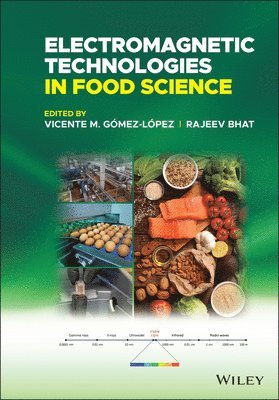
    Electromagnetic Technologies in Food Science

    AvVicente M. Gómez-López,Vicente M. Gómez-López

    Inbunden, Engelska, 2022

    1 861 kr

    Skickas . Fri frakt över 249 kr.

    Beskrivning

    A comprehensive source of in-depth information provided on existing and emerging food technologies based on the electromagnetic spectrum  Electromagnetic Technologies in Food Science examines various methods employed in food applications that are based on the entire electromagnetic (EM) spectrum. Focusing on recent advances and challenges in food science and technology, this is an up-to-date volume that features vital contributions coming from an international panel of experts who have shared both fundamental and advanced knowledge of information on the dosimetry methods, and on potential applications of gamma irradiation, electron beams, X-rays, radio and microwaves, ultraviolet, visible, pulsed light, and more. Organized into four parts, the text begins with an accessible overview of the physics of the electromagnetic spectrum, followed by discussion on the application of the EM spectrum to non-thermal food processing. The physics of infrared radiation, microwaves, and other advanced heating methods are then deliberated in detail—supported by case studies and examples that illustrate a range of both current and potential applications of EM-based methods. The concluding section of the book describes analytical techniques adopted for quality control, such as hyperspectral imaging, infrared and Raman spectroscopy. This authoritative book resource:  Covers advanced theoretical knowledge and practical applications on the use of EM spectrum as novel methods in food processing technology Discusses the latest progress in developing quality control methods, thus enabling the control of continuous fast-speed processes  Explores future challenges and benefits of employing electromagnetic spectrum in food technology applications Addresses emerging processing technologies related to improving safety, preservation, and overall quality of various food commodities Electromagnetic Technologies in Food Science is an essential reading material for undergraduate and graduate students, researchers, academics, and agri-food professionals working in the area of food preservation, novel food processing techniques and sustainable food production.

    Produktinformation

    • Utgivningsdatum:2022-01-03
    • Mått:170 x 244 x 29 mm
    • Vikt:1 021 g
    • Format:Inbunden
    • Språk:Engelska
    • Antal sidor:448
    • Förlag:John Wiley & Sons Inc
    • ISBN:9781119759515

    Utforska kategorier

    • Övrig teknik och tillämpad vetenskap inom Naturvetenskap och teknik

    Mer om författaren

    About the EditorsVicente M. Gómez-López is Professor and Senior Scientist at the Universidad Católica San Antonio de Murcia (UCAM), Murcia, Spain. Rajeev Bhat is Professor and ERA-Chair Holder in Food By-products Valorization Technologies (VALORTECH) at the Estonian University of Life Sciences (EMÜ), Tartu, Estonia.

    Innehållsförteckning

    • List of Contributors xvForeword xixPreface xxi1 Physics of the Electromagnetic Spectrum 1Michael Vollmer1 Introduction 12 Description of Electromagnetic Waves 22.1 Properties of Waves 22.2 Spectrum of Electromagnetic Waves 53 Propagation of Electromagnetic Waves: Geometrical Versus Wave Optics 74 Description of Particle Properties of Electromagnetic Radiation 105 Exponential Attenuation of Electromagnetic Radiation in Matter 116 Microscopic Structure of Matter and Origin of EM Radiation 146.1 UV–VIS and Atomic Spectra 146.2 IR and Molecular Spectra 166.3 X- Rays and Excitations of Inner Electrons in Atoms 186.4 γ- Rays and Nuclear Spectra 196.5 Blackbody Radiation: Generating UV, VIS, and IR Radiation from Hot Objects 206.6 Generation of Microwave and RF EM Waves 217 Interaction of EM Radiation with Food 237.1 Low Frequencies: RF and Microwaves 237.2 IR Radiation 247.3 Visible and UV Radiation 257.4 X- Rays and γ- Radiation 277.4.1 Atomic Photo Effect 277.4.2 Compton Effect 287.4.3 Pair Generation Effect 287.4.4 Probabilities for Absorbing High- Energy Radiation 297.4.5 Consequence of Absorption of High- Energy Photons by Matter 298 Outlook 31References 312 Dosimetry in Food Irradiation 33Bhaskar Sanyal and Sunil K. Ghosh1 Introduction 332 Fundamentals of Dosimetry 342.1 What is Dosimetry 352.2 Absorbed Dose 352.3 Physical Aspects of Radiation Absorption 362.3.1 Photoelectric Effect 362.3.2 Compton Scattering 362.3.3 Pair Production 362.3.4 Interaction of Charged Particles 373 Dosimetry Systems for Food Irradiation Application 373.1 Characterization of Dosimetry Systems 393.1.1 Calibrating the Dosimetry System 393.1.2 Establishing Traceability 393.1.3 Determining Batch Homogeneity 403.1.4 Determining Uncertainty in the Measured Dose Value 403.1.5 Understanding and Quantifying Effects of the Influencing Quantities 403.2 Specific Dosimetry Systems for Food Irradiation Applications 413.2.1 Chemical Dosimeter (Fricke and Ceric- cerous Sulphate) 413.2.2 Alanine Dosimeter 423.2.3 Radiochromic Dosimeter 423.3 Role of Product Density in the Absorbed Dose 434 Dosimetry in Food Irradiation Facility 434.1 Dosimetry in Radionuclide- Based Irradiation Facility 444.1.1 Dose Mapping Experiment 444.1.2 Routine Processing of Food Product 464.2 Dosimetry in Linear Accelerator (LINAC) Facility 465 Emerging Field of Dosimetry in Low- Energy Accelerator Irradiator for Surface Treatment of Food 496 Conclusion and Future Outlook 50References 513 Gamma Irradiation 53Xuetong Fan and Brendan A. Niemira1 Introduction 532 Characteristics and Generation of γ- rays 543 Compton Effect 564 Basic Effects on Food: Interaction of γ-rays with Matter 575 Dose Unit, Dose Rate, and Dose Distribution 596 γ-ray Facility 607 Applications of γ-ray Radiation in Foods 607.1 Improving Microbial Safety 617.2 Preservation of Food 637.3 Phytosanitary Treatment 647.4 Applications on Low- Moisture Foods 647.5 Potential Uses of γ Irradiation for Degradation of Mycotoxin and Allergen 658 Factors Impacting the Efficacy of γ- rays 668.1 Temperature 668.2 Atmosphere 668.3 Water Activity 678.4 Composition of Foods (Antioxidants) 679 Conclusion 67Acknowledgments 68References 684 Electron Beams 74Rajeev Bhat, Benny P. George, and Vicente M. Gómez- López1 Introduction 742 Accelerator as a Source of Ionizing Radiation 763 Working Principle of EB Accelerator 774 Types of Industrial Electron Accelerators 775 Classification of Industrial Electron Beam (EB) Accelerators 786 Absorbed Dose 787 Radiation Dosimetry 797.1 Theoretical Aspect of EB Dosimetry 797.2 Practical Aspect of EB Dosimetry 797.3 Dosimetry Systems 807.4 Calibration of Dosimetry Systems 817.4.1 Performance Check of Measuring Instruments 817.4.2 Calibration of Routine Dosimeters 817.4.3 Establishing Measurement Traceability to National/International Standards 828 Scanning Characteristics of the Electron Beam Accelerator 829 Depth Dose Profile of Electron Beam 8210 Process Validation of Industrial EB Accelerator 8310.1 Installation Qualification (IQ) 8410.2 Operational Qualification (OQ) 8510.3 Performance Qualification (PQ) 8510.4 Routine Monitoring 8611 EB Irradiation in Food Applications 8611.1 Mechanism 9312 Legislations on Electron Beams Application 9313 Conclusions and Future Outlook 96Acknowledgements 97Conflict of Interest Statement 97References 975 X- Rays 105Francesco E. Ricciardi, Amalia Conte, and Matteo A. Del Nobile1 Introduction 1051.1 Thermal and Non- thermal Technologies 1051.2 Irradiation Technology 1071.3 X- Rays 1092 Mechanism of Action of X- Rays 1093 Case Study 1113.1 Seafood Products 1113.2 Fresh and Dried Fruit 1153.3 Dairy Products 1163.4 Meat- Based Foods 1184 Effects of X- Rays on Packaging 1195 Regulation of X- Ray Irradiation 1206 Conclusion and Future Outlook 122References 1226 Ultraviolet Light 128Sandra N. Guerrero, Mariana Ferrario, Marcela Schenk, Daniela Fenoglio, and Antonella Andreone1 Introduction 1282 Characterization of UV- C Dose 1303 Rational Use of the Hurdle Approach in the Design of Food Preservation Technologies 1343.1 UV- C light–based Hurdle Combinations 1363.1.1 Heat 1363.1.2 UV- C Combined with Other Novel Technologies 1533.1.3 UV- C Combined with the Addition of Natural Antimicrobials 1623.1.4 UV- C Combined with Sanitizers 1644 Conclusions and Future Perspectives 170Acknowledgments 171References 1717 Visible Light 181Laura M. Hinds, Mysore L. Bhavya, Colm P. O’Donnell, and Brijesh K. Tiwari1 Introduction 1812 Sources 1823 Quantifying Light Treatment 1834 Applications of Visible Light in the Food Industry 1844.1 Postharvest Handling 1844.2 Food Safety 1865 Challenges and Limitations 1946 Conclusion 194References 1948 Pulsed Light 200Vicente M. Gómez- López, Rajeev Bhat, and José A. Pellicer1 Introduction 2002 Pulsed Light as a Technology Based on the Electromagnetic Spectrum 2013 Photochemistry and Photophysics Laws 2024 Factors Affecting Efficacy 2035 Pulsed Light Systems 2046 Effect on Microorganisms 2056.1 Action Spectrum 2056.2 Inactivation Mechanism 2056.3 Photoreactivation 2066.4 Sublethal Injury 2076.5 Viable but Non- culturable State 2077 Inactivation of Enzymes 2078 Inactivation of Allergens 2089 Effect on Lipids 20910 Effect on Health- Related Compounds 20911 Effect on Vitamin d 21012 Effect on Pesticides 21013 Energy Efficiency 21114 Legislations (Regulations and Safety) of Pulsed Light 21115 Conclusions and Future Outlook 212Conflict of Interest Statement 212References 2129 Infrared Radiation 220Yvan Llave and Noboru Sakai1 Introduction 2202 Fundamentals and Theory of Infrared Radiation 2212.1 Principles of Infrared Radiation Heating 2212.1.1 Infrared Wavelength 2212.1.2 Basics Laws of Infrared Radiation 2222.2 Characteristics of Thermal Radiation 2242.2.1 Types of Infrared Radiation 2242.2.2 Heat Generation 2242.2.3 Sources of Infrared Heating 2242.3 Special Features of Infrared Radiation 2262.3.1 Factors Related to the Penetration of IR 2262.3.2 Advantages of IR Processing 2262.3.3 Limitations of Infrared Radiation Processing 2272.4 Interaction of Infrared Radiation with Food 2272.4.1 Fundamentals of Interaction with Foods 2272.4.2 Selective Infrared Radiation Absorption of Foods 2283 Infrared Radiative Properties of Food Materials 2293.1 Attenuation of Radiation 2293.2 Properties Related to the Radiative Heat Transfer of Foods 2304 Applications of Infrared Radiation in Food Processing 2304.1 Traditional Applications for Foods 2304.1.1 Infrared Radiation Drying 2304.1.2 Infrared Radiation Pasteurization 2314.1.3 Infrared Radiation Grilling, Broiling, and Roasting 2314.1.4 Infrared Radiation Blanching 2314.1.5 Infrared Radiation Baking 2354.1.6 Infrared Radiation Cooking 2354.2 Rough Rice Drying 2354.3 Fruit and Vegetable Peeling 2364.4 Disinfestation and Pest Management 2364.5 Surface Disinfection in the Food Industry 2385 Integrated Heating Technologies 2385.1 Infrared Radiation and Convective Heating 2395.2 Infrared Radiation and Microwave Heating 2405.3 Infrared Radiation and Freeze- Drying 2415.4 Infrared Radiation and Vacuum Drying 2416 Mathematical Modeling and Simulations 2426.1 Basics of Computer Simulations of Infrared Radiation Processes 2426.1.1 Moisture Transfer 2436.1.2 Heat Transfer 2436.1.3 Boundary Conditions 2436.2 Heat and Mass Transfer Modeling of the Infrared Radiation Heating of Foods 2446.3 Computer Simulations of Novel IR Heating Applications of Foods 2447 Future Research to Enhance Practical Applications of Infrared Heating 2478 Conclusions and Future Outlook 247References 24810 Microwaves 254Rifna E. Jerome and Madhuresh Dwivedi1 Introduction 2542 Microwave Heating Mechanism and Principle 2562.1 Dielectric Properties of Food Product 2562.2 Factors Affecting Microwave Heating 2592.2.1 Moisture Content and Temperature Dependency 2592.2.2 Effect of Composition of Food Product 2592.2.3 Effect of Microwave Frequency 2602.2.4 Product Parameters 2602.3 Non- uniformity in Temperature Distribution 2603 Microwave Application in Food Industries 2613.1 Microwave- Assisted Cooking and Baking 2613.2 Microwave- assisted Drying 2623.3 Microwave- Assisted Blanching 2633.4 Microwave- Assisted Microbial Inactivation 2633.5 Microwave- Assisted Extraction 2644 Safety of Food Processed in Microwave for Consumers 2655 Merits and De- merits of Microwave Heating Applications 2656 Conclusion and Outlook 266References 26611 Radio Frequency 272Shunshan Jiao, Eva Salazar, and Shaojin Wang1 Introduction 2722 Principle of RF Heating 2732.1 Dielectric Properties 2732.2 Governing Equation 2742.3 Penetration Depth 2753 Applications of RF Heating in Food Processing 2753.1 Thawing 2753.2 Drying 2773.3 Disinfestation 2793.3.1 For Fresh Fruits 2793.3.2 For Grains 2813.3.3 For Dried Fruits and Nuts 2823.4 Microbial Inactivation 2833.4.1 For Fruits and Vegetables 2833.4.2 For Meat, Poultry Dairy, and Aquatic Products 2833.4.3 For Grains, Nuts, and Spices 2843.5 Enzyme Inactivation 2853.5.1 Blanching 2853.5.2 Stabilization 2874 Conclusions and Future Outlook 288References 28912 Infrared Spectroscopy 298Daniel Cozzolino1 Introduction 2982 The Electromagnetic Radiation 2993 Sample Presentation 3014 Mid- Infrared Spectroscopy – Instrumentation 3025 Near- Infrared Spectroscopy – Instrumentation 3036 Portability (Handheld Instruments) 3047 Hyperspectral and Multispectral Image 3048 Conclusions and Outlook 306Acknowledgments 307Conflict of Interest 307References 30713 Raman Spectroscopy 310Dana Alina Magdas and Camelia Berghian- Grosan1 Introduction 3102 Raman Applications in Food and Beverages Studies 3112.1 Honey 3112.2 Edible Oils 3152.3 Wines 3212.4 Fruit Spirits 3253 Conclusions and Future 328Contribution Statement 329Acknowledgments 329Conflict of Interest 329References 32914 Visible Light Imaging 337Maimunah Mohd Ali and Norhashila Hashim1 Introduction 3372 Principle of Visible Light Imaging 3382.1 Development and Instrumentation 3382.2 Hardware- Orientated Color System 3392.3 Image Processing and Analysis 3403 Applications of Visible Light Imaging in Food 3413.1 Fruits and Vegetables 3413.2 Meat, Fish, and Poultry 3443.3 Nuts, Grains, and Dairy Products 3473.4 Fats and Oils 3493.5 Processed Foods 3514 Advantages and Limitations 3535 Future Trends 3546 Conclusions and Outlook 355Acknowledgment 356Conflict of Interest 356References 35615 Hyperspectral Imaging 363Antoni Femenias and Sonia Marín1 Introduction 3632 Fundamentals of the Hyperspectral Imaging 3643 Image Calibration 3664 Spectral Pre- processing 3675 Model Calibration 3676 Characteristic Wavelengths Extraction 3697 Model Validation 3698 Application of HSI for Plant Products Quality Assessment 3708.1 Discrimination According to Quality Parameters 3718.2 Quantification of Quality Parameters 3749 Application of HSI for Safety Assessment in Fruits and Vegetables 37610 Application of HSI for Microbiological Quality and Safety Assessment in Cereals, Nuts, and Driedruits 37710.1 Assessment of Fungal Damage 37710.2 Assessment of Mycotoxin Contamination 37910.2.1 Aflatoxins 37910.2.2 Fusarium Toxins 38211 Conclusions and Future Outlook 383Acknowledgments 383References 38416 Future Challenges of Employing Electromagnetic Spectrum 391Bibhuti B. Mishra and Prasad S. Variyar1 Introduction 3912 Challenges in γ Irradiation Processing of Food 3932.1 Sources of Radiation: Cobalt 60 and Cesium 137, Electron Beam, and X- ray 3932.2 Scope for Future Research in γ Radiation 3942.3 Economic Considerations for Setting Up Facilities 3963 Challenges in Using UV Light for Processing of Food 3963.1 Design of UV Processing Equipment 3973.2 UV for Disinfestation of Contact Surfaces in Food Processing Facilities 3984 Challenges in Using Infrared (IR) for Processing of Food 3984.1 Limitations of Infrared Processing 3994.2 Selection of Infrared Emitters for Drying Applications 3994.3 Future Scopes for IR Lamp Design Features 3994.4 Novel IR Filament Material 4004.5 Future of IR Drying 4004.6 Scopes for Near- infrared (NIR) Spectroscopy in Industrial Food Processing 4015 Challenges in Microwave Processing of Food 4025.1 Microwave Cooking 4025.2 Microwave Blanching 4035.3 Microwave Pasteurization/Sterilization 4035.4 Microwave- assisted Drying 4035.5 Microwave- assisted Freeze Drying 4045.6 Future of Applications of Microwave 4046 Future Scopes for Radiofrequency Processing of Food 4046.1 Improvement of RF- H Uniformity 4056.2 Future Research on RF Heating Applications in Food 4057 Current Problems and Future Prospects of Tetrahertz (THz) Technology 4068 Regulations for Use of EM Spectrum 4069 Conclusion and Outlook 407References 408Index 411
    Hoppa över listan

    Mer från samma författare

    Vicente M. Gómez-López - Decontamination of Fresh and Minimally Processed Produce, Inbunden

    Decontamination of Fresh and Minimally Processed Produce

    Vicente M. Gómez-López

    Inbunden, 2012

    2 709 kr

    Rajeev Bhat, Vicente M. Gómez-López - Practical Food Safety, Inbunden

    Practical Food Safety

    Rajeev Bhat, Vicente M. Gómez-López

    Inbunden, 2014

    2 450 kr

    Hoppa över listan

    Du kanske också är intresserad av

    Rajeev Bhat, Vicente M. Gómez-López - Practical Food Safety, Inbunden

    Practical Food Safety

    Rajeev Bhat, Vicente M. Gómez-López

    Inbunden, 2014

    2 450 kr

    Vicente M. Gómez-López - Decontamination of Fresh and Minimally Processed Produce, Inbunden

    Decontamination of Fresh and Minimally Processed Produce

    Vicente M. Gómez-López

    Inbunden, 2012

    2 709 kr

    Rajeev Bhat, Vicente M. G mez-L pez - Electromagnetic Technologies in Food Science, E-bok

    Electromagnetic Technologies in Food Science

    Rajeev Bhat, Vicente M. G mez-L pez

    E-bok
    2021

    2 682 kr

    Rajeev Bhat - Future Foods, E-bok

    Future Foods

    Rajeev Bhat

    E-bok
    2021

    2 042 kr

    Rajeev Bhat, Avik Mukherjee, Santosh Kumar - Natural Additives in Food and Sustainable Packaging, E-bok

    Natural Additives in Food and Sustainable Packaging

    Rajeev Bhat, Avik Mukherjee, Santosh Kumar

    E-bok
    2025

    3 245 kr

    Riccardo Accorsi, Rajeev Bhat - Sustainable Development and Pathways for Food Ecosystems, Häftad

    Sustainable Development and Pathways for Food Ecosystems

    Riccardo Accorsi, Rajeev Bhat

    Häftad, 2023

    1 436 kr

    Rajeev Bhat, Avik Mukherjee, Santosh Kumar - Natural Additives in Food and Sustainable Packaging, E-bok

    Natural Additives in Food and Sustainable Packaging

    Rajeev Bhat, Avik Mukherjee, Santosh Kumar

    E-bok
    2025

    3 236 kr

    Gopinadhan Paliyath, Abd Karim Alias, Rajeev Bhat - Progress in Food Preservation, E-bok

    Progress in Food Preservation

    Gopinadhan Paliyath, Abd Karim Alias, Rajeev Bhat

    E-bok
    2011

    3 124 kr

    Rajeev Bhat - Sustainability Challenges in the Agrofood Sector, Inbunden

    Sustainability Challenges in the Agrofood Sector

    Rajeev Bhat

    Inbunden, 2017

    2 901 kr

    Vijai Kumar Gupta, Maria Tuohy, Quang D. Nguyen, Rajeev Bhat, Pramod W. Ramteke - Valorization of Biomass to Bioproducts, Häftad

    Valorization of Biomass to Bioproducts

    Vijai Kumar Gupta, Maria Tuohy, Quang D. Nguyen, Rajeev Bhat, Pramod W. Ramteke

    Häftad, 2023

    2 244 kr