• Fri frakt över 249 kr
  • •
  • Snabba leveranser
  • •
  • Billiga böcker
Kundservice

Du är på sajten för privatpersoner.

Företag, bibliotek eller offentlig verksamhet?

Du handlar på classic.bokus.com, där alla dina funktioner finns intakta.
Till classic.bokus.com
Bokus logotyp. Gå till startsidan.
  • Erbjudanden
  • Nyheter
  • Student
  • Topplistor
  • Barn & ungdom
  • Bokus Play
  • E-böcker
  • Pocketböcker
  • Spel & pussel

10% rabatt på allt med kod NYSTART10 →

Sidfot

Mina sidor

    Hjälp

    • Kundservice
    • Vanliga frågor och svar
    • Frakt och leverans
    • Retur vid ångerrätt
    • Reklamera vara
    • Betalning
    • Köpvillkor
    • Allmänna villkor
    • Information om webbplatsens tillgänglighet

    Om Bokus

    • Om oss
    • Pressrum
    • För studenter
    • För företag
    • För bibliotek och offentlig verksamhet
    • För leverantörer
    • Hållbarhet

    Populärt

    • Aktuella erbjudanden
    • Presentkort
    • Studentlitteratur
    • Nya böcker
    • Topplistor
    • Signerade böcker
    • Engelska böcker

    Inspiration

    • Boktips
    • BookTok
    • Populära bokserier
    • Barnbokskaraktärer
    • Populära författare
    Logotyp för Bokus
    Följ oss på Facebook (extern länk)Följ oss på Instagram (extern länk)Följ oss på YouTube (extern länk)Följ oss på TikTok (extern länk)
    bokus @ CookiesAnpassa cookiesIntegritetspolicyKöpvillkor
    Till Citymail hemsida (extern länk)Till Budbee hemsida (extern länk)Till Postnord hemsida (extern länk)Till Schenker hemsida (extern länk)Till Early Bird hemsida (extern länk)Till Walleys hemsida (extern länk)
    1. Naturvetenskap och teknik
    2. Teknik och industri
    3. Maskinteknik och material

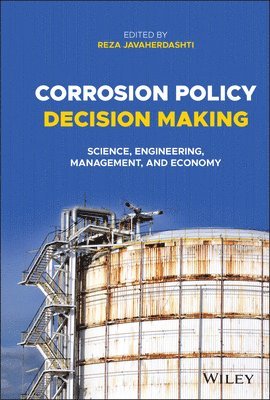
    Corrosion Policy Decision Making

    Science, Engineering, Management, and Economy

    AvReza Javaherdashti,Reza Javaherdashti

    Inbunden, Engelska, 2022

    1 971 kr

    Beställningsvara. Skickas inom 5-8 vardagar. Fri frakt över 249 kr.

    Beskrivning

    CORROSION POLICY DECISION MAKING Explore the science, management, economy, ecology, and engineering of corrosion management and prevention In Corrosion Policy Decision Making, distinguished consultant and corrosion expert Dr. Reza Javaherdashti delivers an insightful overview of the fundamental principles of corrosion with a strong focus on the applicability of corrosion theory to industrial practice. The authors demonstrate various aspects of smart corrosion management and persuasively make the case that there is a real difference between corrosion management and corrosion knowledge management. The book contains seven chapters that each focuses on one important aspect of corrosion and corrosion management. Corrosion management is an issue that is not just corrosion science or corrosion engineering but rather a combination of both elements. To cover this paradoxical aspect of corrosion management, chapter 2 deals with some basic, introductory concepts and principles of corrosion and coating/painting (an important corrosion protection method) while chapter 3 explains the elements of smart corrosion management in detail. Another important principle of smart corrosion management is to be able to study the cost of corrosion, chapter 4 introduces important points in the economics involved in a smart corrosion management. As indicated earlier, corrosion engineering is also an integral part of corrosion management and thus chapter 5 looks at the engineering side of corrosion by detailing the example of Process Additives (EMPA). Chapter 6 for the first time looks at the possibility of using TRIZ (algorithm of invention) in corrosion management. Finally, chapter 7 presents the necessary elements for building a model that would explore the mutual interaction between corrosion and environment mainly by exploring the difference between environmental impact and environmental effect. Chapter 7 is also very important because the four models so far applied to estimate the cost of corrosion (Uhlig Method, Hoar Method, I/O method and LCC method) are not capable of suggesting any clear model or a sensible way of exploring the elements necessary to explain the impact of indirect costs of corrosion the most important of which being environmental damages imposed by corrosion. This book is ideal for engineers, students, and managers working or studying corrosion, Corrosion Policy Decision Making is also an indispensable resource for professionals in the fields of upstream and downstream, on-shore/off-shore oil and gas, transportation, mining, power generation as well as major sectors of other strategic industries.

    Produktinformation

    • Utgivningsdatum:2022-01-14
    • Mått:10 x 10 x 10 mm
    • Vikt:454 g
    • Format:Inbunden
    • Språk:Engelska
    • Antal sidor:400
    • Förlag:John Wiley & Sons Inc
    • ISBN:9781119764311

    Utforska kategorier

    • Maskinteknik och material inom Naturvetenskap och teknik

    Mer om författaren

    Reza Javaherdashti, PhD, is a consultant in the field of corrosion assessment and management. He has extensive experience teaching corrosion, corrosion management, and microbial corrosion to industry professionals around the world, and is the author of six books on the subject.

    Innehållsförteckning

    • Preface xiiiAuthors and Contributors xv1 Introduction 1Reza JavaherdashtiReferences 52 A Short Review of Some Important Aspects of the Science of Corrosion 7Reza Javaherdashti and Ali Ghanbarzadeh2.1 Introduction 72.1.1 Essentials of Electrochemical Corrosion 92.1.2 Prediction of Corrosion 122.1.2.1 Standard Hydrogen Electrode/Electrochemical Series 122.1.2.2 Galvanic Series 132.1.2.3 Pourbaix Diagrams 152.2 Important Technical Treatment Strategies for Corrosion Treatment 162.2.1 Design Modification-change/Materials Selection 172.2.2 Chemical Treatment 212.2.3 Electrical Treatment 222.2.4 Mechanical Treatment 232.2.5 Physical Treatment 232.2.5.1 Paints, Coating Systems, and Premature Destruction in Industrial Facilities 232.2.5.2 Features of Substrate 242.2.5.3 Characteristics of the Environment and Local Features 262.2.5.4 Paints Quality Control 342.2.5.5 Paint Warehousing and Storage 352.2.5.6 Role of Executors and Contractors 362.2.5.7 Surface Preparation 362.2.5.8 Technical Painting Operations 392.2.5.9 Inspection and Management 412.3 Conclusion 43References 443 Smart Corrosion Management Elements 47Reza Javaherdashti and Faranak Javaherdashti3.1 Introduction 473.1.1 Risk, Importance, and How They Are Interrelated? 483.1.2 Corrosion Management: What It Is and What It Is Not 563.1.3 Management of Corrosion 583.1.3.1 Corrosion Reactions Geometry 593.1.3.2 Failure 603.1.3.3 Corrosion Prevention and Corrosion Control 673.1.3.4 cm Model 693.1.4 Phase 1: Definition 703.1.5 Phase 2: Application 733.1.6 Phase 3: Monitoring 743.1.7 Phase 4: Feedback 753.1.7.1 Corrosion Cost Estimation Model 763.1.7.2 Corrosion Knowledge Management (CKM) 793.2 Management of Corrosion and COVID 19 903.3 Environment 933.4 Application of Management of Corrosion Scheme to Underground Fire Water Ring 963.5 Damage Management 993.6 Algorithm 1003.7 Final Remarks 104References 1074 Economics and Corrosion 111Mahsa Mostashar-Nezami4.1 Introduction 1114.2 Economics 1124.2.1 What Is Economics 1124.2.2 Gross Domestic Product 1144.2.2.1 The Expenditure Approach 1154.2.2.2 The Income Approach 1174.2.2.3 The Value-Added Approach 1174.2.2.4 Income, Consumption, Saving, and Investment 1174.2.2.5 Gross National Product 1234.2.3 Introduction to National Account 1234.2.3.1 Production Account, the Intermediate Consumption, and the Consumption of Fixed Capital 1244.2.4 Net Present Value (NPV) and Net Future Value (NFV) 1284.2.5 Input–Output Model in Economics 1294.2.5.1 Technical Coefficients 1304.2.5.2 Price and the Input–output Table 1354.2.5.3 Dynamic Input–output Analysis 1374.2.6 Depreciation, Consumption of Fixed Capital, or Corrosion 1374.3 Corrosion Economics 1384.3.1 Input–output Model in Corrosion 1384.3.1.1 Matrix of Technical Coefficients 1394.3.1.2 Matrix of Capital Coefficients 1404.3.1.3 Input–output Model 1424.3.1.4 Final Demand 1434.3.1.5 World I, World Ii, World III 1444.3.1.6 Estimating Corrosion Cost by Battelle 1444.3.2 Life Cycle Cost (LCC) 1494.3.2.1 Life-Cycle Cost Model 1494.4 Corrosion and Sustainability 1524.5 Conclusion 1544.6 Summary 155References 1555 Effective Management of Process Additives (EMPA) 159Mohamedreza Hamedghafarian5.1 Introduction 1595.2 A Gas Plant 1605.3 Utilities 1615.4 Process Additives (Chemicals) 1655.5 Effective Management of Process Additives (EMPA) 1755.5.1 Production Costs 1755.5.2 Quality Control 1755.5.3 Corrosion 1765.5.4 Energy 1775.5.5 Environment 1785.5.6 Process Issues 1805.5.6.1 Production Reduction 1805.5.6.2 Off-spec Products 1815.5.6.3 Operation History 1 2025.5.6.4 Operation History 2 2035.5.6.5 Operation History 3 2145.5.6.6 Operation History 4 2145.6 Misleading Trends with Corrosion Conclusions 2155.6.1 Phosphate Solution Preparation (Boiler Internal Treatment) 2155.6.2 Putting A Kettle-type Reboiler into Service that Has Been Under Maintenance 2195.6.3 Problems in Sampling from Deaerator and Oxygen Scavenger Analyzation 2205.6.4 Problems in Sampling and Analyzing Specific Conductivity from Demineralized Water 2225.6.5 An Improper Sample Point and Mistake in Determining Free Residual Chlorine 2235.7 Chemicals, Their Corrosion, and Impacts of Their Corrosions on the Environment 2255.7.1 Operation History 5 2265.8 Configuring EMPA 2265.9 Setting up an EMPA 2295.9.1 Description of Activities 2305.9.1.1 Selection 2305.9.1.2 Operation History 6 2305.9.1.3 Operation History 7 2325.9.1.4 Operation History 8 2335.9.1.5 Operation History 9 2345.9.1.6 Procurement 2365.9.1.7 Operation History 10 2365.9.1.8 Operation History 11 2375.9.1.9 Delivery 2375.9.1.10 Operation History 12 2385.9.1.11 Operation History 13 2395.9.2 Storage 2405.9.2.1 Operation History 14 2415.9.2.2 Operation History 15 2425.9.2.3 Operation History 16 2425.9.2.4 Operation History 17 2435.9.2.5 Operation History 18 2445.10 Consumption 2455.10.1 Operation History 19 2465.10.2 Operation History 20 2465.10.3 Operation History 21 2475.10.4 Operation History 22 2485.10.5 Operation History 23 2495.10.6 Operation History 24 2495.10.7 Operation History 25 2565.10.8 Operation History 26 2575.10.9 Operation History 27 2575.10.10 Operation History 28 2595.11 Reporting 2595.12 Documentation 2605.13 Summary 263Abbreviations 263References 2656 Application of TRIZ for Corrosion Management 269Reza Javaherdashti and Mehdi Basirzadeh6.1 Introduction 2696.2 Basic Structure of TRIZ 2716.2.1 The Essence of TRIZ in 50 Words 2736.3 Level of Invention 2746.4 History of TRIZ 2756.5 About the Founder of TRIZ 2766.5.1 Genrich Saulovich Altshuller 2766.6 Contradiction as a Means to Formulate an Inventive Problem 2786.7 Procedure of Inventive Design 2806.8 Concept Development Using TRIZ 2816.9 Contradiction Matrix (39 × 39) 2836.9.1 List of the 39 Features 2846.9.2 List of the 40 Principles 2856.10 Using the TRIZ Matrix 2866.10.1 TRIZ Problem Solving Methodology 2866.10.2 Reality of the “Four-Box Scheme” Theory 2886.11 Physical Contradiction Resolution 2896.12 Ideality and the Ideal Final Result (IFR) 2946.13 TRIZ Crossover QMS 2996.14 The Evolutionary S-Curve 2996.15 Nine Windows 3016.16 Trends of Engineering System Evolution 3026.17 Geometric Evolution of Linear Constructions 3056.18 Trimming 3066.18.1 Making Things Better and Less Expensive 3066.19 Input–Output–Trimming Operator (I–O–T) 3086.20 Resource Analysis 3106.21 Function Analysis 3116.22 Substance-Field Analysis 3126.23 Tool-Object-Product (TOP) Function Analysis 3126.24 Generic Model of a Function 3146.24.1 Precise Description of a Function 3156.24.2 Link between Functions 3156.24.3 Increasing Effectiveness of Function Analysis 3156.25 TRIZ Offers Five Basic Function Models 3156.26 Psychological Inertia 3156.27 Size-Time–Cost Operator 3176.28 Applying the 40 Inventive Principles in Corrosion Management 3186.29 Conclusion 3346.30 Glossary of TRIZ Terms 3346.a TRIZ Contradiction Table 339References 3457 Environmental Impacts of Corrosion and Assessment Strategies 349Reza Javaherdashti7.1 Introduction 3497.1.1 Characterization of the Disaster 3507.1.2 Why Environment? 3527.1.3 Corrosion Impact and Corrosion Effect 3557.1.4 Modeling Environmental Impacts 3567.1.4.1 Necessary Elements for Construction of Corrosion Impact Modeling 3587.2 Some Uses of Rule 365 3637.2.1 Application of Rule 365 to Assess Corrosion Effects 3647.3 Conclusions 365References 365Index 369