• Fri frakt över 249 kr
  • •
  • Snabba leveranser
  • •
  • Billiga böcker
Kundservice

Du är på sajten för privatpersoner.

Företag, bibliotek eller offentlig verksamhet?

Du handlar på classic.bokus.com, där alla dina funktioner finns intakta.
Till classic.bokus.com
Bokus logotyp. Gå till startsidan.
  • Erbjudanden
  • Student
  • Topplistor
  • Barn & ungdom
  • Bokus Play
  • E-böcker
  • Ljudböcker
  • Pocketböcker
  • Spel och pussel

Skapa nya rutiner – hälsoböcker upp till 50% →

Sidfot

Mina sidor

    Hjälp

    • Kundservice
    • Vanliga frågor och svar
    • Frakt och leverans
    • Retur vid ångerrätt
    • Reklamera vara
    • Betalning
    • Köpvillkor
    • Allmänna villkor
    • Information om webbplatsens tillgänglighet

    Om Bokus

    • Om oss
    • Pressrum
    • För studenter
    • För företag
    • För bibliotek och offentlig verksamhet
    • För leverantörer
    • Hållbarhet

    Populärt

    • Aktuella erbjudanden
    • Presentkort
    • Studentlitteratur
    • Nya böcker
    • Topplistor
    • Signerade böcker
    • Engelska böcker

    Inspiration

    • Boktips
    • BookTok
    • Barnbokskaraktärer
    • Populära författare
    Logotyp för Bokus
    Följ oss på Facebook (extern länk)Följ oss på Instagram (extern länk)Följ oss på YouTube (extern länk)Följ oss på TikTok (extern länk)
    bokus @ CookiesAnpassa cookiesIntegritetspolicyKöpvillkor
    Till Citymail hemsida (extern länk)Till Budbee hemsida (extern länk)Till Postnord hemsida (extern länk)Till Schenker hemsida (extern länk)Till Early Bird hemsida (extern länk)Till Walleys hemsida (extern länk)
    1. Naturvetenskap och teknik
    2. Teknik och industri
    3. Elektronik och kommunikationer

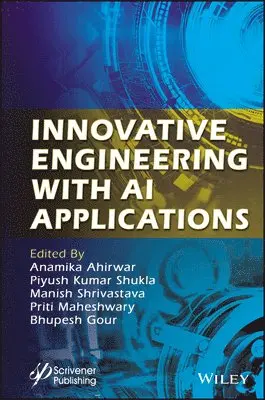
    Innovative Engineering with AI Applications

    AvAnamika Ahirwar,Piyush Kumar Shukla

    Inbunden, Engelska, 2023

    2 585 kr

    Beställningsvara. Skickas inom 5-8 vardagar. Fri frakt över 249 kr.

    Beskrivning

    Innovative Engineering with AI Applications Innovative Engineering with AI Applications demonstrates how we can innovate in different engineering domains as well as how to make most business problems simpler by applying AI to them. Engineering advancements combined with artificial intelligence (AI), have resulted in a hyper-connected society in which smart devices are not only used to exchange data but also have increased capabilities. These devices are becoming more context-aware and smarter by the day. This timely book shows how organizations, who want to innovate and adapt, can enter new markets using expertise in various emerging technologies (e.g. data, AI, system architecture, blockchain), and can build technology-based business models, a culture of innovation, and high-performing networks. The book specifies an approach that anyone can use to better architect, design, and more effectively build things that are technically novel, useful, and valuable, and to do so efficiently, on-time, and repeatable. Audience The book is essential to AI product developers, business leaders in all industries and organizational domains. Researchers, academicians, and students in the AI field will also benefit from reading this book.

    Produktinformation

    • Utgivningsdatum:2023-07-14
    • Vikt:662 g
    • Format:Inbunden
    • Språk:Engelska
    • Antal sidor:288
    • Förlag:John Wiley & Sons Inc
    • ISBN:9781119791638

    Utforska kategorier

    • Elektronik och kommunikationer inom Naturvetenskap och teknik
    • Artificiell intelligens inom Data och IT

    Mer om författaren

    Anamika Ahirwar, PhD, is an associate professor at the Compucom Institute of Information Technology & Management, Jaipur, India. She has about 20 years of experience in teaching and research and has published more than 45 research papers in reputed national/international journals and conferences, authored several books as well as five patents. Piyush Kumar Shukla, PhD, is an associate professor in the Department of Computer Science & Engineering, University Institute of Technology, Bhopal, India. He has about 15 years of experience in teaching and research, is the author of 3 books, more than 50 articles and book chapters in international publications, as well as 15 Indian patents. Manish Shrivastava, PhD, is the Principal of the Chameli Devi Institute of Technology & Management, Indore, India. He has published more than 100 articles in international journals and spent 7 years as a software engineer. Priti Maheshwary, PhD, is a professor in the Department of CSE and Head of the Centre for Excellence in Internet of Things and Advance Computing Lab, Rabindranath Tagore University, Bhopal, India. Bhupesh Gour, PhD, is a professor in the Department of Computer Science and Engineering at Lakshmi Narain College of Technology in Bhopal, India. He has 22 years of experience in academia as well as the software industry. He has published more than 50 articles in national and international journals, as well as four patents.

    Innehållsförteckning

    • Preface xiii1 Introduction of AI in Innovative Engineering 1Anamika Ahirwar1.1 Introduction to Innovation Engineering 21.2 Flow for Innovation Engineering 31.3 Guiding Principles for Innovation Engineering 41.4 Introduction to Artificial Intelligence 71.4.1 History of Artificial Intelligence 81.4.2 Need for Artificial Intelligence 81.4.3 Applications of AI 81.4.4 Comprised Elements of Intelligence 121.4.5 AI Tools 141.4.6 AI Future in 2035 151.4.7 Humanoid Robot and AI 151.4.8 The Explosive Growth of AI 151.5 Types of Learning 161.6 Categories of AI 171.7 Branches of Artificial Intelligence 181.8 Conclusion 21Bibliography 222 An Analytical Review of Deep Learning Algorithms for Stress Prediction in Teaching Professionals 23Ruby Bhatt2.1 Introduction 242.2 Literature Review 262.3 Dataset and Pre-Processing 272.4 Machine Learning Techniques Used 282.5 Performance Parameter 302.6 Proposed Methodology 312.7 Result and Experiment 342.8 Comparison of Six Different Approaches For Stress Detection 372.9 Conclusions 382.10 Future Scope 38References 383 Deep Learning: Tools and Models 41Brijesh K. Soni and Akhilesh A. Waoo3.1 Introduction 413.1.1 Definition 423.1.2 Elements of Neural Networks 433.1.3 Tool: Keras 443.2 Deep Learning Models 473.2.1 Deep Belief Network [DBN] 483.2.1.1 Fundamental Architecture of DBN 483.2.1.2 Implementing DBN Using MNIST Dataset 493.2.2 Recurrent Neural Network [RNN] 503.2.2.1 Fundamental Architecture of RNN 503.2.2.2 Implementing RNN Using MNIST Dataset 513.2.3 Convolutional Neural Network [CNN] 523.2.3.1 Fundamental Architecture of CNN 523.2.3.2 Implementing CNN Using MNIST Dataset 533.2.4 Gradient Adversarial Network [GAN] 573.2.4.1 Fundamental Architecture of GAN 573.2.4.2 Implementing GAN Using MNIST Dataset 573.3 Research Perspective of Deep Learning 613.3.1 Multi-Agent System: Argumentation 613.3.2 Image Processor: Phenotyping 613.3.3 Saliency-Map: Visualization 613.4 Conclusion 61References 624 Web Service Composition Using an AI Planning Technique 65Lalit Purohit and Satyendra Singh Chouhan4.1 Introduction 664.2 Background 694.2.1 Introduction to AI 694.2.2 AI Planning 704.2.3 AI Planning for Effective Composition of Web Services 704.3 Proposed Methodology for AI Planning-Based Composition of Web Services 714.3.1 Clustering Web Services 714.3.2 OWL-S: Semantic Markup for Web Services(For Composition Request) 724.3.3 PDDL: Planning Domain Description Language 734.3.4 AI Planner 754.3.5 Flowchart of Proposed Approach 754.4 Implementation Details 764.4.1 Domain Used 764.4.2 Case Studies on AI Planning 774.4.2.1 Experiments and Results on Case 1 and Case 2 784.5 Conclusions and Future Directions 80References 805 Artificial Intelligence in Agricultural Engineering 83Ashwini A. Waoo, Jyoti Pandey and Akhilesh A. Waoo5.1 Introduction 845.2 Artificial Intelligence in Agriculture 865.2.1 AI Startups in Agriculture 885.2.2 Challenges in AI Adoption 895.2.3 Stunning Discoveries of AI 895.2.3.1 Precision Technology to Sow Seeds 895.2.3.2 Robots for Harvesting 895.2.3.3 Field Inspection Using Drones 905.2.3.4 “See and Spray” Model for Pest and Weed Control 905.3 Scope of Artificial Intelligence in Agriculture 915.3.1 Reactive Machines 925.3.2 Limited Memory 925.3.3 Theory of Mind 925.3.4 Self-Awareness 935.4 Applications of Artificial Intelligence in Agriculture 935.4.1 Agricultural Robots 935.4.2 Soil Analysis and Monitoring 945.4.3 Predictive Analysis 945.4.4 Agricultural Industry 945.4.5 Blue River Technology – Weed Control 945.4.6 Crop Harvesting 955.4.7 Plantix App 955.4.8 Drones 955.4.9 Driverless Tractors 955.4.10 Precise Farming 965.4.11 Return on Investment (RoI) 965.5 Advantages of AI in Agriculture 965.6 Disadvantages of AI in Agriculture 975.7 Conclusion 97References 986 The Potential of Artificial Intelligence in the Healthcare System 101Meena Gupta and Ruchika Kalra6.1 Introduction 1026.2 Machine Learning 1036.3 Neural Networks 1056.4 Expert Systems 1066.5 Robots 1076.6 Fuzzy Logic 1086.7 Natural Language Processing 1096.8 Sensor Network Technology in Artificial Intelligence 1106.9 Sensory Devices in Healthcare 1126.9.1 Wearable Devices 1126.9.2 Implantable Devices 1126.10 Neural Interface for Sensors 1136.10.1 Intrusion Devices in Artificial Intelligence 1136.11 Artificial Intelligence in Healthcare 1156.11.1 Role of Artificial Intelligence in Medicine 1156.11.2 Role of Artificial Intelligence in Surgery 1166.11.3 Role of Artificial Intelligence in Rehabilitation 1166.12 Why Artificial Intelligence in Healthcare 1176.13 Advancements of Artificial Intelligence in Healthcare 1176.14 Future Challenges 1186.15 Discussion 1186.16 Conclusion 119References 1197 Improvement of Computer Vision-Based Elephant Intrusion Detection System (EIDS) with Deep Learning Models 131Jothibasu M., Sowmiya M., Harsha R., Naveen K. S. and Suriyaprakash T. B.7.1 Introduction 1327.2 Elephant Intrusion Detection System (EIDS) 1337.2.1 Existing Approaches 1337.2.2 Challenges 1347.3 Theoretical Framework 1347.3.1 Deep Learning Models for EIDS 1347.3.1.1 Fast RCNN 1357.3.1.2 Faster RCNN 1357.3.1.3 Single-Shot Multibox Detector (SSD) 1377.3.1.4 You Only Look Once (YOLO) 1397.3.2 Hardware Specifications 1417.3.2.1 Raspberry-Pi 3 Model B 1417.3.2.2 Night Vision OV5647 Camera Module 1417.3.2.3 PIR Sensor 1427.3.2.4 GSM Module 1427.3.3 Proposed Work 1427.4 Experimental Results 1447.4.1 Dataset Preparation 1447.4.2 Performance Analysis of DL Algorithms 1467.5 Conclusion 152References 1528 A Study of WSN Privacy Through AI Technique 155Piyush Raja8.1 Introduction 1568.2 Review of Literature 1598.3 ml in WSNs 1608.3.1 Supervised Learning 1618.3.2 Unsupervised Learning 1648.3.3 Reinforcement Learning 1668.4 Conclusion 169References 1699 Introduction to AI Technique and Analysis of Time Series Data Using Facebook Prophet Model 171S. Sivaramakrishnan, C.R. Rathish, S. Premalatha and Niranjana C.9.1 Introduction 1729.2 What is AI? 1729.2.1 Process of Thoughts – Human Approach 1739.3 Main Frameworks of Artificial Intelligence 1749.3.1 Feature Engineering 1749.3.2 Artificial Neural Networks 1759.3.3 Deep Learning 1759.4 Techniques of AI 1779.4.1 Machine Learning 1779.4.1.1 Supervised Learning 1799.4.1.2 Unsupervised Learning 1799.4.1.3 Reinforcement Learning 1799.4.2 Natural Language Processing (NLP) 1809.4.3 Automation and Robotics 1819.4.4 Machine Vision 1819.5 Application of AI in Various Fields 1829.6 Time Series Analysis Using Facebook Prophet Model 1839.7 Feature Scope of AI 1869.8 Conclusion 186References 18710 A Comparative Intelligent Environmental Analysis of Air-Pollution in COVID: Application of IoT and AI Using ML in a Study Conducted at the North Indian Zone 189Rohit Rastogi, Abhishek Goyal, Akshit Rajan Rastogi and Neha Gupta10.1 Introduction 19010.1.1 Intelligent Environment Systems 19010.1.2 Types of Pollution 19010.1.3 Components in Pollution Particles 19110.1.4 Research Problem Introduction and Motivation 19110.2 Related Previous Work 19110.2.1 Machine Learning Models 19210.2.2 Regression Techniques Applications 19210.3 Methodology Adopted in Research 19310.3.1 Data Source 19310.3.2 Data Pre-Processing 19510.3.3 Calculating AQI 19510.3.4 Computing AQI 19510.3.5 Data Pre-Processing 19610.3.6 Feature Selection 19810.4 Results and Discussion 19910.4.1 Collective Analysis 19910.4.2 Applying Various Repressors 20010.4.3 Comparison with Existing State-of-the-Art Technologies 20110.5 Novelties in the Work 20210.6 Future Research Directions 20310.7 Limitations 20310.8 Conclusions 203Acknowledgements 204Key Terms and Definitions 204Additional Readings 205References 20611 Eye-Based Cursor Control and Eye Coding Using Hog Algorithm and Neural Network 209S. Sivaramakrishnan, Vasuprada G., V. R. Harika, Vishnupriya P. and Supriya Castelino11.1 Introduction 21011.2 Related Work 21011.3 Methodology 21211.3.1 Eye Blink Detection 21311.3.2 Hog Algorithm 21411.3.3 Eye Gaze Detection 21511.3.3.1 Deep Learning and CNN 21511.3.3.2 Hog Algorithm for Gaze Determination 21611.3.4 GUI Automation 21611.4 Experimental Analysis 21711.4.1 Eye-Based Cursor Control 21711.4.2 Eye Coding 21711.5 Observation and Results 22011.6 Conclusion 22311.7 Future Scope 224References 22412 Role of Artificial Intelligence in the Agricultural System 227Nilesh Kunhare, Rajeev Kumar Gupta and Yatendra Sahu12.1 Introduction 22812.2 Artificial Intelligence Effect on Farming 22912.2.1 Agriculture Lifecycle 22912.2.2 Problems with Traditional Methods of Farming 23012.3 Applications of Artificial Intelligence in Agriculture 23112.3.1 Forecasting Weather Details 23112.3.2 Crop and Soil Quality Surveillance 23112.3.3 Pesticide Use Reduction 23312.3.4 AI Farming Bots 23312.3.5 AI-Based Monitoring Systems 23312.3.6 AI-Based Irrigation System 23412.4 Robots in Agriculture 23512.5 Drones for Agriculture 23612.6 Advantage of AI Implementation in Farming 23712.6.1 Intelligent Agriculture Cloud Platform 23812.6.1.1 Remote Control and Administration in Real Time 23812.6.1.2 Consultation of Remote Experts 23812.7 Research, Challenges, and Scope for the Future 23912.8 Conclusion 240References 24013 Improving Wireless Sensor Networks Effectiveness with Artificial Intelligence 243Piyush Raja, Santosh Kumar, Digvijay Singh and Taresh Singh13.1 Introduction 24413.2 Wireless Sensor Network (WSNs) 24513.3 AI and Multi-Agent Systems 24613.4 WSN and AI 24713.5 Multi-Agent Constructed Simulation 24813.6 Multi-Agent Model Plan 24913.7 Simulation Models on Behalf of Wireless Sensor Network 25013.8 Model Plan 25113.8.1 Hardware Layer 25113.8.2 Middle Layer 25213.8.3 Application Layer 25313.9 Conclusion 253References 254Index 257
    Hoppa över listan

    Du kanske också är intresserad av

    Ruby Bhatt, Prashant Kumar Shukla, Piyush Kumar Shukla, Anamika Ahirwar - Intelligent Sensor Node-Based Systems, E-bok

    Intelligent Sensor Node-Based Systems

    Ruby Bhatt, Prashant Kumar Shukla, Piyush Kumar Shukla, Anamika Ahirwar

    E-bok
    2023

    2 400 kr

    Anamika Ahirwar, Piyush Kumar Shukla, Prashant Kumar Shukla, Ruby Bhatt - Intelligent Sensor Node-Based Systems, Inbunden

    Intelligent Sensor Node-Based Systems

    Anamika Ahirwar, Piyush Kumar Shukla, Prashant Kumar Shukla, Ruby Bhatt

    Inbunden, 2023

    2 009 kr

    Ruby Bhatt, Prashant Kumar Shukla, Piyush Kumar Shukla, Anamika Ahirwar - Intelligent Sensor Node-Based Systems, E-bok

    Intelligent Sensor Node-Based Systems

    Ruby Bhatt, Prashant Kumar Shukla, Piyush Kumar Shukla, Anamika Ahirwar

    E-bok
    2023

    2 400 kr

    Bhupesh Gour, Priti Maheshwary, Manish Shrivastava, Piyush Kumar Shukla, Anamika Ahirwar - Innovative Engineering with AI Applications, E-bok

    Innovative Engineering with AI Applications

    Bhupesh Gour, Priti Maheshwary, Manish Shrivastava, Piyush Kumar Shukla, Anamika Ahirwar

    E-bok
    2023

    3 201 kr

    Bhupesh Gour, Priti Maheshwary, Manish Shrivastava, Piyush Kumar Shukla, Anamika Ahirwar - Innovative Engineering with AI Applications, E-bok

    Innovative Engineering with AI Applications

    Bhupesh Gour, Priti Maheshwary, Manish Shrivastava, Piyush Kumar Shukla, Anamika Ahirwar

    E-bok
    2023

    3 209 kr

    Abhisar Shrivastava, Manish Shrivastava, Jitendra Sheetlani - Proficiência em Python, Häftad

    Proficiência em Python

    Abhisar Shrivastava, Manish Shrivastava, Jitendra Sheetlani

    Häftad, 2025

    1 313 kr

    Abhisar Shrivastava, Manish Shrivastava, Jitendra Sheetlani - Conoscenza di Python, Häftad

    Conoscenza di Python

    Abhisar Shrivastava, Manish Shrivastava, Jitendra Sheetlani

    Häftad, 2025

    1 313 kr

    Abhisar Shrivastava, Manish Shrivastava, Jitendra Sheetlani - Python Proficiency, Häftad

    Python Proficiency

    Abhisar Shrivastava, Manish Shrivastava, Jitendra Sheetlani

    Häftad, 2024

    1 281 kr

    Abhisar Shrivastava, Manish Shrivastava, Jitendra Sheetlani - Maîtrise de Python, Häftad

    Maîtrise de Python

    Abhisar Shrivastava, Manish Shrivastava, Jitendra Sheetlani

    Häftad, 2025

    1 313 kr

    Abhisar Shrivastava, Manish Shrivastava, Jitendra Sheetlani - Bieglośc w Pythonie, Häftad

    Bieglośc w Pythonie

    Abhisar Shrivastava, Manish Shrivastava, Jitendra Sheetlani

    Häftad, 2025

    1 313 kr