• Fri frakt över 249 kr
  • •
  • Snabba leveranser
  • •
  • Billiga böcker
Kundservice

Du är på sajten för privatpersoner.

Företag, bibliotek eller offentlig verksamhet?

Du handlar på classic.bokus.com, där alla dina funktioner finns intakta.
Till classic.bokus.com
Bokus logotyp. Gå till startsidan.
  • Erbjudanden
  • Nyheter
  • Student
  • Topplistor
  • Barn & ungdom
  • Bokus Play
  • E-böcker
  • Pocketböcker
  • Spel & pussel

10% rabatt på allt med kod: NYSTART10 →

Sidfot

Mina sidor

    Hjälp

    • Kundservice
    • Vanliga frågor och svar
    • Frakt och leverans
    • Retur vid ångerrätt
    • Reklamera vara
    • Betalning
    • Köpvillkor
    • Allmänna villkor
    • Information om webbplatsens tillgänglighet

    Om Bokus

    • Om oss
    • Pressrum
    • För studenter
    • För företag
    • För bibliotek och offentlig verksamhet
    • För leverantörer
    • Hållbarhet

    Populärt

    • Aktuella erbjudanden
    • Presentkort
    • Studentlitteratur
    • Nya böcker
    • Topplistor
    • Signerade böcker
    • Engelska böcker

    Inspiration

    • Boktips
    • BookTok
    • Populära bokserier
    • Barnbokskaraktärer
    • Populära författare
    Logotyp för Bokus
    Följ oss på Facebook (extern länk)Följ oss på Instagram (extern länk)Följ oss på YouTube (extern länk)Följ oss på TikTok (extern länk)
    bokus @ CookiesAnpassa cookiesIntegritetspolicyKöpvillkor
    Till Citymail hemsida (extern länk)Till Budbee hemsida (extern länk)Till Postnord hemsida (extern länk)Till Schenker hemsida (extern länk)Till Early Bird hemsida (extern länk)Till Walleys hemsida (extern länk)
    1. Naturvetenskap och teknik
    2. Teknik och industri
    3. Elektronik och kommunikationer

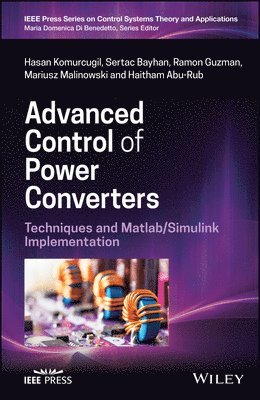
    Advanced Control of Power Converters

    Techniques and Matlab/Simulink Implementation

    AvHasan Komurcugil,Sertac Bayhan

    Inbunden, Engelska, 2023

    Del i serien IEEE Press Series on Control Systems Theory and Applications

    1 408 kr

    Beställningsvara. Skickas inom 5-8 vardagar. Fri frakt över 249 kr.

    Beskrivning

    Advanced Control of Power Converters Unique resource presenting advanced nonlinear control methods for power converters, plus simulation, controller design, analyses, and case studies Advanced Control of Power Converters equips readers with the latest knowledge of three control methods developed for power converters: nonlinear control methods such as sliding mode control, Lyapunov-function-based control, and model predictive control. Readers will learn about the design of each control method, and simulation case studies and results will be presented and discussed to point out the behavior of each control method in different applications. In this way, readers wishing to learn these control methods can gain insight on how to design and simulate each control method easily. The book is organized into three clear sections: introduction of classical and advanced control methods, design of advanced control methods, and case studies. Each control method is supported by simulation examples along with Simulink models which are provided on a separate website. Contributed to by five highly qualified authors, Advanced Control of Power Converters covers sample topics such as: Mathematical modeling of single- and three-phase grid-connected inverter with LCL filter, three-phase dynamic voltage restorer, design of sliding mode control and switching frequency computation under single- and double-band hysteresis modulationsModeling of single-phase UPS inverter and three-phase rectifier and their Lyapunov-function-based control design for global stability assuranceDesign of model predictive control for single-phase T-type rectifier, three-phase shunt active power filter, three-phase quasi-Z-source inverter, three-phase rectifier, distributed generation inverters in islanded ac microgridsHow to realize the Simulink models in sliding mode control, Lyapunov-function-based control and model predictive controlHow to build and run a real-time model as well as rapid prototyping of power converter by using OPAL-RT simulatorAdvanced Control of Power Converters is an ideal resource on the subject for researchers, engineering professionals, and undergraduate/graduate students in electrical engineering and mechatronics; as an advanced level book, and it is expected that readers will have prior knowledge of power converters and control systems.

    Produktinformation

    • Utgivningsdatum:2023-07-05
    • Mått:238 x 160 x 31 mm
    • Vikt:974 g
    • Format:Inbunden
    • Språk:Engelska
    • Serie:IEEE Press Series on Control Systems Theory and Applications
    • Antal sidor:464
    • Förlag:John Wiley & Sons Inc
    • ISBN:9781119854401

    Utforska kategorier

    • Elektronik och kommunikationer inom Naturvetenskap och teknik
    • Energiteknik inom Naturvetenskap och teknik
    • Referensverk och tvärvetenskap inom Samhälle och politik

    Mer om författaren

    Hasan Komurcugil is Professor at the Eastern Mediterranean University, Turkey. His research interests include nonlinear control methods of power converters such as sliding mode control, Lyapunov-function-based control, and model predictive control. Sertac Bayhan is Senior Scientist and Associate Professor at Hamad Bin Khalifa University, Qatar. His research interests include power electronics and its applications in renewable energy, electric vehicle supply equipment, microgrids, and smart grid. Ramon Guzman is Associate Professor at the Technical University of Catalonia, Spain. His research interests include sliding mode control and model predictive control of three phase power converters. Mariusz Malinowski is Professor at the Warsaw University of Technology, Poland. His current research interests include the control and modulation of grid-side converters, multilevel converters, smart grids, and power-generation systems based on renewable energies. Haitham Abu-Rub is Professor at Texas A&M University at Qatar, and is the Managing Director of the Smart Grid Center at the same university. His research interests include energy conversion systems, including electric drives, power electronic converters, renewable energy, and smart grid.

    Innehållsförteckning

    • About the Authors xiiiList of Abbreviations xviiPreface xixAcknowledgment xxiAbout the Companion Website xxiii1 Introduction 11.1 General Remarks 11.2 Basic Closed-Loop Control for Power Converters 31.3 Mathematical Modeling of Power Converters 41.4 Basic Control Objectives 61.4.1 Closed-Loop Stability 61.4.2 Settling Time 101.4.3 Steady-State Error 111.4.4 Robustness to Parameter Variations and Disturbances 121.5 Performance Evaluation 121.5.1 Simulation-Based Method 121.5.2 Experimental Method 131.6 Contents of the Book 13References 152 Introduction to Advanced Control Methods 172.1 Classical Control Methods for Power Converters 172.2 Sliding Mode Control 182.3 Lyapunov Function-Based Control 222.3.1 Lyapunov’s Linearization Method 232.3.2 Lyapunov’s Direct Method 242.4 Model Predictive Control 272.4.1 Functional Principle 272.4.2 Basic Concept 282.4.3 Cost Function 29References 303 Design of Sliding Mode Control for Power Converters 333.1 Introduction 333.2 Sliding Mode Control of DC–DC Buck and Cuk Converters 333.3 Sliding Mode Control Design Procedure 443.3.1 Selection of Sliding Surface Function 443.3.2 Control Input Design 463.4 Chattering Mitigation Techniques 483.4.1 Hysteresis Function Technique 483.4.2 Boundary Layer Technique 493.4.3 State Observer Technique 503.5 Modulation Techniques 513.5.1 Hysteresis Modulation Technique 513.5.2 Sinusoidal Pulse Width Modulation Technique 523.5.3 Space Vector Modulation Technique 533.6 Other Types of Sliding Mode Control 543.6.1 Terminal Sliding Mode Control 543.6.2 Second-Order Sliding Mode Control 54References 554 Design of Lyapunov Function-Based Control for Power Converters 594.1 Introduction 594.2 Lyapunov-Function-Based Control Design Using Direct Method 594.3 Lyapunov Function-Based Control of DC–DC Buck Converter 624.4 Lyapunov Function-Based Control of DC–DC Boost Converter 67References 715 Design of Model Predictive Control 735.1 Introduction 735.2 Predictive Control Methods 735.3 FCS Model Predictive Control 755.3.1 Design Procedure 765.3.2 Tutorial 1: Implementation of FCS-MPC for Three-Phase VSI 805.4 CCS Model Predictive Control 865.4.1 Incremental Models 865.4.2 Predictive Model 885.4.3 Cost Function in CCSMPC 925.4.4 Cost Function Minimization 935.4.5 Receding Control Horizon Principle 965.4.6 Closed-Loop of an MPC System 975.4.7 Discrete Linear Quadratic Regulators 975.4.8 Formulation of the Constraints in MPC 995.4.9 Optimization with Equality Constraints 1035.4.10 Optimization with Inequality Constraints 1055.4.11 MPC for Multi-Input Multi-Output Systems 1085.4.12 Tutorial 2: MPC Design For a Grid-Connected VSI in dq Frame 1095.5 Design and Implementation Issues 1125.5.1 Cost Function Selection 1125.5.1.1 Examples for Primary Control Objectives 1135.5.1.2 Examples for Secondary Control Objectives 1145.5.2 Weighting Factor Design 1145.5.2.1 Empirical Selection Method 1155.5.2.2 Equal-Weighted Cost-Function-Based Selection Method 1165.5.2.3 Lookup Table-Based Selection Method 117References 1186 MATLAB/Simulink Tutorial on Physical Modeling and Experimental Setup 1216.1 Introduction 1216.2 Building Simulation Model for Power Converters 1216.2.1 Building Simulation Model for Single-Phase Grid-Connected Inverter Based on Sliding Mode Control 1226.2.2 Building Simulation Model for Three-Phase Rectifier Based on Lyapunov-Function-Based Control 1266.2.3 Building Simulation Model for Quasi-Z Source Three-Phase Four-Leg Inverter Based on Model Predictive Control 1316.2.4 Building Simulation Model for Distributed Generations in Islanded AC Microgrid 1376.3 Building Real-Time Model for a Single-Phase T-Type Rectifier 1426.4 Building Rapid Control Prototyping for a Single-Phase T-Type Rectifier 1546.4.1 Components in the Experimental Testbed 1556.4.1.1 Grid Simulator 1556.4.1.2 A Single-Phase T-Type Rectifier Prototype 1566.4.1.3 Measurement Board 1576.4.1.4 Programmable Load 1586.4.1.5 Controller 1586.4.2 Building Control Structure on OP- 5707 158References 1627 Sliding Mode Control of Various Power Converters 1637.1 Introduction 1637.2 Single-Phase Grid-Connected Inverter with LCL Filter 1637.2.1 Mathematical Modeling of Grid-Connected Inverter with LCL Filter 1647.2.2 Sliding Mode Control 1657.2.3 PWM Signal Generation Using Hysteresis Modulation 1687.2.3.1 Single-Band Hysteresis Function 1687.2.3.2 Double-Band Hysteresis Function 1687.2.4 Switching Frequency Computation 1707.2.4.1 Switching Frequency Computation with Single-Band Hysteresis Modulation 1707.2.4.2 Switching Frequency Computation with Double-Band Hysteresis Modulation 1717.2.5 Selection of Control Gains 1727.2.6 Simulation Study 1747.2.7 Experimental Study 1777.3 Three-Phase Grid-Connected Inverter with LCL Filter 1807.3.1 Physical Model Equations for a Three-Phase Grid-Connected VSI with an LCL Filter 1817.3.2 Control System 1827.3.2.1 Reduced State-Space Model of the Converter 1837.3.2.2 Model Discretization and KF Adaptive Equation 1877.3.2.3 Sliding Surfaces with Active Damping Capability 1887.3.3 Stability Analysis 1897.3.3.1 Discrete-Time Equivalent Control Deduction 1897.3.3.2 Closed-Loop System Equations 1917.3.3.3 Test of Robustness Against Parameters Uncertainties 1927.3.4 Experimental Study 1927.3.4.1 Test of Robustness Against Grid Inductance Variations 1927.3.4.2 Test of Stability in Case of Grid Harmonics Near the Resonance Frequency 1967.3.4.3 Test of the VSI Against Sudden Changes in the Reference Current 1967.3.4.4 Test of the VSI Under Distorted Grid 1987.3.4.5 Test of the VSI Under Voltage Sags 1987.3.5 Computational Load and Performances of the Control Algorithm 1997.4 Three-Phase AC–DC Rectifier 2007.4.1 Nonlinear Model of the Unity Power Factor Rectifier 2007.4.2 Problem Formulation 2027.4.3 Axis-Decoupling Based on an Estimator 2037.4.4 Control System 2057.4.4.1 Kalman Filter 2067.4.4.2 Practical Considerations: Election of Q and R Matrices 2087.4.4.3 Practical Considerations: Computational Burden Reduction 2087.4.5 Sliding Mode Control 2097.4.5.1 Inner Control Loop 2097.4.5.2 Outer Control Loop 2107.4.6 Hysteresis Band Generator with Switching Decision Algorithm 2127.4.7 Experimental Study 2157.5 Three-Phase Transformerless Dynamic Voltage Restorer 2247.5.1 Mathematical Modeling of Transformerless Dynamic Voltage Restorer 2247.5.2 Design of Sliding Mode Control for TDVR 2257.5.3 Time-Varying Switching Frequency with Single-Band Hysteresis 2277.5.4 Constant Switching Frequency with Boundary Layer 2297.5.5 Simulation Study 2317.5.6 Experimental Study 2337.6 Three-Phase Shunt Active Power Filter 2407.6.1 Nonlinear Model of the SAPF 2407.6.2 Problem Formulation 2427.6.3 Control System 2437.6.3.1 State Model of the Converter 2437.6.3.2 Kalman Filter 2457.6.3.3 Sliding Mode Control 2467.6.3.4 Hysteresis Band Generator with SDA 2477.6.4 Experimental Study 2487.6.4.1 Response of the SAPF to Load Variations 2497.6.4.2 SAPF Performances Under a Distorted Grid 2537.6.4.3 SAPF Performances Under Grid Voltage Sags 2547.6.4.4 Spectrum of the Control Signal 254References 2578 Design of Lyapunov Function-Based Control of Various Power Converters 2618.1 Introduction 2618.2 Single-Phase Grid-Connected Inverter with LCL Filter 2618.2.1 Mathematical Modeling and Controller Design 2618.2.2 Controller Modification with Capacitor Voltage Feedback 2648.2.3 Inverter-Side Current Reference Generation Using Proportional- Resonant Controller 2648.2.4 Grid Current Transfer Function 2668.2.5 Harmonic Attenuation and Harmonic Impedance 2678.2.6 Results 2708.3 Single-Phase Quasi-Z-Source Grid-Connected Inverter with LCL Filter 2778.3.1 Quasi-Z-Source Network Modeling 2778.3.2 Grid-Connected Inverter Modeling 2808.3.3 Control of Quasi-Z-Source Network 2818.3.4 Control of Grid-Connected Inverter 2818.3.5 Reference Generation Using Cascaded PR Control 2828.3.6 Results 2838.4 Single-Phase Uninterruptible Power Supply Inverter 2878.4.1 Mathematical Modeling of Uninterruptible Power Supply Inverter 2878.4.2 Controller Design 2888.4.3 Criteria for Selecting Control Parameters 2908.4.4 Results 2928.5 Three-Phase Voltage-Source AC–DC Rectifier 2988.5.1 Mathematical Modeling of Rectifier 2988.5.2 Controller Design 3018.5.3 Results 304References 3079 Model Predictive Control of Various Converters 3099.1 CCS MPC Method for a Three-Phase Grid-Connected VSI 3099.1.1 Model Predictive Control Design 3109.1.1.1 VSI Incremental Model with an Embedded Integrator 3109.1.1.2 Predictive Model of the Converter 3119.1.1.3 Cost Function Minimization 3129.1.1.4 Inclusion of Constraints 3139.1.2 MATLAB ® /Simulink ® Implementation 3159.1.3 Simulation Studies 3229.2 Model Predictive Control Method for Single-Phase Three-Level Shunt Active Filter 3259.2.1 Modeling of Shunt Active Filter (SAPF) 3259.2.2 The Energy-Function-Based MPC 3289.2.2.1 Design of Energy-Function-Based MPC 3289.2.2.2 Discrete-Time Model 3319.2.3 Experimental Studies 3329.2.3.1 Steady-State and Dynamic Response Tests 3339.2.3.2 Comparison with Classical MPC Method 3379.3 Model Predictive Control of Quasi-Z Source Three-Phase Four-Leg Inverter 3419.3.1 qZS Four-Leg Inverter Model 3419.3.2 MPC Algorithm 3459.3.2.1 Determination of References 3459.3.2.2 Discrete-Time Models of the System 3469.3.2.3 Cost Function Optimization 3479.3.2.4 Control Algorithm 3479.3.3 Simulation Results 3499.4 Weighting Factorless Model Predictive Control for DC–DC SEPIC Converters 3529.4.1 Principle of Control Strategy 3529.4.1.1 Conventional Model Predictive Current Control 3559.4.1.2 Cost Function Analysis of Conventional MPC 3569.4.1.3 Cost Function Design of Presented MPC in [11] 3589.4.1.4 Output Voltage Control 3619.4.2 Experimental Results 3629.4.2.1 Switching Frequency Control Test 3629.4.2.2 Dynamic Response Test Under Input Voltage Variation 3639.4.2.3 Dynamic Response Test Under Load Change 3669.4.2.4 Influence of Parameter Mismatch 3679.5 Model Predictive Droop Control of Distributed Generation Inverters in Islanded AC Microgrid 3709.5.1 Conventional Droop Control 3709.5.2 Control Technique 3739.5.2.1 Reference Voltage Generation Through Droop Control 3739.5.2.2 Model Predictive Control 3749.5.3 Simulation Results 3769.6 FCS-MPC for a Three-Phase Shunt Active Power Filter 3789.6.1 System Modeling 3819.6.2 Control Technique 3839.6.3 FCS-MPC with Reduced States 3849.6.3.1 Vector Selection Based on Vector Operation 3849.6.3.2 Cost Function Minimization Procedure 3879.6.3.3 Kalman Filter 3879.6.4 Experimental Results 3899.7 FCS-MPC for a Single-Phase T-Type Rectifier 3959.7.1 Modeling of Single-Phase T-Type Rectifier 3959.7.2 Model Predictive Control 3979.7.2.1 Sensorless Grid Voltage Estimation 3979.7.2.2 Reference Current Generation 4009.7.2.3 MPC for the T-Type Rectifier 4009.7.2.4 MPC for the Power Decoupling Circuit 4029.7.3 Experimental Studies 4049.7.3.1 Steady-State Analysis 4049.7.3.2 Robustness Analysis 4049.8 Predictive Torque Control of Brushless Doubly Fed Induction Generator Fed by a Matrix Converter 4089.8.1 Overview of the System Model 4119.8.1.1 Topology Overview 4119.8.1.2 Mathematical Model of the CDFIG 4129.8.1.3 Mathematical Model of the Matrix Converter 4149.8.2 Predictive Torque Control of CDFIG 4159.8.2.1 Outer Loop 4169.8.2.2 Internal Model of the Controller 4169.8.2.3 Cost Function Minimization 4189.8.3 Simulation Results 4189.9 An Enhanced Finite Control Set Model Predictive Control Method with Self-Balancing Capacitor Voltages for Three-Level T-Type Rectifiers 4209.9.1 Overview of the System Model 4229.9.2 Problem Definition 4249.9.3 Derivation of Lyapunov-Energy Function 4259.9.4 Discrete-Time Model 4289.9.5 Experimental Studies 429References 431Index 435