• Fri frakt över 249 kr
  • •
  • Snabba leveranser
  • •
  • Billiga böcker
Kundservice

Du är på sajten för privatpersoner.

Företag, bibliotek eller offentlig verksamhet?

Du handlar på classic.bokus.com, där alla dina funktioner finns intakta.
Till classic.bokus.com
Bokus logotyp. Gå till startsidan.
  • Erbjudanden
  • Nyheter
  • Student
  • Topplistor
  • Barn & ungdom
  • Bokus Play
  • E-böcker
  • Pocketböcker
  • Spel & pussel

10% rabatt på allt med kod: NYSTART10 →

Sidfot

Mina sidor

    Hjälp

    • Kundservice
    • Vanliga frågor och svar
    • Frakt och leverans
    • Retur vid ångerrätt
    • Reklamera vara
    • Betalning
    • Köpvillkor
    • Allmänna villkor
    • Information om webbplatsens tillgänglighet

    Om Bokus

    • Om oss
    • Pressrum
    • För studenter
    • För företag
    • För bibliotek och offentlig verksamhet
    • För leverantörer
    • Hållbarhet

    Populärt

    • Aktuella erbjudanden
    • Presentkort
    • Studentlitteratur
    • Nya böcker
    • Topplistor
    • Signerade böcker
    • Engelska böcker

    Inspiration

    • Boktips
    • BookTok
    • Populära bokserier
    • Barnbokskaraktärer
    • Populära författare
    Logotyp för Bokus
    Följ oss på Facebook (extern länk)Följ oss på Instagram (extern länk)Följ oss på YouTube (extern länk)Följ oss på TikTok (extern länk)
    bokus @ CookiesAnpassa cookiesIntegritetspolicyKöpvillkor
    Till Citymail hemsida (extern länk)Till Budbee hemsida (extern länk)Till Postnord hemsida (extern länk)Till Schenker hemsida (extern länk)Till Early Bird hemsida (extern länk)Till Walleys hemsida (extern länk)
    1. Historia och arkeologi
    2. Historia
    3. Europas historia

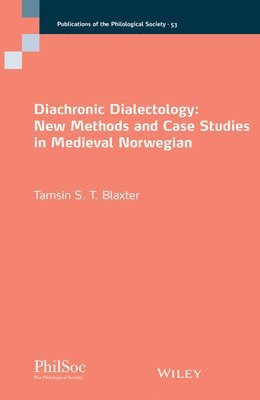
    Diachronic Dialectology

    New Methods and Case Studies in Medieval Norwegian

    AvTamsin S. T. Blaxter

    Häftad, Engelska, 2022

    Del i serien Publications of the Philological Society

    331 kr

    Beställningsvara. Skickas inom 5-8 vardagar. Fri frakt över 249 kr.

    Beskrivning

    This book presents the use of kernelsmoothing, a family of methods adapted from fields such as signal processing, as a way to identify the true spatial distribution of linguistic forms at particular points in time.  Discusses the use of kernel smoothing in historical dialectology and new approaches to parameter settingPresents a series of case studies from the history of Norwegian languageInvestigates some of the major phonological and morphosyntactic shifts which transformed the language from Old Norwegian through Middle to early Modern NorwegianDemonstrates how the kernel smoothing method allows us to see how these changes spread from place to place, and these findings are used to throw light on a number of more general research questions of interest to an audience beyond ScandinavianistsA step-by-step guide to kernel smoothing is offered, so that non-experts can apply the approach to their own data

    Produktinformation

    • Utgivningsdatum:2022-02-04
    • Mått:154 x 230 x 14 mm
    • Vikt:454 g
    • Format:Häftad
    • Språk:Engelska
    • Serie:Publications of the Philological Society
    • Antal sidor:272
    • Förlag:John Wiley and Sons Ltd
    • ISBN:9781119858973

    Utforska kategorier

    • Europas historia inom Historia och arkeologi
    • Språkvetenskap och lingvistik inom Språk och ordböcker

    Mer om författaren

    After a BA in Linguistics at the University of Essex, Tamsin Blaxter did her MPhil in General Linguistics and Comparative Philology at the University of Oxford, with a dissertation that explored gendered language in the medieval Íslendingasögur. For her PhD at the University of Cambridge, she worked on language change and space in medieval Norway. Her work focuses on new methods of gathering and exploring large datasets in variationist linguistics, with a particular interest in space.

    Innehållsförteckning

    • List of figuresList of tablesAbbreviations and symbolsAcknowledgements1. Introduction 1.1. Foreword1.2. Structure2. The statistics of space in historical linguistics 2.1. Introduction2.1.1. Visualising time and space: problems and solutions2.2. Kernel smoothing2.2.1. Kernel smoothing for spatial variation2.2.2. Time2.3. Parameter setting2.3.1. Setting bandwidths based on real-world priors2.3.2. Setting bandwidths based on predictive accuracy2.3.3. Setting bandwidths based on power analysis2.3.4. Conclusions3. Language in medieval Norway and sources of data 3.1. Introduction3.2. Norway and Norwegian in the late medieval period3.2.1. Sociolinguistic statuses of the languages3.2.2. Contact3.2.3. A note on Jamtland3.3. The Diplomatarium Norvegicum and the DN online3.3.1. The Diplomatarium Norvegicum3.3.2. Annotation4. Variable definitions and datasets 4.1. Introduction4.2. Phonological variables4.2.1. Rise of svarabhakti vowels4.2.2. Loss of voiceless dental fricatives4.2.3. Loss of voiced dental fricatives4.3. Morphological variables4.3.1. Changes in agreement of verbs with 1sg. subjects4.3.2. Changes in the form of 1pl and 1du. subject pronouns4.3.3. Changes in agreement of verbs with 1pl and 1du. subjects4.4. Syntactic variables4.4.1. Loss of lexical genitives5. Individual changes 5.1. Introduction5.2. The loss of the dental fricatives5.2.1. Timing5.2.2. Spatial distribution5.3. The loss of 1pl active -um5.3.1. Timing5.3.2. Spatial distribution5.4. The Constant Rate Effect5.5. Conclusions6. The Trudgill conjecture 6.1. Introduction6.2. Theoretical background6.2.1. Trudgill, Dahl and McWhorter6.2.2. Other proposals regarding relationships between complexity and social factors6.2.3. The case of Nordic6.3. Predictions6.4. Variables6.5. Spatial distributions6.5.1. Loss of 1sg agreement in the present active6.5.2. Loss of the voiced dental fricative6.5.3. The rise of svarabhakti vowels6.5.4. Loss of the voiceless dental fricative6.5.5. Merger of 1du. pronoun into 1pl pronoun6.5.6. Merger of 1pl pronoun into 1du. pronoun6.5.7. Replacement of the 1pl pronoun by borrowed vi6.5.8. Replacement of the 1du. pronoun by borrowed vi6.5.9. Loss of 1pl middle agreement6.5.10. Loss of genitive objects of millum6.5.11. Loss of 1pl agreement in verb-subject order6.5.12. Loss of 1pl agreement in subject-verb order6.5.13. Loss of number agreement on present tense verbs6.6. Conclusions7. Spatial models of diffusion 7.1. Background7.2. Methods7.2.1. Approach7.2.2. Hierarchicality measure7.3. Variables7.3.1. Replacement of 1pl v´er by reanalysed m´er7.3.2. Replacement of 1du. vit by reanalysed mit7.4. Results7.5. Discussion8. Conclusions 9. Annex: A step-by-step guide to kernel smoothing for historical dialectology9.1. Introduction9.2. Software and dependencies9.3. Preparing your data9.4. Preliminary exploration9.5. Determining bandwidths9.6. Temporal kernel smoothing9.7. Spatial-temporal kernel smoothing9.8. Spatial visualisation10. Appendix