• Fri frakt över 249 kr
  • •
  • Snabba leveranser
  • •
  • Billiga böcker
Kundservice

Du är på sajten för privatpersoner.

Företag, bibliotek eller offentlig verksamhet?

Du handlar på classic.bokus.com, där alla dina funktioner finns intakta.
Till classic.bokus.com
Bokus logotyp. Gå till startsidan.
  • Erbjudanden
  • Nyheter
  • Student
  • Topplistor
  • Barn & ungdom
  • Bokus Play
  • E-böcker
  • Pocketböcker
  • Spel & pussel

Upp till 20% på populära nyheter →

Sidfot

Mina sidor

    Hjälp

    • Kundservice
    • Vanliga frågor och svar
    • Frakt och leverans
    • Retur vid ångerrätt
    • Reklamera vara
    • Betalning
    • Köpvillkor
    • Allmänna villkor
    • Information om webbplatsens tillgänglighet

    Om Bokus

    • Om oss
    • Pressrum
    • För studenter
    • För företag
    • För bibliotek och offentlig verksamhet
    • För leverantörer
    • Hållbarhet

    Populärt

    • Aktuella erbjudanden
    • Presentkort
    • Studentlitteratur
    • Nya böcker
    • Topplistor
    • Signerade böcker
    • Engelska böcker

    Inspiration

    • Boktips
    • BookTok
    • Populära bokserier
    • Barnbokskaraktärer
    • Populära författare

    Mina sidor

      Hjälp

      • Kundservice
      • Vanliga frågor och svar
      • Frakt och leverans
      • Retur vid ångerrätt
      • Reklamera vara
      • Betalning
      • Köpvillkor
      • Allmänna villkor
      • Information om webbplatsens tillgänglighet

      Om Bokus

      • Om oss
      • Pressrum
      • För studenter
      • För företag
      • För bibliotek och offentlig verksamhet
      • För leverantörer
      • Hållbarhet

      Populärt

      • Aktuella erbjudanden
      • Presentkort
      • Studentlitteratur
      • Nya böcker
      • Topplistor
      • Signerade böcker
      • Engelska böcker

      Inspiration

      • Boktips
      • BookTok
      • Populära bokserier
      • Barnbokskaraktärer
      • Populära författare
      Logotyp för Bokus
      Följ oss på Facebook (extern länk)Följ oss på Instagram (extern länk)Följ oss på YouTube (extern länk)Följ oss på TikTok (extern länk)
      bokus @ CookiesIntegritetspolicyKöpvillkor
      Till Citymail hemsida (extern länk)Till Budbee hemsida (extern länk)Till Postnord hemsida (extern länk)Till Schenker hemsida (extern länk)Till Early Bird hemsida (extern länk)Till Walleys hemsida (extern länk)
      1. Data och IT
      2. Databaser

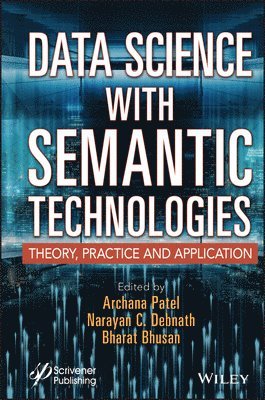
      Data Science with Semantic Technologies

      Theory, Practice and Application

      AvArchana Patel,Narayan C. Debnath

      Inbunden, Engelska, 2022

      Del i serien Advances in Intelligent and Scientific Computing

      2 493 kr

      Beställningsvara. Skickas inom 5-8 vardagar. Fri frakt över 249 kr.

      Beskrivning

      DATA SCIENCE WITH SEMANTIC TECHNOLOGIES This book will serve as an important guide toward applications of data science with semantic technologies for the upcoming generation and thus becomes a unique resource for scholars, researchers, professionals, and practitioners in this field. To create intelligence in data science, it becomes necessary to utilize semantic technologies which allow machine-readable representation of data. This intelligence uniquely identifies and connects data with common business terms, and it also enables users to communicate with data. Instead of structuring the data, semantic technologies help users to understand the meaning of the data by using the concepts of semantics, ontology, OWL, linked data, and knowledge-graphs. These technologies help organizations to understand all the stored data, adding the value in it, and enabling insights that were not available before. As data is the most important asset for any organization, it is essential to apply semantic technologies in data science to fulfill the need of any organization. Data Science with Semantic Technologies provides a roadmap for the deployment of semantic technologies in the field of data science. Moreover, it highlights how data science enables the user to create intelligence through these technologies by exploring the opportunities and eradicating the challenges in the current and future time frame. In addition, this book provides answers to various questions like: Can semantic technologies be able to facilitate data science? Which type of data science problems can be tackled by semantic technologies? How can data scientists benefit from these technologies? What is knowledge data science? How does knowledge data science relate to other domains? What is the role of semantic technologies in data science? What is the current progress and future of data science with semantic technologies? Which types of problems require the immediate attention of researchers? Audience Researchers in the fields of data science, semantic technologies, artificial intelligence, big data, and other related domains, as well as industry professionals, software engineers/scientists, and project managers who are developing the software for data science. Students across the globe will get the basic and advanced knowledge on the current state and potential future of data science.

      Produktinformation

      • Utgivningsdatum:2022-08-30
      • Mått:10 x 10 x 10 mm
      • Vikt:454 g
      • Format:Inbunden
      • Språk:Engelska
      • Serie:Advances in Intelligent and Scientific Computing
      • Antal sidor:464
      • Förlag:John Wiley & Sons Inc
      • ISBN:9781119864981

      Utforska kategorier

      • Databaser inom Data och IT

      Mer om författaren

      Archana Patel, PhD, is a faculty of the Department of Software Engineering, School of Computing and Information Technology, Binh Duong Province, Vietnam. She completed her Postdoc from the Freie Universität Berlin, Berlin, Germany. Dr. Patel is an author or co-author of more than 30 publications in numerous refereed journals and conference proceedings. She has been awarded the Best Paper award (three times) at international conferences. Her research interests are ontological engineering, semantic web, big data, expert systems, and knowledge warehouse. Narayan C. Debnath, PhD, is the Founding Dean of the School of Computing and Information Technology at Eastern International University, Vietnam. He is also serving as the Head of the Department of Software Engineering at Eastern International University, Vietnam. Dr. Debnath has been the Director of the International Society for Computers and their Applications (ISCA), USA since 2014. Formerly, Dr. Debnath served as a Full Professor of Computer Science at Winona State University, Minnesota, USA for 28 years. Bharat Bhusan, PhD, is an assistant professor in the Department of Computer Science and Engineering, School of Engineering and Technology, Sharda University, India. In the last three years, he has published more than 80 research papers in various renowned international conferences and SCI indexed journals and edited 11 books.

      Innehållsförteckning

      • Preface xv1 A Brief Introduction and Importance of Data Science 1Karthika N., Sheela J. and Janet B.1.1 What is Data Science? What Does a Data Scientist Do? 21.2 Why Data Science is in Demand? 21.3 History of Data Science 41.4 How Does Data Science Differ from Business Intelligence? 91.5 Data Science Life Cycle 111.6 Data Science Components 131.7 Why Data Science is Important 141.8 Current Challenges 151.8.1 Coordination, Collaboration, and Communication 161.8.2 Building Data Analytics Teams 161.8.3 Stakeholders vs Analytics 171.8.4 Driving with Data 171.9 Tools Used for Data Science 191.10 Benefits and Applications of Data Science 281.11 Conclusion 28References 292 Exploration of Tools for Data Science 31Qasem Abu Al-Haija2.1 Introduction 322.2 Top Ten Tools for Data Science 352.3 Python for Data Science 352.3.1 Python Datatypes 362.3.2 Helpful Rules for Python Programming 372.3.3 Jupyter Notebook for IPython 372.3.4 Your First Python Program 382.4 R Language for Data Science 392.4.1 R Datatypes 392.4.2 Your First R Program 412.5 SQL for Data Science 442.6 Microsoft Excel for Data Science 482.6.1 Detection of Outliers in Data Sets Using Microsoft Excel 482.6.2 Regression Analysis in Excel Using Microsoft Excel 502.7 D3.JS for Data Science 572.8 Other Important Tools for Data Science 582.8.1 Apache Spark Ecosystem 582.8.2 MongoDB Data Store System 602.8.3 MATLAB Computing System 622.8.4 Neo4j for Graphical Database 632.8.5 VMWare Platform for Virtualization 652.9 Conclusion 66References 683 Data Modeling as Emerging Problems of Data Science 71Mahyuddin K. M. Nasution and Marischa Elveny3.1 Introduction 723.2 Data 723.2.1 Unstructured Data 743.2.2 Semistructured Data 743.2.3 Structured Data 763.2.4 Hybrid (Un/Semi)-Structured Data 773.2.5 Big Data 783.3 Data Model Design 793.4 Data Modeling 813.4.1 Records-Based Data Model 813.4.2 Non–Record-Based Data Model 843.5 Polyglot Persistence Environment 87References 884 Data Management as Emerging Problems of Data Science 91Mahyuddin K. M. Nasution and Rahmad Syah4.1 Introduction 924.2 Perspective and Context 924.2.1 Life Cycle 934.2.2 Use 954.3 Data Distribution 984.4 CAP Theorem 1004.5 Polyglot Persistence 101References 1025 Role of Data Science in Healthcare 105Anidha Arulanandham, A. Suresh and Senthil Kumar R.5.1 Predictive Modeling—Disease Diagnosis and Prognosis 1065.1.1 Supervised Machine Learning Models 1075.1.2 Clustering Models 1105.1.2.1 Centroid-Based Clustering Models 1105.1.2.2 Expectation Maximization (EM) Algorithm 1105.1.2.3 DBSCAN 1115.1.3 Feature Engineering 1115.2 Preventive Medicine—Genetics/Molecular Sequencing 1115.2.1 Technologies for Sequencing 1135.2.2 Sequence Data Analysis with BioPython 1145.2.2.1 Sequence Data Formats 1145.2.2.2 BioPython 1175.3 Personalized Medicine 1215.4 Signature Biomarkers Discovery from High Throughput Data 1225.4.1 Methodology I — Novel Feature Selection Method with Improved Mutual Information and Fisher Score 1235.4.1.1 Algorithm for the Novel Feature Selection Method with Improved Mutual Information and Fisher Score 1245.4.1.2 Computing F-Score Values for the Features 1255.4.1.3 Block Diagram for the Method-1 1255.4.1.4 Data Set 1265.4.1.5 Identification of Biomarkers Using the Feature Selection Technique-I 1275.4.2 Feature Selection Methodology-II — Entropy Based Mean Score with mRMR 1285.4.2.1 Algorithm for the Feature Selection Methodology-II 1305.4.2.2 Introduction to mRMR Feature Selection 1325.4.2.3 Data Sets 1325.4.2.4 Identification of Biomarkers Using Rank Product 1335.4.2.5 Fold Change Values 133Conclusion 136References 1366 Partitioned Binary Search Trees (P(h)-BST): A Data Structure for Computer RAM 139Pr. D.E Zegour6.1 Introduction 1406.2 P(h)-BST Structure 1416.2.1 Preliminary Analysis 1436.2.2 Terminology and Conventions 1436.3 Maintenance Operations 1436.3.1 Operations Inside a Class 1456.3.2 Operations Between Classes (Outside a Class) 1486.4 Insert and Delete Algorithms 1536.4.1 Inserting a New Element 1536.4.2 Deleting an Existing Element 1576.5 P(h)-BST as a Generator of Balanced Binary Search Trees 1606.6 Simulation Results 1626.6.1 Data Structures and Abstract Data Types 1646.6.2 Analyzing the Insert and Delete Process in Random Case 1646.6.3 Analyzing the Insert Process in Ascending (Descending) Case 1686.6.4 Comparing P(2)-BST/P(∞)-BST to Red-Black/AVL Trees 1746.7 Conclusion 175Acknowledgments 176References 1767 Security Ontologies: An Investigation of Pitfall Rate 179Archana Patel and Narayan C. Debnath7.1 Introduction 1797.2 Secure Data Management in the Semantic Web 1847.3 Security Ontologies in a Nutshell 1877.4 InFra_OE Framework 1897.5 Conclusion 193References 1938 IoT-Based Fully-Automated Fire Control System 199Lalit Mohan Satapathy8.1 Introduction 2008.2 Related Works 2018.3 Proposed Architecture 2038.4 Major Components 2058.4.1 Arduino UNO 2058.4.2 Temperature Sensor 2078.4.3 LCD Display (16X2) 2088.4.4 Temperature Humidity Sensor (DHT11) 2098.4.5 Moisture Sensor 2108.4.6 CO2 Sensor 2118.4.7 Nitric Oxide Sensor 2128.4.8 CO Sensor (MQ-9) 2128.4.9 Global Positioning System (GPS) 2128.4.10 GSM Modem 2138.4.11 Photovoltaic System 2148.5 Hardware Interfacing 2168.6 Software Implementation 2188.7 Conclusion 222References 2239 Phrase Level-Based Sentiment Analysis Using Paired Inverted Index and Fuzzy Rule 225Sheela J., Karthika N. and Janet B.9.1 Introduction 2269.2 Literature Survey 2289.3 Methodology 2339.3.1 Construction of Inverted Wordpair Index 2349.3.1.1 Sentiment Analysis Design Framework 2359.3.1.2 Sentiment Classification 2369.3.1.3 Preprocessing of Data 2379.3.1.4 Algorithm to Find the Score 2409.3.1.5 Fuzzy System 2409.3.1.6 Lexicon-Based Sentiment Analysis 2419.3.1.7 Defuzzification 2429.3.2 Performance Metrics 2439.4 Conclusion 244References 24410 Semantic Technology Pillars: The Story So Far 247Michael DeBellis, Jans Aasman and Archana Patel10.1 The Road that Brought Us Here 24810.2 What is a Semantic Pillar? 24910.2.1 Machine Learning 24910.2.2 The Semantic Approach 25010.3 The Foundation Semantic Pillars: IRI’s, RDF, and RDFS 25210.3.1 Internationalized Resource Identifier (IRI) 25410.3.2 Resource Description Framework (RDF) 25410.3.2.1 Alternative Technologies to RDF: Property Graphs 25610.3.3 RDF Schema (RDFS) 25710.4 The Semantic Upper Pillars: OWL, SWRL, SPARQL, and SHACL 25910.4.1 The Web Ontology Language (OWL) 26010.4.1.1 Axioms to Define Classes 26210.4.1.2 The Open World Assumption 26310.4.1.3 No Unique Names Assumption 26310.4.1.4 Serialization 26410.4.2 The Semantic Web Rule Language 26410.4.2.1 The Limitations of Monotonic Reasoning 26710.4.2.2 Alternatives to SWRL 26710.4.3 SPARQL 26810.4.3.1 The SERVICE Keyword and Linked Data 26810.4.4 SHACL 27110.4.4.1 The Fundamentals of SHACL 27210.5 Conclusion 274References 27411 Evaluating Richness of Security Ontologies for Semantic Web 277Ambrish Kumar Mishra, Narayan C. Debnath and Archana Patel11.1 Introduction 27711.2 Ontology Evaluation: State-of-the-Art 28011.2.1 Domain-Dependent Ontology Evaluation Tools 28111.2.2 Domain-Independent Ontology Evaluation Tools 28211.3 Security Ontology 28411.4 Richness of Security Ontologies 28711.5 Conclusion 295References 29512 Health Data Science and Semantic Technologies 299Haleh Ayatollahi12.1 Health Data 30012.2 Data Science 30112.3 Health Data Science 30112.4 Examples of Health Data Science Applications 30412.5 Health Data Science Challenges 30612.6 Health Data Science and Semantic Technologies 30812.6.1 Natural Language Processing (NLP) 30912.6.2 Clinical Data Sharing and Data Integration 31012.6.3 Ontology Engineering and Quality Assurance (QA) 31112.7 Application of Data Science for COVID-19 31312.8 Data Challenges During COVID-19 Outbreak 31412.9 Biomedical Data Science 31512.10 Conclusion 316References 31713 Hybrid Mixed Integer Optimization Method for Document Clustering Based on Semantic Data Matrix 323Tatiana Avdeenko and Yury Mezentsev13.1 Introduction 32413.2 A Method for Constructing a Semantic Matrix of Relations Between Documents and Taxonomy Concepts 32713.3 Mathematical Statements for Clustering Problem 33013.3.1 Mathematical Statements for PDC Clustering Problem 33013.3.2 Mathematical Statements for CC Clustering Problem 33413.3.3 Relations between PDC Clustering and CC Clustering 33613.4 Heuristic Hybrid Clustering Algorithm 34013.5 Application of a Hybrid Optimization Algorithm for Document Clustering 34213.6 Conclusion 344Acknowledgment 344References 34414 Role of Knowledge Data Science During COVID-19 Pandemic 347Veena Kumari H. M. and D. S. Suresh14.1 Introduction 34814.1.1 Global Health Emergency 35014.1.2 Timeline of the COVID-19 35114.2 Literature Review 35414.3 Model Discussion 35614.3.1 COVID-19 Time Series Dataset 35714.3.2 FBProphet Forecasting Model 35814.3.3 Data Preprocessing 36014.3.4 Data Visualization 36014.4 Results and Discussions 36214.4.1 Analysis and Forecasting: The World 36214.4.2 Performance Metrics 37114.4.3 Analysis and Forecasting: The Top 20 Countries 37714.5 Conclusion 388References 38915 Semantic Data Science in the COVID-19 Pandemic 393Michael DeBellis and Biswanath Dutta15.1 Crises Often Are Catalysts for New Technologies 39315.1.1 Definitions 39415.1.2 Methodology 39515.2 The Domains of COVID-19 Semantic Data Science Research 39715.2.1 Surveys 39815.2.2 Semantic Search 39915.2.2.1 Enhancing the CORD-19 Dataset with Semantic Data 39915.2.2.2 CORD-19-on-FHIR – Semantics for COVID-19 Discovery 40015.2.2.3 Semantic Search on Amazon Web Services (AWS) 40015.2.2.4 COVID*GRAPH 40215.2.2.5 Network Graph Visualization of CORD-19 40315.2.2.6 COVID-19 on the Web 40415.2.3 Statistics 40515.2.3.1 The Johns Hopkins COVID-19 Dashboard 40515.2.3.2 The NY Times Dataset 40615.2.4 Surveillance 40615.2.4.1 An IoT Framework for Remote Patient Monitoring 40615.2.4.2 Risk Factor Discovery 40815.2.4.3 COVID-19 Surveillance in a Primary Care Network 40815.2.5 Clinical Trials 40915.2.6 Drug Repurposing 41115.2.7 Vocabularies 41415.2.8 Data Analysis 41515.2.8.1 CODO 41515.2.8.2 COVID-19 Phenotypes 41615.2.8.3 Detection of “Fake News” 41715.2.8.4 Ontology-Driven Weak Supervision for Clinical Entity Classification 41715.2.9 Harmonization 41815.3 Discussion 41815.3.1 Privacy Issues 42015.3.2 Domains that May Currently be Under Utilized 42115.3.2.1 Detection of Fake News 42115.3.2.2 Harmonization 42115.3.3 Machine Learning and Semantic Technology: Synergy Not Competition 42215.3.4 Conclusion 423Acknowledgment 423References 423Index 427
      Hoppa över listan

      Du kanske också är intresserad av

      Bharat Bhusan, Narayan C. Debnath, Archana Patel - Data Science with Semantic Technologies, E-bok

      Data Science with Semantic Technologies

      Bharat Bhusan, Narayan C. Debnath, Archana Patel

      E-bok
      2022

      2 908 kr

      Bharat Bhusan, Narayan C. Debnath, Archana Patel - Data Science with Semantic Technologies, E-bok

      Data Science with Semantic Technologies

      Bharat Bhusan, Narayan C. Debnath, Archana Patel

      E-bok
      2022

      2 908 kr

      Archana Patel, Narayan C. Debnath, Bharat Bhushan - Semantic Web Technologies, Inbunden

      Semantic Web Technologies

      Archana Patel, Narayan C. Debnath, Bharat Bhushan

      Inbunden, 2022

      2 518 kr

      Archana Patel, Narayan C. Debnath - Handbook of Data Science with Semantic Technologies, Övrigt

      Handbook of Data Science with Semantic Technologies

      Archana Patel, Narayan C. Debnath

      6 025 kr

      Narayan C. Debnath, Archana Patel - Data Science with Semantic Technologies, E-bok

      Data Science with Semantic Technologies

      Narayan C. Debnath, Archana Patel

      E-bok
      2023

      1 192 kr

      Bharat Bhushan, Narayan C. Debnath, Archana Patel - Semantic Web Technologies, E-bok

      Semantic Web Technologies

      Bharat Bhushan, Narayan C. Debnath, Archana Patel

      E-bok
      2022

      1 030 kr

      Archana Patel, Purvi Pokhariyal, Narayan C. Debnath, Shweta Anand, Ambrish Kumar Mishra - Artificial Intelligence for Risk Mitigation in the Financial Industry, E-bok

      Artificial Intelligence for Risk Mitigation in the Financial Industry

      Archana Patel, Purvi Pokhariyal, Narayan C. Debnath, Shweta Anand, Ambrish Kumar Mishra

      E-bok
      2024

      2 664 kr

      Narayan C. Debnath, Archana Patel - Data Science with Semantic Technologies, E-bok

      Data Science with Semantic Technologies

      Narayan C. Debnath, Archana Patel

      E-bok
      2023

      1 192 kr

      Archana Patel, Narayan C. Debnath - Data Science with Semantic Technologies, Häftad

      Data Science with Semantic Technologies

      Archana Patel, Narayan C. Debnath

      Häftad, 2024

      1 014 kr

      Archana Patel, Purvi Pokhariyal, Narayan C. Debnath, Shweta Anand, Ambrish Kumar Mishra - Artificial Intelligence for Risk Mitigation in the Financial Industry, E-bok

      Artificial Intelligence for Risk Mitigation in the Financial Industry

      Archana Patel, Purvi Pokhariyal, Narayan C. Debnath, Shweta Anand, Ambrish Kumar Mishra

      E-bok
      2024

      2 664 kr