Bharat Bhusan - Böcker
Visar alla böcker från författaren Bharat Bhusan. Handla med fri frakt och snabb leverans.
3 produkter
3 produkter
1 459 kr
Skickas
Today, Internet of Things (IoT) is ubiquitous as it is applied in practice in everything from Industrial Control Systems (ICS) to e-Health, e-commerce, Cyber Physical Systems (CPS), smart cities, smart parking, healthcare, supply chain management and many more. Numerous industries, academics, alliances and standardization organizations make an effort on IoT standardization, innovation and development. But there is still a need for a comprehensive framework with integrated standards under one IoT vision. Furthermore, the existing IoT systems are vulnerable to huge range of malicious attacks owing to the massive numbers of deployed IoT systems, inadequate data security standards and the resource-constrained nature. Existing security solutions are insufficient and therefore it is necessary to enable the IoT devices to dynamically counter the threats and save the system.Apart from illustrating the diversified IoT applications, this book also addresses the issue of data safekeeping along with the development of new security-enhancing schemes such as blockchain, as well as a range of other advances in IoT. The reader will discover that the IoT facilitates a multidisciplinary approach dedicated to create novel applications and develop integrated solutions to build a sustainable society. The innovative and fresh advances that demonstrate IoT and computational intelligence in practice are discussed in this book, which will be helpful and informative for scientists, research scholars, academicians, policymakers, industry professionals, government organizations and others.This book is intended for a broad target audience, including scholars of various generations and disciplines, recognized scholars (lecturers and professors) and young researchers (postgraduate and undergraduates) who study the legal and socio-economic consequences of the emergence and dissemination of digital technologies such as IoT. Furthermore, the book is intended for researchers, developers and operators working in the field of IoT and eager to comprehend the vulnerability of the IoT paradigm. The book will serve as a comprehensive guide for the advanced-level students in computer science who are interested in understanding the severity and implications of the accompanied security issues in IoT.Dr. Bharat Bhushan is an Assistant Professor of Department of Computer Science and Engineering (CSE) at School of Engineering and Technology, Sharda University, Greater Noida, India.Prof. (Dr.) Sudhir Kumar Sharma is currently a Professor and Head of the Department of Computer Science, Institute of Information Technology & Management affiliated to GGSIPU, New Delhi, India.Prof. (Dr.) Bhuvan Unhelkar (BE, MDBA, MSc, PhD; FACS; PSM-I, CBAP®) is an accomplished IT professional and Professor of IT at the University of South Florida, Sarasota-Manatee (Lead Faculty).Dr. Muhammad Fazal Ijaz is working as an Assistant Professor in Department of Intelligent Mechatronics Engineering, Sejong University, Seoul, Korea.Prof. (Dr.) Lamia Karim is a professor of computer science at the National School of Applied Sciences Berrechid (ENSAB), Hassan 1st University.
717 kr
Skickas inom 10-15 vardagar
Today, Internet of Things (IoT) is ubiquitous as it is applied in practice in everything from Industrial Control Systems (ICS) to e-Health, e-commerce, Cyber Physical Systems (CPS), smart cities, smart parking, healthcare, supply chain management and many more. Numerous industries, academics, alliances and standardization organizations make an effort on IoT standardization, innovation and development. But there is still a need for a comprehensive framework with integrated standards under one IoT vision. Furthermore, the existing IoT systems are vulnerable to huge range of malicious attacks owing to the massive numbers of deployed IoT systems, inadequate data security standards and the resource-constrained nature. Existing security solutions are insufficient and therefore it is necessary to enable the IoT devices to dynamically counter the threats and save the system.Apart from illustrating the diversified IoT applications, this book also addresses the issue of data safekeeping along with the development of new security-enhancing schemes such as blockchain, as well as a range of other advances in IoT. The reader will discover that the IoT facilitates a multidisciplinary approach dedicated to create novel applications and develop integrated solutions to build a sustainable society. The innovative and fresh advances that demonstrate IoT and computational intelligence in practice are discussed in this book, which will be helpful and informative for scientists, research scholars, academicians, policymakers, industry professionals, government organizations and others.This book is intended for a broad target audience, including scholars of various generations and disciplines, recognized scholars (lecturers and professors) and young researchers (postgraduate and undergraduates) who study the legal and socio-economic consequences of the emergence and dissemination of digital technologies such as IoT. Furthermore, the book is intended for researchers, developers and operators working in the field of IoT and eager to comprehend the vulnerability of the IoT paradigm. The book will serve as a comprehensive guide for the advanced-level students in computer science who are interested in understanding the severity and implications of the accompanied security issues in IoT.Dr. Bharat Bhushan is an Assistant Professor of Department of Computer Science and Engineering (CSE) at School of Engineering and Technology, Sharda University, Greater Noida, India.Prof. (Dr.) Sudhir Kumar Sharma is currently a Professor and Head of the Department of Computer Science, Institute of Information Technology & Management affiliated to GGSIPU, New Delhi, India.Prof. (Dr.) Bhuvan Unhelkar (BE, MDBA, MSc, PhD; FACS; PSM-I, CBAP®) is an accomplished IT professional and Professor of IT at the University of South Florida, Sarasota-Manatee (Lead Faculty).Dr. Muhammad Fazal Ijaz is working as an Assistant Professor in Department of Intelligent Mechatronics Engineering, Sejong University, Seoul, Korea.Prof. (Dr.) Lamia Karim is a professor of computer science at the National School of Applied Sciences Berrechid (ENSAB), Hassan 1st University.
2 240 kr
Skickas inom 7-10 vardagar
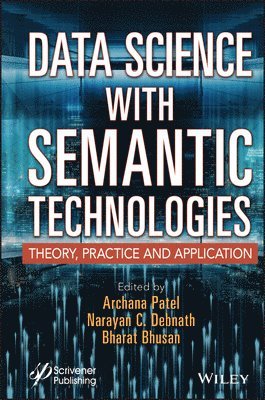
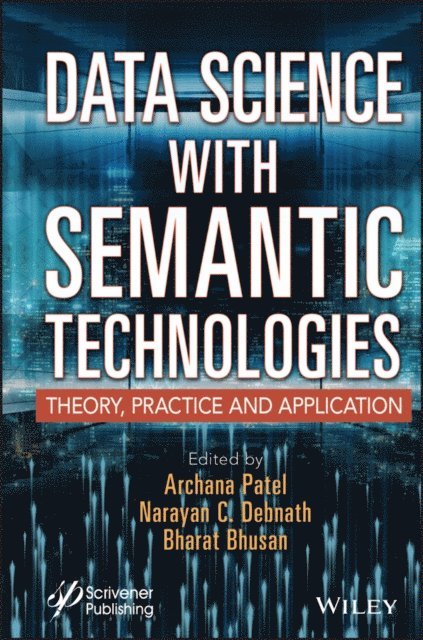
DATA SCIENCE WITH SEMANTIC TECHNOLOGIES This book will serve as an important guide toward applications of data science with semantic technologies for the upcoming generation and thus becomes a unique resource for scholars, researchers, professionals, and practitioners in this field. To create intelligence in data science, it becomes necessary to utilize semantic technologies which allow machine-readable representation of data. This intelligence uniquely identifies and connects data with common business terms, and it also enables users to communicate with data. Instead of structuring the data, semantic technologies help users to understand the meaning of the data by using the concepts of semantics, ontology, OWL, linked data, and knowledge-graphs. These technologies help organizations to understand all the stored data, adding the value in it, and enabling insights that were not available before. As data is the most important asset for any organization, it is essential to apply semantic technologies in data science to fulfill the need of any organization. Data Science with Semantic Technologies provides a roadmap for the deployment of semantic technologies in the field of data science. Moreover, it highlights how data science enables the user to create intelligence through these technologies by exploring the opportunities and eradicating the challenges in the current and future time frame. In addition, this book provides answers to various questions like: Can semantic technologies be able to facilitate data science? Which type of data science problems can be tackled by semantic technologies? How can data scientists benefit from these technologies? What is knowledge data science? How does knowledge data science relate to other domains? What is the role of semantic technologies in data science? What is the current progress and future of data science with semantic technologies? Which types of problems require the immediate attention of researchers? Audience Researchers in the fields of data science, semantic technologies, artificial intelligence, big data, and other related domains, as well as industry professionals, software engineers/scientists, and project managers who are developing the software for data science. Students across the globe will get the basic and advanced knowledge on the current state and potential future of data science.