• Fri frakt över 249 kr
  • •
  • Snabba leveranser
  • •
  • Billiga böcker
Kundservice

Du är på sajten för privatpersoner.

Företag, bibliotek eller offentlig verksamhet?

Du handlar på classic.bokus.com, där alla dina funktioner finns intakta.
Till classic.bokus.com
Bokus logotyp. Gå till startsidan.
  • Erbjudanden
  • Student
  • Topplistor
  • Barn & ungdom
  • Bokus Play
  • E-böcker
  • Ljudböcker
  • Pocketböcker
  • Spel och pussel

Skapa nya rutiner – hälsoböcker upp till 50% →

Sidfot

Mina sidor

    Hjälp

    • Kundservice
    • Vanliga frågor och svar
    • Frakt och leverans
    • Retur vid ångerrätt
    • Reklamera vara
    • Betalning
    • Köpvillkor
    • Allmänna villkor
    • Information om webbplatsens tillgänglighet

    Om Bokus

    • Om oss
    • Pressrum
    • För studenter
    • För företag
    • För bibliotek och offentlig verksamhet
    • För leverantörer
    • Hållbarhet

    Populärt

    • Aktuella erbjudanden
    • Presentkort
    • Studentlitteratur
    • Nya böcker
    • Topplistor
    • Signerade böcker
    • Engelska böcker

    Inspiration

    • Boktips
    • BookTok
    • Barnbokskaraktärer
    • Populära författare
    Logotyp för Bokus
    Följ oss på Facebook (extern länk)Följ oss på Instagram (extern länk)Följ oss på YouTube (extern länk)Följ oss på TikTok (extern länk)
    bokus @ CookiesAnpassa cookiesIntegritetspolicyKöpvillkor
    Till Citymail hemsida (extern länk)Till Budbee hemsida (extern länk)Till Postnord hemsida (extern länk)Till Schenker hemsida (extern länk)Till Early Bird hemsida (extern länk)Till Walleys hemsida (extern länk)
    1. Naturvetenskap och teknik
    2. Teknik och industri
    3. Maskinteknik och material

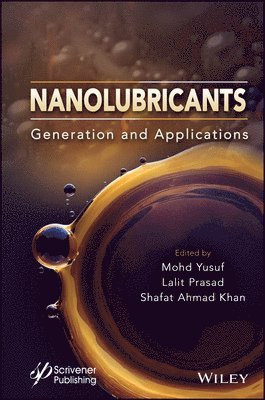
    Nanolubricants

    Generation and Applications

    AvMohd Yusuf,Lalit Prasad

    Inbunden, Engelska, 2024

    2 074 kr

    Beställningsvara. Skickas inom 5-8 vardagar. Fri frakt över 249 kr.

    Beskrivning

    NANOLUBRICANTS Through the dissemination of the latest advancements in nanolubrication science, this volume addresses the pressing concerns surrounding their economic feasibility, environmental acceptability, sustainability, and overall viability. Lubrication is the lifeblood of machinery and the key to its smooth operation. In the world of mechanics and engineering, the role of lubricants cannot be overstated. They are the unsung heroes that reduce friction between surfaces in contact, thus preventing excessive heat generation during motion. Beyond this primary function, lubricants find their application in diverse areas, including power transmission, foreign object transportation, and the regulation of surface temperature. In recent times, the world has shifted towards sustainable and environmentally-friendly practices, prompting a transition from conventional lubricants to more efficient and eco-conscious alternatives. Among these emerging solutions, nanolubricants have emerged as formidable contenders, reshaping the landscape of lubrication technology. Their adoption not only promises enhanced performance but also carries the added benefit of environmental responsibility through biodegradability. This book delves into the multifaceted realm of nanolubricants, exploring their characterization and application across various domains. From vegetable oil-based lubricants to those incorporating metal and non-metal oxide components, this comprehensive work encompasses nine meticulously curated chapters. A particular focus is placed on the intriguing synergy between nano-dimensionality and the incorporation of metals and metal oxides into vegetable oil-based biodegradable lubricants. The book explores the environmental advantages, progress, and challenges associated with this innovative approach. Furthermore, it delves into the integration of functionalized nanostructured semi-metal-based compounds as lubricant additives in non-edible vegetable oils, paving the way for improved tribological properties. Audience The book is extremely important to industrial practitioners working in mechanical engineering, tribology, wear, tear, friction and lubrication behavior of machinery. Researchers in nanoscience, nanotechnology, materials science, and sustainability subjects, will find this book useful.

    Produktinformation

    • Utgivningsdatum:2024-04-19
    • Vikt:717 g
    • Format:Inbunden
    • Språk:Engelska
    • Antal sidor:288
    • Förlag:John Wiley & Sons Inc
    • ISBN:9781119865100

    Utforska kategorier

    • Maskinteknik och material inom Naturvetenskap och teknik

    Mer om författaren

    Mohd Yusuf, PhD, is a dean and associate professor in the School of Life & Natural Sciences at the Glocal University in Saharanpur, India. He earned a PhD in nature-derived products and their applications in 2013. His research focuses on green and sustainable materials, functional biomaterials, biocolorants, and energy storage technology. He has more than 60 publications in applied sciences and sustainable materials. Lalit Prasad, PhD, is a professor of basic sciences at Galgotias University in Greater Noida, India. He earned a PhD from the Indian Institute of Technology Delhi in New Delhi, India. He has contributed 26 research articles to peer-reviewed journals, several book chapters and has conducted international projects. His research interests are in organic applied chemistry, interdisciplinary science, nanotechnology, and renewable biofuels. Shafat Ahmad Khan, PhD, is an associate professor at Galgotias University in Greater Noida, India. He holds a PhD in organic chemistry from Jamia Millia Islamia, New Delhi. His research focuses on natural product chemistry, colorant thermodynamics and kinetics, UV-blocking, and antibacterial textile finishing. He has also written numerous research papers for international and national scientific bodies.

    Innehållsförteckning

    • Preface xiii1 An Insight into Nanolubrication and Nanolubricants 1Deepshikha Singh, Wasim Khan and Mohd Yusuf1.1 Introduction 11.2 Advantages of Nanolubricants 21.3 Preparation of Nanolubricants 31.3.1 Methods of Nanolubricant Preparation 41.3.2 Types of Nanolubricants Based on Additives' Characteristics 61.4 Lubrication Mechanism 81.5 Tribological and Thermophysical Properties of Nanolubricants 91.5.1 Tribological Properties 101.5.2 Thermophysical Properties 111.6 Conclusion and Future Directions 132 Nanolubrication Chemistry and Its Application 17Smrita Singh, Ashutosh Singh Chauhan and Lalit Prasad2.1 Introduction 182.2 Nanolubrication and Its Requirements 192.3 Synthesis of Nanoparticles 212.3.1 Physical Method 212.3.2 Chemical Methods 222.3.3 Biological Methods 222.4 Preparation of Nanofluids/Nanolubricants 242.4.1 One-Step Method 242.4.2 Two-Step Method 252.4.2.1 Disadvantages of the Two-Step Method 252.4.3 Dispersion of Nanoparticles in Lubricating Oils 252.4.4 Interaction Forces in a Nanofluids/Nanolubricant System 262.4.4.1 Van der Waals Forces 262.4.4.2 Electrostatic or Electric Double Layer Force (EDL) 272.4.4.3 DLVO Theory 282.4.4.4 Capillary Forces 282.5 Mechanism of Nanolubrication 282.6 Nanoparticle Properties Necessary for Nanolubrication 302.6.1 Nanolubricating Film Properties 312.6.2 Nanoparticles in Nanolubricants 322.7 Advantages of Nanolubricants 332.8 Nanoparticles Ability to Boost Grease Performance 342.9 Tribological Performance of Nanolubricants 382.9.1 Mechanical Properties of a Tribological System 382.9.2 Physicochemical Properties of the Lubricant 392.10 Nanolubricants and Base Oils 402.10.1 Nanolubricants 402.10.2 Base Oils 402.11 Various Types of Nanoparticles as Lubricant Additives 422.11.1 Metal Oxides 432.11.2 Metal Sulfides 442.11.3 Carbon-Based Nanoparticles 442.11.4 Nanocomposites 452.11.5 Rare Earth Compounds 462.12 Recent Advancement in Nanolubrication 462.13 Conclusion and Future Outlook 473 Characterization Techniques for Nanolubricants Using Different Approaches 61Priyanka Chhabra and Akshara Johari3.1 Introduction 623.2 Nanoparticles as an Additive to Nanolubricants 633.3 Application of Nanolubricants 663.4 Preparation of Nanolubricants 673.5 Characterization Factors of Nanolubricants 693.6 Characterization Techniques Used for Nanolubricants 703.6.1 Morphology and Topography Analysis 703.6.1.1 Dynamic Light Scattering (DLS): Particle Size Analysis 703.6.1.2 Electron Microscopy 723.6.1.3 X-Ray Diffraction 733.6.1.4 Atomic Force Microscopy 733.6.1.5 UV-Visible Spectroscopy 783.6.1.6 Fourier-Transform Infrared Spectroscopy (FTIR) 823.6.1.7 Raman Spectroscopy 843.7 Conclusion 854 Metal-Based Nanolubricants: Current and Future Perspectives 89Deepak Gupta, Chandra Kumar, Aakash Mathur, Shruti Mishra, Anis Ahmad, Namrata Deka, Priyanki Kalita and Milan Singh4.1 Introduction 904.2 Synthesis Mechanism of NPs 924.2.1 Top-Down Methods 924.2.1.1 Ball Milling 924.2.1.2 Electrospinning 924.2.1.3 Lithography 934.2.1.4 Sputter Deposition 944.2.1.5 Pulsed Laser Deposition 954.2.2 Bottom-Up Approaches 964.2.2.1 Chemical Vapor Deposition (CVD) 964.2.2.2 Hydrothermal/Solvothermal Methods 974.2.2.3 Sol--Gel Method 984.2.2.4 Co-Precipitation 984.3 NPs as Potential Candidate for Lubricant Additive 984.3.1 Nanometal-Based Lubricant Additives 994.3.2 Coefficient of Friction (COF) and Anti-Wear Properties of Nanolubricants 994.3.3 Lubrication Mechanisms 1004.3.4 Rolling Effect or Ball-Bearing Effect 1004.3.5 Protective Film Formation 1014.3.6 Mending Effect 1024.3.7 Polishing Effect 1024.3.8 Surface Modified NP for Nanolubrication 1024.4 Methods to Enhance Dispersion Stability of Nanolubricants 1034.4.1 Physical Method 1034.4.2 Use of Surfactant 1044.4.3 Stability by Modification on Surface 1044.4.4 Metal-Based Nanolubricants 1054.4.5 Transition Metal Dichalcogenides (TMDCs)-Based Nanolubricants 1154.6 Conclusion 1245 Transition Metal-Based Catalysts for Preparing Biomass-Based Lubricating Oils 135Binitendra Naath Mongal and Himanshu Arora5.1 Introduction 1355.2 Synthesis of Biolubricants 1375.2.1 Esterification 1375.2.2 Transesterification 1375.2.3 Hydrogenation 1375.2.4 Simultaneous Hydrogenation--Esterification 1385.3 Catalysts for Biolubricant Synthesis 1385.3.1 Catalysts for Esterification 1385.3.2 Catalysts for Transesterification Reaction 1405.4 Conclusions 1446 Effect of Integration of Nanostructured Semimetals on Lubrication Performance of Non-Edible Vegetable Oil-Based Biolubricants 149Umar Farooq and Farha Naaz6.1 Introduction 1506.2 Lubrication and Lubricating Materials 1526.3 Inedible Vegetable Oils-Based Biolubricants 1546.3.1 Resources 1566.3.2 Properties 1566.3.3 Merits and Demerits of Vegetable Oil-Based Lubricants 1576.4 Nanoparticle Additives to Enhance Tribological Performance of Non-Edible Vegetable Oil Lubricants 1596.4.1 Tribological Performance-Based Categorization of Nanoparticles 1616.4.2 Effect of Nanoparticle Dispersion Stability, Shape, Size, Surface, Concentration, and Kind of Tribo-Test on the Tribological Performance 1616.4.2.1 Dispersion Stability 1616.4.2.2 Shape of Nanoparticles 1616.4.2.3 Size of Nanoparticles 1626.4.2.4 Surface Functionalization 1626.4.2.5 Nanoparticles Concentration 1626.4.2.6 Nature of Tribo-Testing 1636.5 Tribological Mechanisms of Nanoparticles 1636.5.1 Ball-Bearing Effect 1636.5.2 Protective Film Formation 1636.5.3 Mending Effect or Self-Healing Effect 1636.5.4 Polishing Effect 1636.5.5 Semimetal-Based Nano-Biolubricants 1646.5.6 Boron-Based Nanoadditives in Non-Edible Vegetable Oils-Based Lubricants 1646.6 Conclusion 1677 Zinc Oxide Nanomaterials--Synthesis, Characterization, and Applications Focused on Lubricating Behavior 173Monika Chauhan, Diwakar Chauhan, Ajay Kumar and Arvind Kumar Jain7.1 Introduction 1747.2 Preparations 1767.2.1 Synthesis of ZnO by Pulsed Laser Ablation Technique 1767.2.2 Synthesis of ZnO by Chemical Vapor Deposition Method 1777.2.3 Synthesis of ZnO by Anodization Method 1797.2.4 Synthesis of ZnO by Electrophoretic Deposition Process 1807.2.5 Hydrothermal Process for the Synthesis of ZnO 1807.2.6 Synthesis of ZnO by Electrochemical Deposition Method 1817.2.7 Preparation of ZnO by Using the Sol--Gel Technique 1827.2.8 Synthesis of ZnO by Thermolysis Method 1847.2.9 Synthesis of ZnO by Combustion Method 1867.2.10 Synthesis of ZnO by Ultrasonic Method 1867.2.11 Microwave-Assisted Combustion Method to Synthesize Zinc Oxide 1877.2.12 Synthesis of ZnO by Co-Precipitation Method 1887.2.13 Synthesis of ZnO by Green Synthesis Method 1897.3 Characterization 1917.4 Applications 1978 Improvement in the Properties of BiodegradableNanolubricants 209Sandip Paul Choudhury, Pushpendra Singh Shekhawat, Debanjan Bhattacharjee and Umesh K. Dwivedi8.1 Introduction 2098.1.1 Why Biodegradable Lubricants? 2108.1.2 Vegetable Oil-Based Lubricants 2108.1.3 Synthetic Lubricants 2118.1.4 Properties and Synthesis of Nanolubricants 2128.2 Nanoparticles for Lubricants 2138.3 Types of Biodegradable Nanolubricants 2178.3.1 Vegetable Oil as a Biodegradable Lubricant 2188.3.2 Additives-Based Biodegradable Nanolubricants 2198.3.3 Water-Based Nanolubricants 2228.4 Conclusion and Outlook 2239 Nanodimensional Metal-/Metal Oxide-Incorporated Vegetable Oil-Based Biodegradable Lubricants: Environmental Benefits, Progress, and Challenges 229Pooja Sharma, Umar Farooq, Syed Salman Ali and Kaneez Fatima9.1 Introduction 2309.2 Concept of Lubrication and Characteristics of a Lubricant 2329.2.1 Friction 2329.2.2 Wear 2339.2.3 Lubrication Regimes 2349.2.4 Characteristics of a Lubricant 2359.3 Vegetable Oil-Based Biolubricants 2369.3.1 Limitations of Vegetable Oils (VOs) as Lubricants 2389.3.1.1 Auto-Oxidation 2389.3.1.2 Photo-Oxidation of VOs 2409.3.1.3 Thermal Oxidation of Vegetable Oils 2419.4 Nanolubricants 2419.4.1 Mending Mechanism 2429.4.2 Rolling/Ball-Bearing Mechanism 2429.4.3 Formation of Protective Films 2429.4.4 Polishing 2439.4.5 Types of Nanoadditives 2439.4.6 Vegetable Oil Metal/Metal Oxide-Based Nanolubricants 2449.5 Challenges for Sustainable Bio-Nanolubrication 2509.6 Conclusion 250References 251Index 257
    Hoppa över listan

    Du kanske också är intresserad av

    Shafat Ahmad Khan, Mohd Yusuf - Biomaterials in Food Packaging, E-bok

    Biomaterials in Food Packaging

    Shafat Ahmad Khan, Mohd Yusuf

    E-bok
    2022

    1 882 kr

    Mohd Yusuf, Shafat Ahmad Khan - Biomaterials in Food Packaging, Inbunden

    Biomaterials in Food Packaging

    Mohd Yusuf, Shafat Ahmad Khan

    Inbunden, 2022

    1 622 kr

    Rajender S Varma, Arvind Kumar Jain, Shafat Ahmad Khan, Lalit Prasad - Green Chemistry, E-bok

    Green Chemistry

    Rajender S Varma, Arvind Kumar Jain, Shafat Ahmad Khan, Lalit Prasad

    E-bok
    2025

    2 446 kr

    Shafat Ahmad Khan, Mohd Yusuf - Biomaterials in Food Packaging, E-bok

    Biomaterials in Food Packaging

    Shafat Ahmad Khan, Mohd Yusuf

    E-bok
    2022

    1 945 kr

    Prasad,Lali, Lalit Prasad, Shafat Ahmad Khan, Arvind Kumar Jain, Rajender S Varma - Green Chemistry, Häftad

    Green Chemistry

    Prasad,Lali, Lalit Prasad, Shafat Ahmad Khan, Arvind Kumar Jain, Rajender S Varma

    Häftad, 2025

    1 933 kr

    Shafat Ahmad Khan, Lalit Prasad, Mohd Yusuf - Nanolubricants, E-bok

    Nanolubricants

    Shafat Ahmad Khan, Lalit Prasad, Mohd Yusuf

    E-bok
    2024

    2 587 kr

    Shafat Ahmad Khan, Lalit Prasad, Mohd Yusuf - Nanolubricants, E-bok

    Nanolubricants

    Shafat Ahmad Khan, Lalit Prasad, Mohd Yusuf

    E-bok
    2024

    2 587 kr

    Shakeel Ahmad Bhat, Tawheed Amin, Omar Bashir, Shafat Ahmad Khan - Greenhouse Technology for Sustainable Agriculture, Inbunden

    Greenhouse Technology for Sustainable Agriculture

    Shakeel Ahmad Bhat, Tawheed Amin, Omar Bashir, Shafat Ahmad Khan

    Inbunden, 2025

    2 052 kr

    Mohammad Shahid, Saptarshi Maiti, Shafat Ahmad Khan, Ravindra V. Adivarekar - Advancements in Textile Coloration, Inbunden

    Advancements in Textile Coloration

    Mohammad Shahid, Saptarshi Maiti, Shafat Ahmad Khan, Ravindra V. Adivarekar

    Inbunden, 2025

    1 929 kr

    Ravindra V. Adivarekar, Shafat Ahmad Khan, Saptarshi Maiti, Mohammad Shahid - Advancements in Textile Coloration, E-bok

    Advancements in Textile Coloration

    Ravindra V. Adivarekar, Shafat Ahmad Khan, Saptarshi Maiti, Mohammad Shahid

    E-bok
    2025

    2 524 kr