• Fri frakt över 249 kr
  • •
  • Snabba leveranser
  • •
  • Billiga böcker
Kundservice

Du är på sajten för privatpersoner.

Företag, bibliotek eller offentlig verksamhet?

Du handlar på classic.bokus.com, där alla dina funktioner finns intakta.
Till classic.bokus.com
Bokus logotyp. Gå till startsidan.
  • Erbjudanden
  • Nyheter
  • Student
  • Topplistor
  • Barn & ungdom
  • Bokus Play
  • E-böcker
  • Pocketböcker
  • Spel & pussel

10% rabatt på allt med kod NYSTART10 →

Sidfot

Mina sidor

    Hjälp

    • Kundservice
    • Vanliga frågor och svar
    • Frakt och leverans
    • Retur vid ångerrätt
    • Reklamera vara
    • Betalning
    • Köpvillkor
    • Allmänna villkor
    • Information om webbplatsens tillgänglighet

    Om Bokus

    • Om oss
    • Pressrum
    • För studenter
    • För företag
    • För bibliotek och offentlig verksamhet
    • För leverantörer
    • Hållbarhet

    Populärt

    • Aktuella erbjudanden
    • Presentkort
    • Studentlitteratur
    • Nya böcker
    • Topplistor
    • Signerade böcker
    • Engelska böcker

    Inspiration

    • Boktips
    • BookTok
    • Populära bokserier
    • Barnbokskaraktärer
    • Populära författare
    Logotyp för Bokus
    Följ oss på Facebook (extern länk)Följ oss på Instagram (extern länk)Följ oss på YouTube (extern länk)Följ oss på TikTok (extern länk)
    bokus @ CookiesAnpassa cookiesIntegritetspolicyKöpvillkor
    Till Citymail hemsida (extern länk)Till Budbee hemsida (extern länk)Till Postnord hemsida (extern länk)Till Schenker hemsida (extern länk)Till Early Bird hemsida (extern länk)Till Walleys hemsida (extern länk)
    1. Data och IT
    2. Systemvetenskap och AI
    3. Artificiell intelligens

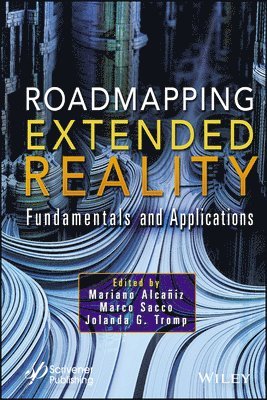
    Roadmapping Extended Reality

    Fundamentals and Applications

    AvMariano Alcañiz,Marco Sacco

    Inbunden, Engelska, 2022

    2 456 kr

    Beställningsvara. Skickas inom 5-8 vardagar. Fri frakt över 249 kr.

    Beskrivning

    ROADMAPPING EXTENDED REALITY This book offers a comprehensive overview of the technological aspects of Extended Realities (XR) and discusses the main challenges and future directions in the field. This book is important and timely – XR technologies have overcome the 3 main aspects that were holding it back from mainstream adoption: cost, cables, and size. However, there are many aspects of XR technologies that are now going to be explored and developed that still need urgent research in terms of security, privacy, health and safety, long-term effects, addiction risks, and age-related developmental concerns, and the aim of the book is to inform all readers of these open issues and challenges. There are currently a great number of interdisciplinary researchers and developers working in the XR R&D field. Recently, XR technologies moved from the Gartner Hype Cycle onto the Plateau of Productivity on the Gartner Hype Cycle signaling that the fundamental XR technologies are now deemed mature technologies and ready for deployment in a wide variety of application areas. Corroborated by the fact that XR technologies are part of the future Metaverse, a concept that went rapidly mainstream during the time of writing of this book. Roadmapping Extended Reality is divided into two parts: (1) fundamentals and (2) applications. The first part covers the main technological aspects of XR. The chapters in this section review and discuss relevant fundamental concepts of XR, the actual state-of-the-art, and future challenges. The second part of the book focuses on covering a wide range of applications of XR including a future roadmap. All in all, the book offers a snapshot of the state-of-the-art in XR and addresses the needs of a multidisciplinary audience working in both academia and the industry, as well as stakeholders at government agencies and non-profit organizations. AudienceThis book is aimed at academic and industrial developers, exploring and developing applications in the XR, VR, AR, AI, smart IoT, 4th Industrial Revolution space, including those that are solving technology requirements, human factors, evaluation methodology advances, and ROI investigations.

    Produktinformation

    • Utgivningsdatum:2022-10-19
    • Mått:152 x 231 x 25 mm
    • Vikt:636 g
    • Format:Inbunden
    • Språk:Engelska
    • Antal sidor:384
    • Förlag:John Wiley & Sons Inc
    • ISBN:9781119865148

    Utforska kategorier

    • Artificiell intelligens inom Data och IT

    Mer om författaren

    Mariano Alcañiz, PhD, is the founding director of the Immersive Neurotechnologies Lab (LabLENI) as well as a Full Professor of Biomedical Engineering at the Polytechnic University of Valencia, Spain. He has published more than 350 academic papers in interdisciplinary journals such as Scientific Reports and PLoS One, as well as domain-specific journals in the fields of biomedical engineering, computer science, psychology, marketing, management, psychology, and education. Marco Sacco, PhD, is a Senior Researcher, head of CNR-STIIMA Lecco subsidiary, and head of the division, Enterprise Engineering, and Virtual Applications. President of EuroXR (European Association of Extended Reality). He has more than 160 publications including papers in academic journals and conference proceedings. Jolanda G. Tromp, PhD, is a consultant to the EuroXR association for the Delphi consensus study; Director Center for Visualization & Simulation (CVS), Duy Tan University, Da Nang, Viet Nam; founding CIO spinout company for Visualization & Simulation, Viet Nam; visiting research professor XR lab Grupo DIANA, University of Malaga, Spain, and XR R&D Study Abroad internships Adjunct Instructor HCI Master and XR curriculum R&D, State University of New York in Oswego, NY, USA, and Duy Tan University, Viet Nam.

    Innehållsförteckning

    • Foreword xvPreface xvii1 Future Directions for XR 2021-2030: International Delphi Consensus Study 1Jolanda G. Tromp, Gabriel Zachmann, Jerome Perret and Beatrice Palacco1.1 Introduction 21.2 XR and the Delphi Study Forecast 41.3 Key Enabling R&D Prerequisites, Concerns and Targets 151.4 Future Research Agenda and Roadmap 211.5 Near-Term Challenges 26Acknowledgments 31References 312 Digital Narratives in Extended Realities 35Luis Emilio Bruni, Nele Kadastik, Thomas Anthony Pedersen and Hossein Dini2.1 Introduction 362.2 XR and Interactive Digital Narratives (IDN) 372.3 Domains of Applications 472.4 Future Perspectives 52References 553 Haptic Interfaces 63Jerome Perret3.1 Introduction 633.2 State-of-the-Art 653.3 Scientific and Technological Challenges 663.4 Application-Specific Challenges 693.5 Future Research Agenda and Roadmap 71References 734 Immersive Sound for XR 75Arcadio Reyes-Lecuona, Tifanie Bouchara and Lorenzo Picinali4.1 Introduction 754.2 Immersive Audio Rendering for XR 774.3 Technological Challenges 814.4 Envisioning Applications 884.5 Future Research Agenda and Roadmap 94Acknowledgments 96References 965 Visual Interfaces in XR 103Rubén Mohedano and Julio Chaves5.1 Introduction 1035.2 Definitions 1045.3 Visual Interfaces Building Blocks 1055.4 Visual Interfaces in VR 1085.5 Visual Interfaces in AR 1195.6 Future Research Agenda and Roadmap 128References 1326 XR and Metaverse Software Platforms 135Lorenzo Cappannari and Antony Vitillo6.1 Introduction 1366.2 Enabling Platforms 1386.3 Content Platforms 1436.4 Human-Centered Platforms 1466.5 Utility Platforms 1496.6 Application Platforms 1526.7 Future Research Agenda and Roadmap 154References 1557 Human Perception Engineering 157Evan G. Center, Katherine Mimnaugh, Jukka Häkkinen and Steven M. Lavalle7.1 Introduction 1577.2 XR and Human Perception 1657.3 Future Research Agenda and Roadmap 167Funding 177References 1778 Extended Reality and Artificial Intelligence: Synergic Approaches in Real World Applications 183Maria di Summa, Vito Reno, Pierluigi Dibari, Gaetano Pernisco, Marco Sacco and Ettore Stella8.1 Introduction 1838.2 XR and Artificial Intelligence 1868.3 Future Research Agenda and Roadmap 189References 1909 Extended Reality & The Backbone: Towards a 3D Mirrorworld 193Jolanda G. Tromp9.1 Introduction 1949.2 Critical Uncertainties for the Future of XR 2009.3 XR and Decentralization: Blockchain Infrastructure 2089.4 XR and the Backbone: Enabling Critical Functionalities 2119.5 XR Open Sharing and Interoperability 2169.6 Future Research Agenda and Roadmap 220Acknowledgments 223References 22310 Human Factors and Ergonomics 229Marta Mondellini, Vera Colombo, Sara Arlati, Glyn Lawson and Sue Cobb10.1 Introduction 23010.2 XR and Human Factors 23110.3 Future Research Agenda and Roadmap 244Acknowledgments 248References 24911 XR and Neurorehabilitation 257Sara Arlati and Davide Borghetti11.1 Introduction 25811.2 XR and Neurorehabilitation 25911.3 Future Research Agenda and Roadmap 268References 27312 Use of XR’s Technologies for Consumer Behavior Analysis 283Cristina Gil-Lopez, Jaime Guixeres, Javier Marín-Morales and Mariano Alcañiz12.1 Introduction 28312.2 The Concept of Virtual Consumer Experience 28412.3 A Framework for the Use of XR in Consumer Behavior Research 28812.4 Future Research Agenda and Roadmap 299References 30113 XR for Industrial Training & Maintenance 309Luca Greci13.1 Introduction 30913.2 XR and Industrial Training and Maintenance 31113.3 Future Research Agenda and Roadmap 316References 31814 Use of XR Technologies for the Assessment and Training of Leadership Skills 321Elena Parra, Mariano Alcañiz, Cristina Giglio and Irene Alice Chicchi Giglioli14.1 What is Leadership? 32214.2 Leadership Assessment: Explicit Methods 32214.3 Leadership Biomarkers: Organizational Neuroscience 32314.4 Extended Reality Technologies and Leadership Assessment 32714.5 Future Research Agenda and Roadmap 330References 33115 Surgery Applications: Expanding Surgeons’ Capabilities 337Jose M Sabater-Navarro, Jose M Vicente-Samper, Sofia Aledo and Pedro L. Solarte15.1 Introduction 33715.2 XR and Surgery 33815.3 Future Research Agenda and Roadmap 351References 352Index 357