E-bok, Engelska, 1999
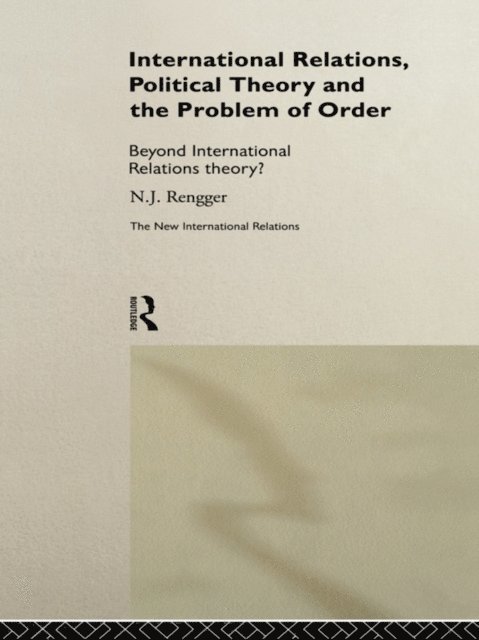
International Relations, Political Theory and the Problem of Order
1004 kr
Läs direkt i Bokus Reader – eller ladda ned till din enhet (PDF kräver ofta zoom och scroll på små skärmar).
Beskrivning
At the turn of the millennium, and now after the fall of the Berlin wall, the best way to map the trajectories of contemporary international relations is hotly contested. Is the world more or less ordered than during the cold war? Are we on the way to a neo-liberal era of free markets and global governance, or in danger of collapsing into a new Middle Ages? Are we on the verge of a new world order or are we slipping back into an old one?
These issues are amongst those that have dominated International Relations Theory in the late 1980s and 1990s, but they have their roots in older questions both about the appropriate ways to study international relations and about the general frameworks and normative assumptions generated by various different methodological approaches. This book seeks to offer a general interpretation and critique of both methodolgical and substantive aspects of International theory, and in particular to argue that International Relations theory has seperated itself from the concerns of political theory more generally at considerable cost to each.
Focussing intially on the ''problem of order'' in international politics, the book suggests that International Relations theory in the twentieth century had adopted two broad families of approaches, the first of which seeks to find ways of ''managing'' order in international relations and the second of which seeks to ''end'' the problem of order. It traces three specific sets of responses to the problem of order within the first approach, which emphasize ''balance'', ''society'' and ''institutions'' and outlines two responses within the second grouping, an emphasis on emancipation and an emphasis on limits. Finally, the book assesses the state of International Relations theory today and suggests an alternative way of reading the problem of order which generates a different trajectory for theory in the twenty first century.
These issues are amongst those that have dominated International Relations Theory in the late 1980s and 1990s, but they have their roots in older questions both about the appropriate ways to study international relations and about the general frameworks and normative assumptions generated by various different methodological approaches. This book seeks to offer a general interpretation and critique of both methodolgical and substantive aspects of International theory, and in particular to argue that International Relations theory has seperated itself from the concerns of political theory more generally at considerable cost to each.
Focussing intially on the ''problem of order'' in international politics, the book suggests that International Relations theory in the twentieth century had adopted two broad families of approaches, the first of which seeks to find ways of ''managing'' order in international relations and the second of which seeks to ''end'' the problem of order. It traces three specific sets of responses to the problem of order within the first approach, which emphasize ''balance'', ''society'' and ''institutions'' and outlines two responses within the second grouping, an emphasis on emancipation and an emphasis on limits. Finally, the book assesses the state of International Relations theory today and suggests an alternative way of reading the problem of order which generates a different trajectory for theory in the twenty first century.
Produktinformation
- Utgivningsdatum: 1999-11-04
- Språk: Engelska
- Filformat: PDF
- Kopieringsskydd: LCP
- ISBN: 9781134865598
- Förlag: Taylor & Francis
Utforska kategorier
Betyg & recensioner
0 recensioner
Inga recensioner tillgängliga.