• Fri frakt över 249 kr
  • •
  • Snabba leveranser
  • •
  • Billiga böcker
Kundservice

Du är på sajten för privatpersoner.

Företag, bibliotek eller offentlig verksamhet?

Du handlar på classic.bokus.com, där alla dina funktioner finns intakta.
Till classic.bokus.com
Bokus logotyp. Gå till startsidan.
  • Erbjudanden
  • Nyheter
  • Student
  • Topplistor
  • Barn & ungdom
  • Bokus Play
  • E-böcker
  • Pocketböcker
  • Spel & pussel

10% rabatt på allt med kod: NYSTART10 →

Sidfot

Mina sidor

    Hjälp

    • Kundservice
    • Vanliga frågor och svar
    • Frakt och leverans
    • Retur vid ångerrätt
    • Reklamera vara
    • Betalning
    • Köpvillkor
    • Allmänna villkor
    • Information om webbplatsens tillgänglighet

    Om Bokus

    • Om oss
    • Pressrum
    • För studenter
    • För företag
    • För bibliotek och offentlig verksamhet
    • För leverantörer
    • Hållbarhet

    Populärt

    • Aktuella erbjudanden
    • Presentkort
    • Studentlitteratur
    • Nya böcker
    • Topplistor
    • Signerade böcker
    • Engelska böcker

    Inspiration

    • Boktips
    • BookTok
    • Populära bokserier
    • Barnbokskaraktärer
    • Populära författare
    Logotyp för Bokus
    Följ oss på Facebook (extern länk)Följ oss på Instagram (extern länk)Följ oss på YouTube (extern länk)Följ oss på TikTok (extern länk)
    bokus @ CookiesAnpassa cookiesIntegritetspolicyKöpvillkor
    Till Citymail hemsida (extern länk)Till Budbee hemsida (extern länk)Till Postnord hemsida (extern länk)Till Schenker hemsida (extern länk)Till Early Bird hemsida (extern länk)Till Walleys hemsida (extern länk)
    1. Samhälle och politik
    2. Samhälle och kultur
    3. Sociala och etiska frågor

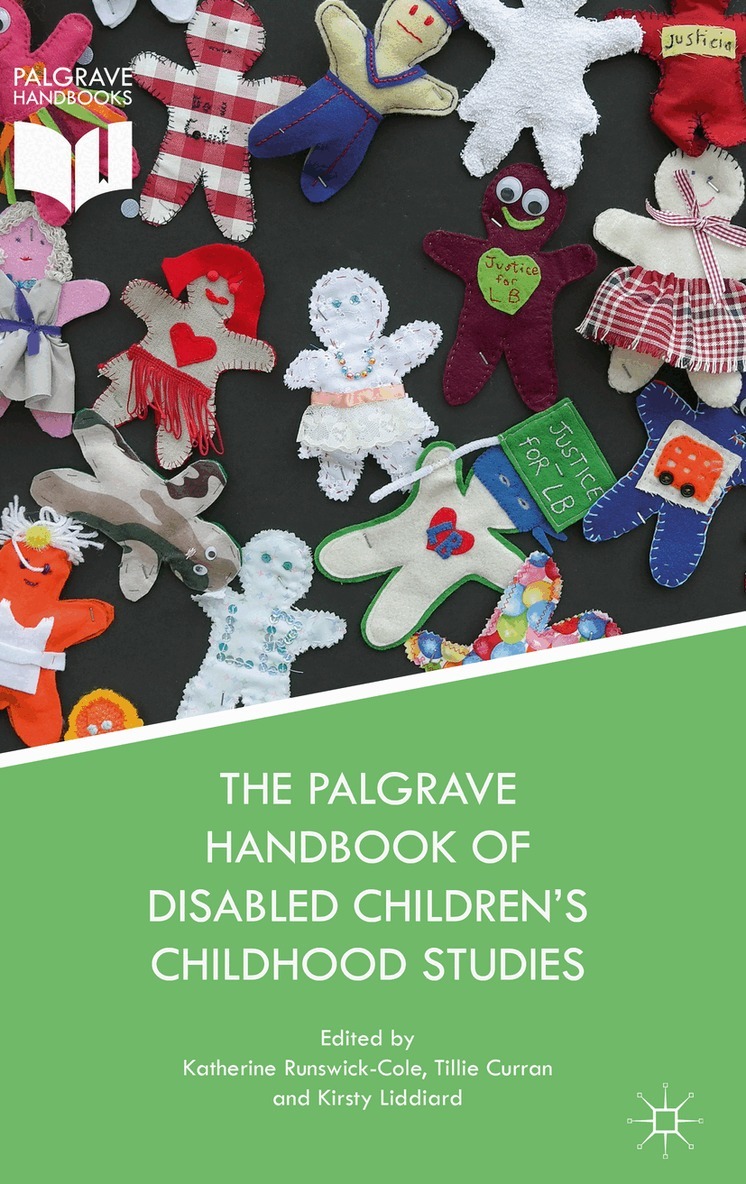
    Palgrave Handbook of Disabled Children’s Childhood Studies

    AvKatherine Runswick-Cole,Tillie Curran

    Inbunden, Engelska, 2017

    2 705 kr

    Beställningsvara. Skickas inom 10-15 vardagar. Fri frakt över 249 kr.

    Beskrivning

    Disabled children’s lives have often been discussed through medical concepts of disability rather than concepts of childhood. Western understandings of childhood have defined disabled children against child development ‘norms’ and have provided the rationale for segregated or ‘special’ welfare and education provision. In contrast, disabled children’s childhood studies begins with the view that studies of children’s impairment are not studies of their childhoods.  Disabled children’s childhood studies demands ethical research practices that position disabled children and young people at the centre of the inquiry outside of the shadow of perceived ‘norms’.The Palgrave Handbook of Disabled Children’s Childhood Studies will be of interest to students and scholars across a range of disciplines, as well as practitioners in health, education, social work and youth work.

    Produktinformation

    • Utgivningsdatum:2017-11-17
    • Mått:156 x 234 x 37 mm
    • Vikt:1 130 g
    • Format:Inbunden
    • Språk:Engelska
    • Antal sidor:661
    • Upplaga:17001
    • Förlag:Palgrave Macmillan
    • ISBN:9781137544452

    Utforska kategorier

    • Sociala och etiska frågor inom Samhälle och politik
    • Sociologi inom Samhälle och politik

    Mer om författaren

    Katherine Runswick-Cole is Professor of Critical Disability Studies and Psychology , Manchester Metropolitan University, UK.Tillie Curran is Senior Lecturer in Social Work, University of the West of England, UK.Kirsty Liddiard is Research Associate in the School of Education, University of Sheffield, UK.

    Recensioner i media

    “Valuable and vibrant personal perspectives are presented alongside robust academic engagements spanning empirical and theoretical research. … This book would be appealing to researchers, students, and practitioners within disabled children’s childhood studies, disability studies and childhood studies as well as those working in health and social care.” (Amanda Ptolomey, Disability & Society, May, 2018)

    Innehållsförteckning

    • Introduction; Katherine Runswick-Cole, Tillie Curran and Kirsty Liddiard.- Part 1:  Experience and Building Understandings.- 1. The Texting Project; Blair Manns and Sarah Manns.- 2. The Tree of Participation: our thoughts about growing a culture of participation between young people, parents and health team staff; Jennifer McElwee, David Cox, Tony Cox, Rosemary Holland, Thomas Holland, Theresa Mason, Chloe Pearce, Caroline Sobey, Julie Bugler, Andy James and Beverley Pearce.- 3. “What can I say?”; Wendy Merchant and Jamie Merchant.- 4. The Heaviest Burdens and Life’s Most Intense Fulfilment: a retrospective and re-understanding of my experiences with childhood liver disease and transplantation; Sophie Savage.- 5. My Sister, My World: from second Mum to Nurse; Rebecca Whitehead.- 6. Being a Disabled Woman and Mum: my journey from childhood; Jo Skitteral.- 7. Going ‘off grid’: A mother’s account of refusing disability; Kim Davies.- Part 2: Research Studies.- Part 2.1: Research Involving Disabled Children and Young People.- 8. The social relational model of Deaf childhood in action; Kristin Snoddon and Kathryn Underwood.- 9. Shared Perspectives: the embodiment of disabled children and young people’s voices about participating in recreational activities; Dawn Pickering.-10. Making Space for the Embodied Participation of Young Disabled Children in a Sure Start Children's Centre; Heloise Maconochie.- 11. Interrogating the ‘normal’ in the 'inclusive' early childhood classroom: silence, taboo and the ‘elephant in the room’; Karen Watson.- 12. The kids are alright—they have been included for years; Ben Whitburn.- 13. Expressive eyebrows and beautiful bubbles: Playfulness and children with profound impairments; Debby Watson, Alison Jones and Helen Potter.- 14. My Friends and Me. Friendship and identity following acquired brain injury in young people; Sandra Dowling, Roy McConkey, Marlene Sinclair.- 15. Thinking and Doing Consent and Advocacy in Disabled Children’s Childhood Studies Research; Jill C. Smith.- Part 2.2: Research Involving Parents of Disabled Children, Young people and Adult Children.- 16. The Making of a ‘maternal commons;: re-thinking motherhood through disability; Katherine Runswick-Cole and Dan Goodley.- 17. Autism and Gender in Context: intersectionality in research with fathers of children with the label of autism; Joanne Heeney.- 18. The construction of life trajectories: reflections, research and resolutions for young people with behavioural disabilities;Tania Watson.- 19. Personalisation and Parents: the formalisation of family care for adult children with learning disabilities in England ; Barbara Coles.- Part 3: Ethics and values.- 20. Anonymity, Confidentiality and Informed Consent: exploring ethical quandaries and dilemmas  in Research with and about disabled children’s childhoods; Liz Thackray.- 21. Supporting Families in Raising Disabled Children to Enhance African Child Development; Judith McKenzie and Tsitsi Chataika.- 22. Normalcy, Intersectionality and Ableism: teaching about and around ‘inclusion’ to future educators; Jenny Slater and Elizabeth Chapman.- 23. “Just Sumaira: Not Her, Them or It”; Sumaira Nasseem.- Part 4: Theory and Critical Ways of Thinking.- 24. What’s wrong with ‘special’? Thinking differently in New Zealand teacher education about disabled children and their lives; Gill Rutherford and Jude MacArthur.- 25. A Diversity of Crip Childhoods: Considering the Looked After Childhood; Luke Jones and Kirsty Liddiard.- 26.  A Relational Understanding of Language Impairment - children's experiences in the context of their social worlds; Helen Hambly.- 27. Resilience in the Lives of Disabled Children: a Many Splendoured Thing; Katherine Runswick-Cole, Dan Goodley and Rebecca Lawthom.- 28. Growing up disabled: Impairment, familial relationships and identity; Brian Watermeyer.- 29. Autistic development, trauma and personhood: beyond the frame of the neoliberal individual; Damian Milton.- Part 5: Changing Practice and Policy.- 30. Making policy for whom? The significance of the ‘psychoanalytic medical humanities’ for policy and practice that affects the lives of disabled children;Harriet Cooper.- 31. Disabled Children’s Childhood Studies and Leadership as Experts by Experience: the case for learning activism in health and social care;Tillie Curran, Ruth Sayers and Barry Percy-Smith.- 32. Being a Speech and Language Therapist: between support and oppression;Anat Greenstein.- 33. “You say .. I hear”: epistemic gaps in Practitioner-parent/carer talk; Nick Hodge and Katherine Runswick-Cole.- 34. Disabled Children in Out-of-Home Care: issues and challenges for practice; Berni Kelly, Sandra Dowling and Karen Winter.- 35. Easy Targets: Seen and not heard - The silencing and invisibility of disabled children and parents in post-reform Aotearoa New Zealand; Rod Wills.- 36. Family Voices in Teacher Education; Peggy Gallagher, Cheryl Rhodes and Karen Young Lewis.- 37. Rights not needs: changing the legal model for special educational needs; Debbie Sayers.- Concluding Thoughts and Future Directions; Kirsty Liddiard, Tillie Curran and Katherine Runswick-Cole.