• Fri frakt över 249 kr
  • •
  • Snabba leveranser
  • •
  • Billiga böcker
Kundservice

Du är på sajten för privatpersoner.

Företag, bibliotek eller offentlig verksamhet?

Du handlar på classic.bokus.com, där alla dina funktioner finns intakta.
Till classic.bokus.com
Bokus logotyp. Gå till startsidan.
  • Erbjudanden
  • Nyheter
  • Student
  • Topplistor
  • Barn & ungdom
  • Bokus Play
  • E-böcker
  • Pocketböcker
  • Spel & pussel

10% rabatt på allt med kod: NYSTART10 →

Sidfot

Mina sidor

    Hjälp

    • Kundservice
    • Vanliga frågor och svar
    • Frakt och leverans
    • Retur vid ångerrätt
    • Reklamera vara
    • Betalning
    • Köpvillkor
    • Allmänna villkor
    • Information om webbplatsens tillgänglighet

    Om Bokus

    • Om oss
    • Pressrum
    • För studenter
    • För företag
    • För bibliotek och offentlig verksamhet
    • För leverantörer
    • Hållbarhet

    Populärt

    • Aktuella erbjudanden
    • Presentkort
    • Studentlitteratur
    • Nya böcker
    • Topplistor
    • Signerade böcker
    • Engelska böcker

    Inspiration

    • Boktips
    • BookTok
    • Populära bokserier
    • Barnbokskaraktärer
    • Populära författare
    Logotyp för Bokus
    Följ oss på Facebook (extern länk)Följ oss på Instagram (extern länk)Följ oss på YouTube (extern länk)Följ oss på TikTok (extern länk)
    bokus @ CookiesAnpassa cookiesIntegritetspolicyKöpvillkor
    Till Citymail hemsida (extern länk)Till Budbee hemsida (extern länk)Till Postnord hemsida (extern länk)Till Schenker hemsida (extern länk)Till Early Bird hemsida (extern länk)Till Walleys hemsida (extern länk)
    1. Samhälle och politik
    2. Samhälle och kultur
    3. Sociala och etiska frågor

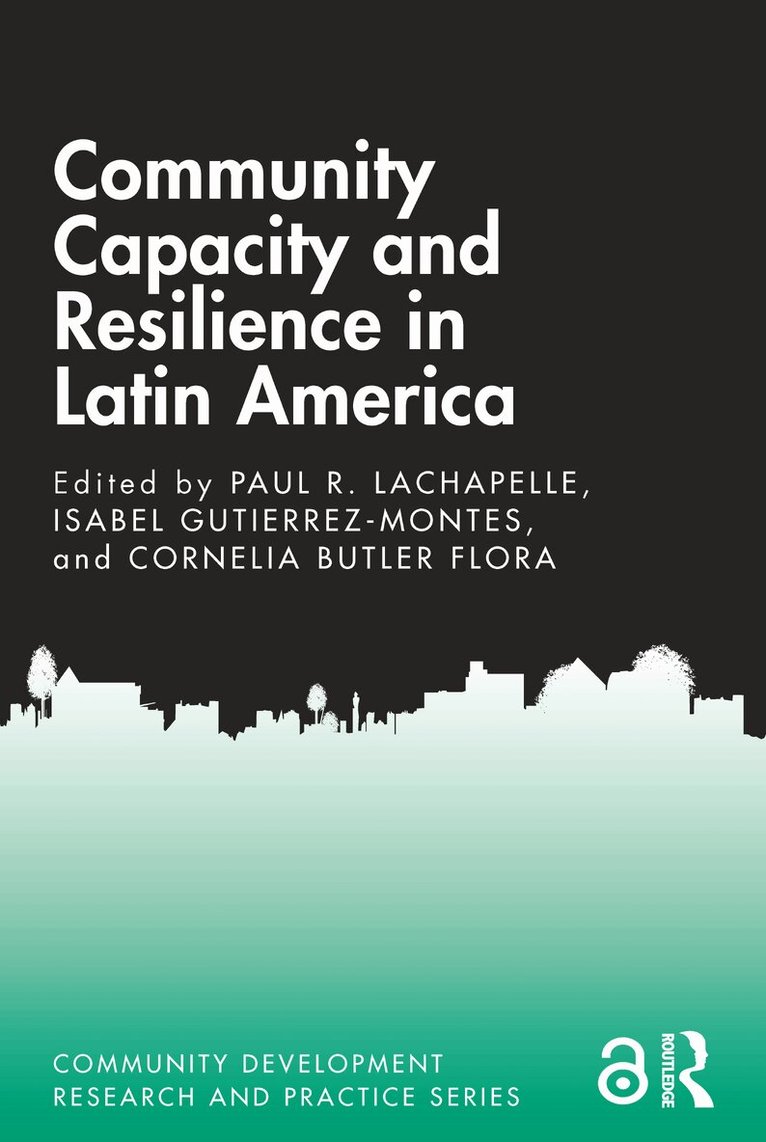
    Community Capacity and Resilience in Latin America

    AvPaul R. Lachapelle,Isabel Gutierrez-Montes

    Häftad, Engelska, 2020

    Del i serien Community Development Research and Practice Series

    614 kr

    Beställningsvara. Skickas inom 10-15 vardagar. Fri frakt över 249 kr.

    Beskrivning

    Community Capacity and Resilience in Latin America addresses the role of communities in building their capacity to increase resiliency and carry out rural development strategies in Latin America. Resiliency in a community sense is associated with an ability to address stress and respond to shock while obtaining participatory engagement in community assessment, planning and outcome. Although the political contexts for community development have changed dramatically in a number of Latin American countries in recent years, there are growing opportunities and examples of communities working together to address common problems and improve collective quality of life.This book links scholarship that highlights community development praxis using new frameworks to understand the potential for community capacity and resiliency. By rejecting old linear models of development, based on technology transfer and diffusion of technology, many communities in Latin America have built capacity of their capital assets to become more resilient and adapt positively to change. This book is an essential resource for academics and practitioners of rural development, demonstrating that there is much we can learn from the skills of self-diagnosis and building on existing assets to enhance community capitals.Chapter 3 of this book is freely available as a downloadable Open Access PDF at http://www.taylorfrancis.com under a Creative Commons Attribution (CC-BY) 4.0 license.

    Produktinformation

    • Utgivningsdatum:2020-07-09
    • Mått:156 x 234 x 16 mm
    • Vikt:326 g
    • Format:Häftad
    • Språk:Engelska
    • Serie:Community Development Research and Practice Series
    • Antal sidor:202
    • Förlag:Taylor & Francis Ltd
    • ISBN:9781138084902

    Utforska kategorier

    • Sociala och etiska frågor inom Samhälle och politik
    • Landskapsarkitektur inom Kultur
    • Regional planering inom Naturvetenskap och teknik

    Mer om författaren

    Paul R. Lachapelle is Professor in the Department of Political Science at Montana State University-Bozeman, USA. His teaching and research spans many disciplines and practices, from community climate change resiliency to social impact investing to diversity, inclusion and social justice topics. His publications include the edited book in this current series, Addressing Climate Change at the Community Level (Routledge 2019) as well as journal articles on energy impacts in communities, democratic practice and local governance, and community visioning. He earned a Ph.D. (Forestry) at the University of Montana's College of Forestry and Conservation with a focus on natural resource policy and governance and serves as Editor of the Community Development Society Current Issues Book Series and member of the Board of Directors (and past-president) of the International Association for Community Development.Isabel Gutierrez-Montes is Colombian Biologist (Universidad Nacional de Colombia), with a master’s degree in Natural Resources from CATIE and a Ph.D. in Rural Sociology from Iowa State University. Isabel works in Mesoamerica and South America using qualitative research methods as a diagnostic and planning tool in landscape management, assessment of vulnerability, implementation of farmer field schools, and socioenvironmental educational programs. She currently is the dean of CATIE (Tropical Agricultural Research and Higher Education Center) graduate school. In the past she has been the academic coordinator of the Environmental Socioeconomics Master’s Program, Coordinator and Leader of the Mesoamerican Agroenvironmental Program (MAP) and Director of the Development and Conservation Academic Program (PAPDC) at CATIE, Costa Rica. In the academic field, she has been a principal advisor for the Ph.D. theses of three students and served on Ph.D. thesis committees for two students, as well as major professor for the master’s theses of 46 students and master’s thesis committees of 35 students. She has published books, book chapters and technical and scientific articles in English and Spanish.Cornelia Butler Flora is Charles F. Curtiss Distinguished Professor Emeritus of Sociology at Iowa State University and research professor at Kansas State University. Her doctorate is from Cornell University, specializing in the sociology of development and population studies. She served as Director of the Population Research Laboratory at Kansas State University, Chair of the technical committee of the Sustainable Agriculture and Natural Resource Management Collaborative Research Support Program, Head of the Department of Sociology at Virginia Polytechnic Institute and State University, and Director of the North Central Regional Center for Rural Development. She served as member of the board of directors of Consortium for Sustainable Development of the Andean Ecoregion and Winrock International and served as past president of the Rural Sociological Society, the Community Development Society and the Agriculture, Food and Human Values Society. She has been consultant for international organizations and foundations in Africa, Asia, Latin America, the United States and Canada. Her primary research interests are the intersections of human communities and agro-ecosystems and sustainable intensification in the context of climate change, with an emphasis on gender. She has taught courses and done research on rural development in Spain (as a Fulbright Professor) and Uruguay (including periods as a Fulbright Professor) as well as Argentina and Peru.

    Recensioner i media

    "Community Capacity and Resilience in Latin America speaks to the power of local communities as agents of change. From local farmers, to university students, to indigenous leaders, to youth, this book describes how communities can collectively build from their own cultural, natural, social and political capital to create a better world. While financial capital runs rampant over the world, this book tells another story - of how communities across Latin America use their own community capitals to create a different alternative. Bio-cultural and sustainable approaches, grounded in indigenous knowledge and inclusion of women and youth, show how to address agricultural, energy, economic and employment challenges in rural communities."—Mildred E. Warner, Professor, Department of City and Regional Planning, Cornell University"This is an excellent volume using the Community Capitals Framework to address critical socioeconomic, cultural, and ecological issues. Presenting a diverse array of authors, the book contributes to theory and fine-grained case studies at multiple scales from communities to international institutions. It covers important topics such as climate change and adaptation, resilience and quality of life, gender equity and social inclusion, the role of churches and faith-rooted organizations in community change initiatives, and rural livelihoods and food security. The book will be useful to practitioners, policy-makers, scholars, and students alike, including the very experienced and those just learning about Latin America and some of the topics presented here."—Maria Elisa Christie, Director, Women and Gender in International Development, Center for International Research, Education and Development, Virginia Tech"Agricultural and rural communities across the world face many challenges, not least to produce food sustainably, mitigate against climate change, and ensure there are fair markets for their produce. This timely, wise and scholarly book highlights the values of social capital in community development and shows how resilience emerges from processes of engagement and progressive transformation."—Jules Pretty, Professor of Environment & Society, School of Life Sciences, University of Essex"Latin America is a large and diverse area that is home to 630 million people. It is an area of tremendous opportunity, yet significant challenges. This book is an excellent resource to help communities throughout the region overcome obstacles and bring prosperity to more communities and individuals."—Don Albrecht, Executive Director, Western Rural Development Center

    Innehållsförteckning

    • Chapter 1. Community Capacity and Resilience in Latin America through the Community Capitals LensChapter 2. Promoting Development and Conservation Practice in Latin America and the Caribbean through CATIE Masters ProgramChapter 3. Building Local strategies for the adaptation to Climate Change of Farming Livelihoods: Review of a Participatory Approach Applied in Mesoamerica.Chapter 4. Bioculturality and Transdisciplinarity: Two Paths for Reaching Sustainability Through Community Capacity Building in MexicoChapter 5. Bonds of Faith for Community Change: New Actors in Rural Community Development in El SalvadorChapter 6. Evaluation on a Shoestring: One International Development Organization’s Experience Measuring Impact in Central AmericaChapter 7. Using Community Capitals to Adapt to Environmental Challenges in Rural UruguayChapter 8. Using the Community Capitals Framework to Understand the Potential for Inclusive Innovation: Three Case Studies of an Energy Project in PeruChapter 9. Youth Development in Northern Nicaragua: An Empowerment PerspectiveChapter 10. Reflection on Building Sustainable Resilience Solutions to Achieve SDG 2 in Colombia