• Fri frakt över 249 kr
  • •
  • Snabba leveranser
  • •
  • Billiga böcker
Kundservice

Du är på sajten för privatpersoner.

Företag, bibliotek eller offentlig verksamhet?

Du handlar på classic.bokus.com, där alla dina funktioner finns intakta.
Till classic.bokus.com
Bokus logotyp. Gå till startsidan.
  • Erbjudanden
  • Student
  • Topplistor
  • Barn & ungdom
  • Bokus Play
  • E-böcker
  • Ljudböcker
  • Pocketböcker
  • Spel & pussel

10% rabatt på allt med kod NYSTART10 →

Sidfot

Mina sidor

    Hjälp

    • Kundservice
    • Vanliga frågor och svar
    • Frakt och leverans
    • Retur vid ångerrätt
    • Reklamera vara
    • Betalning
    • Köpvillkor
    • Allmänna villkor
    • Information om webbplatsens tillgänglighet

    Om Bokus

    • Om oss
    • Pressrum
    • För studenter
    • För företag
    • För bibliotek och offentlig verksamhet
    • För leverantörer
    • Hållbarhet

    Populärt

    • Aktuella erbjudanden
    • Presentkort
    • Studentlitteratur
    • Nya böcker
    • Topplistor
    • Signerade böcker
    • Engelska böcker

    Inspiration

    • Boktips
    • BookTok
    • Populära bokserier
    • Barnbokskaraktärer
    • Populära författare
    Logotyp för Bokus
    Följ oss på Facebook (extern länk)Följ oss på Instagram (extern länk)Följ oss på YouTube (extern länk)Följ oss på TikTok (extern länk)
    bokus @ CookiesAnpassa cookiesIntegritetspolicyKöpvillkor
    Till Citymail hemsida (extern länk)Till Budbee hemsida (extern länk)Till Postnord hemsida (extern länk)Till Schenker hemsida (extern länk)Till Early Bird hemsida (extern länk)Till Walleys hemsida (extern länk)
    1. Samhälle och politik
    2. Social välfärd och brottslighet
    3. Socialt arbete och välfärd

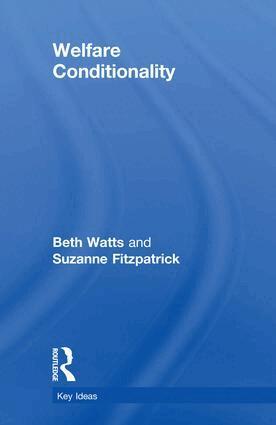
    Welfare Conditionality

    AvBeth Watts,Suzanne Fitzpatrick

    Inbunden, Engelska, 2018

    Del i serien Key Ideas

    2 418 kr

    Beställningsvara. Skickas inom 10-15 vardagar. Fri frakt över 249 kr.

    Fler format och utgåvor

    Häftad

    610 kr

    Beskrivning

    Welfare conditionality has become an idea of global significance in recent years. A ‘hot topic’ in North America, Australia, and across Europe, it has been linked to austerity politics, and the rise of foodbanks and destitution. In the Global South, where publicly funded welfare protection systems are often absent, conditional approaches have become a key tool employed by organisations pursuing human development goals.The essence of welfare conditionality lies in requirements for people to behave in prescribed ways in order to access cash benefits or other welfare support. These conditions are typically enforced through benefit ‘sanctions’ of various kinds, reflecting a new vision of ‘welfare’, focused more on promoting ‘pro-social’ behaviour than on protecting people against classic ‘social risks’ like unemployment. This new book in Routledge’s Key Ideas series charts the rise of behavioural conditionality in welfare systems across the globe, its appeal to politicians of Right and Left, and its application to a growing range of social problems. Crucially it explores why, in the context of widespread use of conditional approaches as well as apparently strong public support, both the efficacy and the ethics of welfare conditionality remain so controversial. As such, Welfare Conditionality is essential reading for students, researchers, and commentators in social and public policy, as well as those designing and implementing welfare policies.

    Produktinformation

    • Utgivningsdatum:2018-05-15
    • Mått:129 x 198 x 18 mm
    • Vikt:299 g
    • Format:Inbunden
    • Språk:Engelska
    • Serie:Key Ideas
    • Antal sidor:208
    • Förlag:Taylor & Francis Ltd
    • ISBN:9781138119901

    Utforska kategorier

    • Socialt arbete och välfärd inom Samhälle och politik

    Mer om författaren

    Beth Watts is Senior Research Fellow at the Institute for Social Policy, Housing and Equalities Research (I-SPHERE), Heriot-Watt University. She has a background in political and moral philosophy, and is interested in the application of philosophical tools in social and housing policy analysis. Beth completed her PhD comparing homelessness policy in Scotland and Ireland in 2013 at the University of York, and has previously worked at the Young Foundation, the Joseph Rowntree Foundation and Shelter.Suzanne Fitzpatrick is Professor of Housing and Social Policy and Director of I-SPHERE, Heriot-Watt University. She completed her PhD on youth homelessness at the University of Glasgow in 1998. Suzanne held various posts in the Department of Urban Studies at the University of Glasgow until 2003, when she was appointed the Joseph Rowntree Professor of Housing Policy and Director of the Centre for Housing Policy at the University of York. Suzanne has a background in law, and specialises in research on homelessness and housing exclusion.

    Recensioner i media

    "An excellent guide to the complex and often contentious debates about the efficacy and legitimacy of welfare conditionality." - Alan Deacon, Emeritus Professor of Social Policy, University of Leeds"What the book does unambiguously show is – as the introduction suggests – that conditionality is intensifying in welfare systems across the world. It is this fact that makes this book timely and important." -Citizens Basic Income Trust, 22nd July 2018 "Readers of this journal will be most interested in the author’s wide-ranging discussionof housing policy and practice as a key site for conditionality (p.67). Thisincludes exploration of various themes including criminalisation of vagrancy,banning food distribution and use of anti-social behaviour orders. It also reviewsrecent UK trends towards more conditional, probationary and renewable socialhousing tenancies and the tendency towards segregated ‘very social’ housingpractices in France, Austria and Sweden." - Dr. Mary P. Murphy, Department of Sociology, Maynooth University, Ireland"This is a really excellent book. It is thoughtful, reflective and well informed, and reaches some very sane and sensible, albeit controversial, conclusions. It is the latest title in Routledge’s Key Ideas series, which is committed to publishing "critical essays rather than literature reviews, offering lively and original treatments of their subject matter". Welfare Conditionality does just that and, like a number of other titles in the series that have already done so, it deserves to go into several editions. The blurb says that the book is essential reading for "students, researchers and commentators in social and public policy, as well as those designing and implementing welfare policies". This is undoubtedly the case but the publishers could have added that it is also essential reading for students, researchers and practitioners in social security and housing law." - Michael Adler, Emeritus Professor of Socio-Legal Studies, School of Social and Political Science, University of Edinburgh "Welfare Conditionality’ by the two eminent housing and social policy scholars Beth Watts and Suzanne Fitzpatrick is an excellent addition to the ‘Key Ideas’ series of Routledge. In a very engaging and comprehensible manner, the book takes a deep dive into the matter of what welfare conditionality is, how it evolved over time, who is subjected to it, and what its personal but also soci-etal consequences are. ‘Welfare Conditionality’ is the result of a 5-year long research project funded by the ESPRC in the UK. The book espouses an effort-less and well-informed interdisciplinary approach, combining legal, moral philosophical, social policy, as well as behavioural perspectives on conditional-ity. Another core strength of the book is that although it is not empirical as such, international evidence is used to support theoretical reasoning illustratively."- Christian Lennartz, Housing Researcher, Dutch Environmental Assessment Agency

    Innehållsförteckning

    • Acknowledgements; Chapter 1. Introduction; The Broadening and Deepening of Welfare Conditionality; Conditionality, Austerity and Public Opinion; Conditionality and Social Control; This Book; Chapter 2. The Context for Conditionality; Targeting; Generosity; Entitlement; Concluding Comments; Chapter 3. The Techniques of Conditionality; Behavioural Requirements; Monitoring and Verification; Sanctions; Incentives; Concluding Comments; Chapter 4. The Subjects of Conditionality; Unemployed People; Low-Income Families with Children; Social Tenants; Homeless People; Concluding Comments; Chapter 5. The Impacts of Conditionality; Behavioural Assumptions; Effectiveness; Unintended, Spill-Over and Scar Effects; Costs; Alternatives; Concluding Comments; Chapter 6. The Ethics of Conditionality; Conditionality as an Ethical 'Problem' ; Rights; Utilitarianism; Contractualism; Communitarianism; Paternalism; Social Justice; Concluding Comments; Chapter 7. Conclusions; Putting Conditionality in the Spotlight; Putting Conditionality to the Test; Putting Conditionality in Context; Bibliography; Index