• Fri frakt över 249 kr
  • •
  • Snabba leveranser
  • •
  • Billiga böcker
Kundservice

Du är på sajten för privatpersoner.

Företag, bibliotek eller offentlig verksamhet?

Du handlar på classic.bokus.com, där alla dina funktioner finns intakta.
Till classic.bokus.com
Bokus logotyp. Gå till startsidan.
  • Erbjudanden
  • Student
  • Topplistor
  • Barn & ungdom
  • Bokus Play
  • E-böcker
  • Ljudböcker
  • Pocketböcker
  • Spel och pussel

5% studentrabatt – använd koden KURSBOK27 →

Sidfot

Mina sidor

    Hjälp

    • Kundservice
    • Vanliga frågor och svar
    • Frakt och leverans
    • Retur vid ångerrätt
    • Reklamera vara
    • Betalning
    • Köpvillkor
    • Allmänna villkor
    • Information om webbplatsens tillgänglighet

    Om Bokus

    • Om oss
    • Pressrum
    • För studenter
    • För företag
    • För bibliotek och offentlig verksamhet
    • För leverantörer
    • Hållbarhet

    Populärt

    • Aktuella erbjudanden
    • Presentkort
    • Studentlitteratur
    • Nya böcker
    • Topplistor
    • Signerade böcker
    • Engelska böcker

    Inspiration

    • Boktips
    • BookTok
    • Barnbokskaraktärer
    • Populära författare
    Logotyp för Bokus
    Följ oss på Facebook (extern länk)Följ oss på Instagram (extern länk)Följ oss på YouTube (extern länk)Följ oss på TikTok (extern länk)
    bokus @ CookiesAnpassa cookiesIntegritetspolicyKöpvillkor
    Till Citymail hemsida (extern länk)Till Budbee hemsida (extern länk)Till Postnord hemsida (extern länk)Till Schenker hemsida (extern länk)Till Early Bird hemsida (extern länk)Till Walleys hemsida (extern länk)
    1. Språk och ordböcker
    2. Språk: referensverk och allmänt
    3. Språk: historia och allmänt

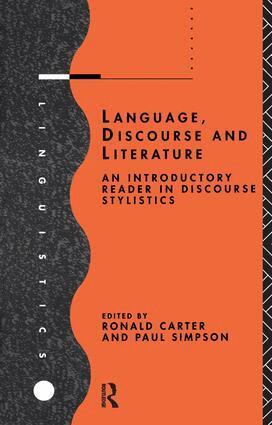
    Language, Discourse and Literature

    An Introductory Reader in Discourse Stylistics

    AvRonald Carter,Paul Simpson

    Inbunden, Engelska, 2016

    2 771 kr

    Beställningsvara. Skickas inom 10-15 vardagar. Fri frakt över 249 kr.

    Beskrivning

    This collection shows students of English and applied linguistics ways in which language and literary study can be integrated. By drawing on a wide range of texts by mainly British and American writers, from a variety of different periods, the contributors show how discourse stylistics can provide models for the systematic description of, for example, dialogue in fiction; language of drama and balladic poetry; speech presentation; the interactive properties of metre; the communicative context of author/reader. Among the texts examined are novels, poetry and drama by major twentieth-century writers such as Joyce, Auden, Pinter and Hopkins, as well as examples from Shakespeare, Donne and Milton. Each chapter has a wide range of exercises for practical analysis, an extensive glossary and a comprehensive bibliography with suggestions for further reading. The book will be particularly useful to undergraduate students of English and applied linguistics and advanced students of modern languages or English as a foreign language.

    Produktinformation

    • Utgivningsdatum:2016-04-15
    • Mått:138 x 216 x 19 mm
    • Vikt:453 g
    • Format:Inbunden
    • Språk:Engelska
    • Antal sidor:304
    • Förlag:Taylor & Francis Ltd
    • ISBN:9781138140950

    Utforska kategorier

    • Språk: historia och allmänt inom Språk och ordböcker
    • Språkvetenskap och lingvistik inom Språk och ordböcker
    • Litteraturteori inom Skönlitteratur

    Innehållsförteckning

    • Introduction 1 Changing the Guard at Elsinore 2 Phatic Communion and Fictional Dialogue 3 Poetry and Conversation: An Essay in Discourse Analysis 4 Polyphony in Hard Times 5 Dickens’s Social Semiotic: The Modal Analysis of Ideological Structure 6 Semantic Relational Structuring in Milton’ s Areopagitica 7 Discourse-Centred Stylistics: A Way Forward 8 Discourse Analysis and the Analysis of Drama 9 Politeness Phenomena in Ionesco’s The Lesson 10 Analysing Conversation in Fiction: an Example from Joyce’s Portrait 11 Subject Construction as Stylistic Strategy in Gerard Manley Hopkins 12 Metre and Discourse 13 ‘Working Effects with Words’—Whose Words?: Stylistics and Reader Intertextuality