• Fri frakt över 249 kr
  • •
  • Snabba leveranser
  • •
  • Billiga böcker
Kundservice

Du är på sajten för privatpersoner.

Företag, bibliotek eller offentlig verksamhet?

Du handlar på classic.bokus.com, där alla dina funktioner finns intakta.
Till classic.bokus.com
Bokus logotyp. Gå till startsidan.
  • Erbjudanden
  • Nyheter
  • Student
  • Topplistor
  • Barn & ungdom
  • Bokus Play
  • E-böcker
  • Pocketböcker
  • Spel & pussel

10% rabatt på allt med kod NYSTART10 →

Sidfot

Mina sidor

    Hjälp

    • Kundservice
    • Vanliga frågor och svar
    • Frakt och leverans
    • Retur vid ångerrätt
    • Reklamera vara
    • Betalning
    • Köpvillkor
    • Allmänna villkor
    • Information om webbplatsens tillgänglighet

    Om Bokus

    • Om oss
    • Pressrum
    • För studenter
    • För företag
    • För bibliotek och offentlig verksamhet
    • För leverantörer
    • Hållbarhet

    Populärt

    • Aktuella erbjudanden
    • Presentkort
    • Studentlitteratur
    • Nya böcker
    • Topplistor
    • Signerade böcker
    • Engelska böcker

    Inspiration

    • Boktips
    • BookTok
    • Populära bokserier
    • Barnbokskaraktärer
    • Populära författare
    Logotyp för Bokus
    Följ oss på Facebook (extern länk)Följ oss på Instagram (extern länk)Följ oss på YouTube (extern länk)Följ oss på TikTok (extern länk)
    bokus @ CookiesAnpassa cookiesIntegritetspolicyKöpvillkor
    Till Citymail hemsida (extern länk)Till Budbee hemsida (extern länk)Till Postnord hemsida (extern länk)Till Schenker hemsida (extern länk)Till Early Bird hemsida (extern länk)Till Walleys hemsida (extern länk)
    1. Samhälle och politik
    2. Sociologi och antropologi
    3. Antropologi

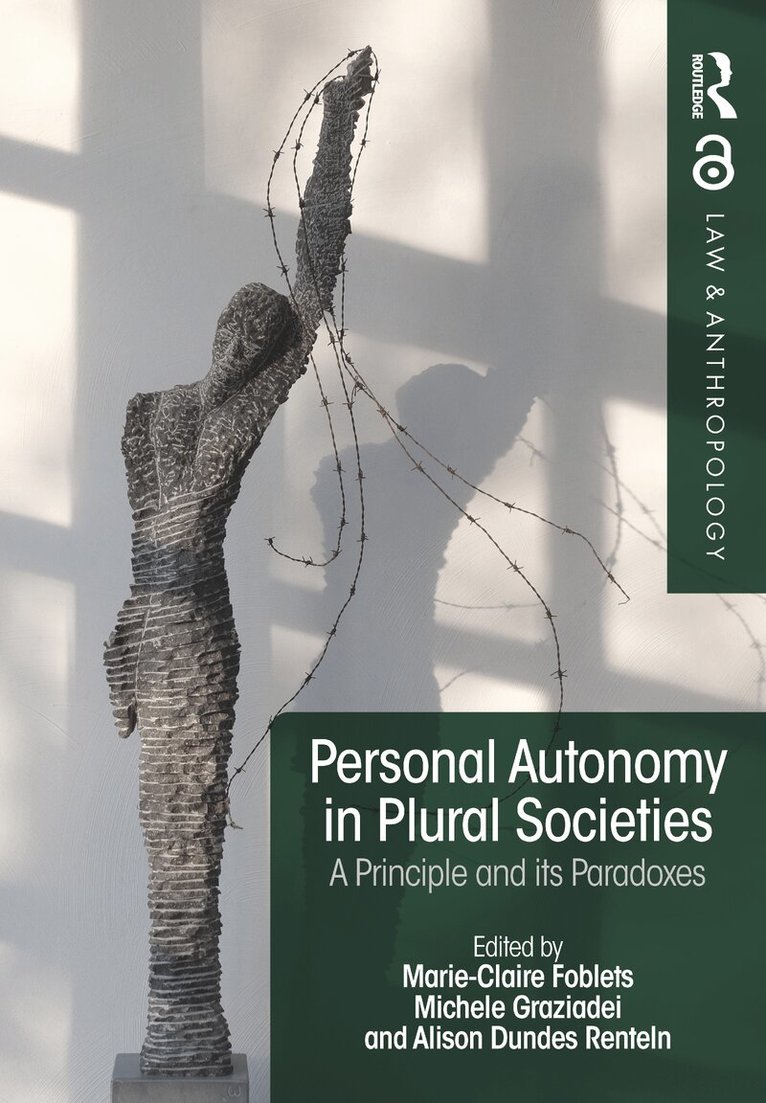
    Personal Autonomy in Plural Societies

    A Principle and its Paradoxes

    AvMarie-Claire Foblets,Michele Graziadei

    Inbunden, Engelska, 2017

    Del i serien Law and Anthropology

    2 229 kr

    Beställningsvara. Skickas inom 10-15 vardagar. Fri frakt över 249 kr.

    Beskrivning

    This volume addresses the exercise of personal autonomy in contemporary situations of normative pluralism. In the Western liberal tradition, from a strictly legal and theoretical perspective the social individual has the right to exercise the autonomy of his or her will. In a context of legal plurality, however, personal autonomy becomes more complicated. Can and should personal autonomy be recognized as a legal foundation for protecting a person’s freedom to renounce what others view as his or her fundamental ‘human rights’? This collection develops an interdisciplinary conceptual framework to address these questions and presents empirical studies examining the gap between the principle of personal autonomy and its implementation. In a context of cultural diversity, this gap manifests itself in two particular ways. First, not every culture gives the same pre-eminence to personal autonomy when examining the legal effects of an individual’s acts. Second, in a society characterized by ‘weak pluralism’, the legal assessment of personal autonomy often favours the views of the dominant majority. In highlighting these diverse perspectives and problematizing the so-called ‘guardian function’ of human rights, i.e., purporting to protect weaker parties by limiting their personal autonomy in the name of gender equality, fair trial, etc., this book offers a nuanced approach to the principle of autonomy and addresses the questions of whether it can effectively be deployed in situations of internormativity and what conditions must be met in order to ensure that it is not rendered devoid of all meaning. The Open Access version of this book, available at http://www.taylorfrancis.com, has been made available under a Creative Commons Attribution-Non Commercial-No Derivatives (CC-BY-NC-ND) 4.0 license.

    Produktinformation

    • Utgivningsdatum:2017-11-20
    • Mått:174 x 246 x 27 mm
    • Vikt:740 g
    • Format:Inbunden
    • Språk:Engelska
    • Serie:Law and Anthropology
    • Antal sidor:302
    • Förlag:Taylor & Francis Ltd
    • ISBN:9781138220218

    Utforska kategorier

    • Antropologi inom Samhälle och politik
    • Rättsvetenskap inom Juridik

    Mer om författaren

    Marie-Claire Foblets is Professor of Law at the University of Leuven, Belgium and since 2012 also Director of the Department of Law & Anthropology at the Max Planck Institute for Social Anthropology in Halle, Germany. She has held various visiting professorships both within and outside Europe. She has conducted extensive research and published widely on issues of migration law, citizenship/nationality laws, compulsory integration, anti-racism and non-discrimination, etc. In the field of anthropology of law, her research focuses on cultural diversity and legal practice, with a particular interest in the application of Islamic family law in Europe, and more recently in the accommodation of cultural and religious diversity under state law. Alison Dundes Renteln is Professor of Political Science, Anthropology, Law, and Public Policy at the University of Southern California, where she teaches International Law and Human Rights. She has taught judges, lawyers, court interpreters, jury consultants, and police officers at meetings of the American Bar Association, National Association of Women Judges, North American South Asian Bar Association, American Society of Trial Consultants, and others. She has collaborated with the UN on the implementation of the Convention on the Rights of Persons with Disabilities, lectured on comparative legal ethics in Bangkok and Manila at ABA-sponsored conferences, and served on several California civil rights commissions and the California committee of Human Rights Watch. She has published extensively on her areas of research. Michele Graziadei is Professor of Comparative Law at the University of Turin, Italy. His research concentrates on the methodology of comparative law, legal pluralism, law and language, and on other theoretical problems relating to the comparison of laws. He has published widely in several languages, and has directed or taken part in international research projects concerning law and other social sciences. He is a member of the International Academy of Comparative Law, President of the Italian Society for Research on Comparative Law (SIRD), President of the Italian Group of the Association Capitant, and fellow of the European Centre on Tort and Insurance Law, Vienna. He has been a visiting professor at Paris 2 Panthéon-Assas, Cornell University, Université de Luxembourg, and Bar-Ilan University, and is visiting Professor at the Université Jean Moulin, Lyon III. He teaches at the Faculté internationale de droit comparé, Strasbourg.

    Recensioner i media

    'This rich Volume not only invites – but forces – the reader to critically reflect on the meaning of liberalism, in a liberal democracy, in relation to the notions of personal autonomy and human rights. Whatever has been taken for granted turns out to be much more complicated when contrasted with the needs in a pluralistic society. The Volume is a warmly recommended reading for anyone concerned about the limits of cultural diversity.'Maarit Jänterä-Jareborg, Prof. Dr. Dr. h.c. mult., Professor of Private International Law and International Civil Procedure, Uppsala University, Sweden'In principle, personal autonomy should be a useful idea to navigate the troubled waters of contemporary plural societies. But what happens if that rudder is itself culturally conditioned? Is it still personal autonomy to stay the course? These are the main questions that this book seeks to answer.'Carlos Gómez Martínez, Judge in the Court of Appeal of the Balearic Islands

    Innehållsförteckning

    • Introduction: Individual Autonomy in Contemporary Plural Societies: How to Reconcile Competing Normative Standards? - Marie-Claire Foblets, Michele Graziadei and Alison Dundes RentelnPart I: Autonomy in the Face of Cultural Diversity: Disciplinary Perspectives1. The Fault in our Stars: Personal Autonomy, Philosophy, and the Law - Michele Graziadei2. Confronting Autonomy in Liberal Practice - Geoffrey Brahm Levey3. Autonomy and Deeply Embedded Cultural Identities - John Christman 4. Three Approaches to the Protection of Religious Freedom: Choice, Interest, Identity - Avigail Eisenberg5. Appeals to Choice and Sexual Equality: Debates over Religious Attire - Monique Deveaux 6. Why the Individual must be Defended ~ Seemingly against all Anthropological Odds - Olaf ZenkerPart II: Autonomy in Context: Empirical IllustrationsA: The Majoritarian Assessment of Personal Autonomy7. Cultural Diversity in the Workplace: Personal Autonomy as a Pillar for the Accommodation of Employees’ Religious Practices? - Katayoun Alidadi8. Adopting a Face-Veil, Concluding an Islamic Marriage: Autonomy, Agency, and Liberal-Secular Rule - Annelies Moors9. Unregistered Muslim Marriages in the UK: Examining Normative Influences Shaping Choice of Legal Protection - Rajnaara Akhtar10. Quis custodiet ipsos custodes? Personal Autonomy, Forced Marriage, and the Inherent Jurisdiction in English Law - Alberto Neidhardt11. Balancing Migration Policy and Personal Autonomy in Private International Law: A Shattered Illusion? - Jinske Verhellen12. The Anti-Religious Bias in Personal Autonomy: Towards Coherence and a Solution - Toon Agten13. Shaping Notions of Personal Autonomy in Plural Societies: Addressing Female Genital Cutting in France and the European Regulatory Framework’s Approach to this Custom - Lucia Bellucci14. The Human Rights Dimensions of Virginity Restoration Surgery - Alison Dundes RentelnB. Individual Agency in situ15. ‘It is Better for Me to Agree When My Guardian is Here’: Consent and Relational Personhood in Postcolonial Malawi - Jessica Johnson16. The Multiple Search for Autonomy among Moluccans in the Netherlands: A Relational Approach - Keebet von Benda-Beckmann17. An All but Trivial Abortion: Scrutinizing Sex Selection Legislation in India through the Lens of Women’s Autonomy - Kalindi Kokal18. Rethinking Social Norms: Contraceptive Use and Women’s Right to Choose in Senegal - Chiara Quagliariello19. Autonomous Aspirations? Re-reading the CEDAW Drafting Process and Examining Muslim Women’s Contributions - Shaheen Sardar Ali and Arjumand Bano Kazmi20. ‘That’s not our Culture’: Paradoxes of Personal Property in Indigenous Self-Governance - Ian Kalman