• Fri frakt över 249 kr
  • •
  • Snabba leveranser
  • •
  • Billiga böcker
Kundservice

Du är på sajten för privatpersoner.

Företag, bibliotek eller offentlig verksamhet?

Du handlar på classic.bokus.com, där alla dina funktioner finns intakta.
Till classic.bokus.com
Bokus logotyp. Gå till startsidan.
  • Erbjudanden
  • Nyheter
  • Student
  • Topplistor
  • Barn & ungdom
  • Bokus Play
  • E-böcker
  • Pocketböcker
  • Spel & pussel

10% rabatt på allt med kod: NYSTART10 →

Sidfot

Mina sidor

    Hjälp

    • Kundservice
    • Vanliga frågor och svar
    • Frakt och leverans
    • Retur vid ångerrätt
    • Reklamera vara
    • Betalning
    • Köpvillkor
    • Allmänna villkor
    • Information om webbplatsens tillgänglighet

    Om Bokus

    • Om oss
    • Pressrum
    • För studenter
    • För företag
    • För bibliotek och offentlig verksamhet
    • För leverantörer
    • Hållbarhet

    Populärt

    • Aktuella erbjudanden
    • Presentkort
    • Studentlitteratur
    • Nya böcker
    • Topplistor
    • Signerade böcker
    • Engelska böcker

    Inspiration

    • Boktips
    • BookTok
    • Populära bokserier
    • Barnbokskaraktärer
    • Populära författare
    Logotyp för Bokus
    Följ oss på Facebook (extern länk)Följ oss på Instagram (extern länk)Följ oss på YouTube (extern länk)Följ oss på TikTok (extern länk)
    bokus @ CookiesAnpassa cookiesIntegritetspolicyKöpvillkor
    Till Citymail hemsida (extern länk)Till Budbee hemsida (extern länk)Till Postnord hemsida (extern länk)Till Schenker hemsida (extern länk)Till Early Bird hemsida (extern länk)Till Walleys hemsida (extern länk)
    1. Samhälle och politik
    2. Krig och försvar
    3. Krigsvetenskap

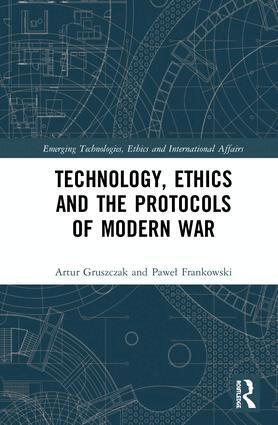
    Technology, Ethics and the Protocols of Modern War

    AvArtur Gruszczak,Pawel Frankowski

    Inbunden, Engelska, 2018

    Del i serien Emerging Technologies, Ethics and International Affairs

    2 421 kr

    Beställningsvara. Skickas inom 10-15 vardagar. Fri frakt över 249 kr.

    Beskrivning

    Contemporary security has expanded its meaning, content and structure in response to globalisation and the emergence of greatly improved world-wide communication. The protocols of modern warfare, including targeted killing, enhanced interrogations, mass electronic surveillance and the virtualisation of war have changed the moral landscape and brought diverse new interactions with politics, law, religion, ethics and technology.This book addresses how and why the nature of security has changed and what this means for the security actors involved and the wider society. Offering a crossdisciplinary perspective on concepts, meanings and categories of security, the book brings together scholars and experts from a range of disciplines including political, military studies and security studies, political economy and international relations. Contributors reflect upon new communication methods, postmodern concepts of warfare, technological determinants and cultural preferences to provide new theoretical and analytical insights into a changing security environment and the protocols of war in the 21st century.A useful text for scholars and students of security studies, international relations, global governance, international law and ethics, foreign policy, comparative studies and contemporary world history.

    Produktinformation

    • Utgivningsdatum:2018-03-28
    • Mått:156 x 234 x 21 mm
    • Vikt:476 g
    • Format:Inbunden
    • Språk:Engelska
    • Serie:Emerging Technologies, Ethics and International Affairs
    • Antal sidor:222
    • Förlag:Taylor & Francis Ltd
    • ISBN:9781138221338

    Utforska kategorier

    • Krigsvetenskap inom Samhälle och politik
    • Etiska frågor och debatter inom Samhälle och politik
    • Internationella relationer inom Samhälle och politik

    Mer om författaren

    Artur Gruszczak is an associate professor of political science, chair of national security at the Department of International and Political Studies, Jagiellonian University in Krakow, Poland. He is also faculty member of the European Academy Online run by the Centre International de Formation Européenne in Berlin. His principal interests and research areas include: EU internal security, EU intelligence cooperation, Euro-Atlantic security, modern warfare theory. Recently he published Intelligence Security in the European Union, Building a Strategic Intelligence Community (Palgrave Macmillan 2016) and edited Euro-Atlantic Security Policy: Between NATO Summits in Newport and Warsaw (Institute of Strategic Studies in Krakow 2015).Paweł Frankowski is an associate professor of international relations at the Institute of Political Science and International Relations, Jagiellonian University in Krakow, Poland. He was post-doctoral fellow at University of Iceland (2010-2011) and University of St. Gallen (2011-2012). He was also a 2008 US State Department Fellow, SCIEX 2012 Fellow and 2015 Salzburg Global Seminar Fellow. His current research interests include: outer space security, social standards in free tree agreements, and regional integration schemes in Africa.

    Innehållsförteckning

    • 1 Introduction: Protocols of modern war PART I Security transformations 2 Strategic communication and contemporary European security 3 Violence reconsidered: Towards post-modern warfare 4 Private security and military companies and foreign fighters: possible interactions and potential practical implications 5 Uprisings, violence and the securitisation of inequality 6 Complicating security: The multiple narratives emerging from the Ukraine crisis PART II Technology and ethics 7 Technology, development, global commons and international security: A global commons and interdisciplinary approach to global security 8 Organisational networks in post-conflict disarmament efforts 9 From MK-Ultra project to Human Terrain System: Militarisation of social sciences - ethical dilemmas and future prospects 10 Ethical dimension of post-heroic and autonomous modern armed conflicts 11 European military and dual-use technology transfers to Russia: The impact on European and Transatlantic security PART III Counterterrorism and cyber security 12 Dilemmas of security and social justice: The Maoist insurgency in India 13 Cyber security norms in the Euro-Atlantic region: NATO and the EU as norm entrepreneurs and norm diffusers 14 Cyberspace’s ontological implications for national security 15 Conclusions: Protocols of war - dimensions and layers