• Fri frakt över 249 kr
  • •
  • Snabba leveranser
  • •
  • Billiga böcker
Kundservice

Du är på sajten för privatpersoner.

Företag, bibliotek eller offentlig verksamhet?

Du handlar på classic.bokus.com, där alla dina funktioner finns intakta.
Till classic.bokus.com
Bokus logotyp. Gå till startsidan.
  • Erbjudanden
  • Nyheter
  • Student
  • Topplistor
  • Barn & ungdom
  • Bokus Play
  • E-böcker
  • Pocketböcker
  • Spel & pussel

10% rabatt på allt med kod NYSTART10 →

Sidfot

Mina sidor

    Hjälp

    • Kundservice
    • Vanliga frågor och svar
    • Frakt och leverans
    • Retur vid ångerrätt
    • Reklamera vara
    • Betalning
    • Köpvillkor
    • Allmänna villkor
    • Information om webbplatsens tillgänglighet

    Om Bokus

    • Om oss
    • Pressrum
    • För studenter
    • För företag
    • För bibliotek och offentlig verksamhet
    • För leverantörer
    • Hållbarhet

    Populärt

    • Aktuella erbjudanden
    • Presentkort
    • Studentlitteratur
    • Nya böcker
    • Topplistor
    • Signerade böcker
    • Engelska böcker

    Inspiration

    • Boktips
    • BookTok
    • Populära bokserier
    • Barnbokskaraktärer
    • Populära författare
    Logotyp för Bokus
    Följ oss på Facebook (extern länk)Följ oss på Instagram (extern länk)Följ oss på YouTube (extern länk)Följ oss på TikTok (extern länk)
    bokus @ CookiesAnpassa cookiesIntegritetspolicyKöpvillkor
    Till Citymail hemsida (extern länk)Till Budbee hemsida (extern länk)Till Postnord hemsida (extern länk)Till Schenker hemsida (extern länk)Till Early Bird hemsida (extern länk)Till Walleys hemsida (extern länk)
    1. Språk och ordböcker
    2. Språkundervisning och språkinlärning

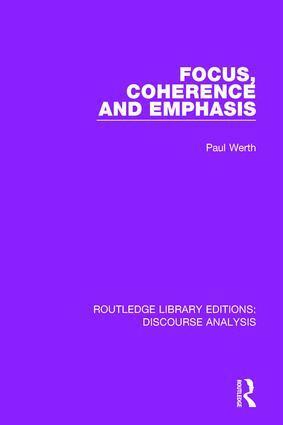
    Focus, Coherence and Emphasis

    AvPaul Werth

    Häftad, Engelska, 2018

    Del i serien RLE: Discourse Analysis

    427 kr

    Beställningsvara. Skickas inom 10-15 vardagar. Fri frakt över 249 kr.

    Beskrivning

    First published in 1984, this book examines a number of questions on the boundary of competence and performance — whose solutions have implications for linguistic theory in general. In particular, the form of grammatical statements, the relationship between various rules of grammar, the interaction between sentence in a sequence, and the inferences to be drawn from linguistic behaviour to linguistic knowledge. The author argues that many grammatical processes, inadequately handled by conventional sentence-grammars, require a text grammar in which the basic constitutive processes of information and deixis can be specified. They ago further to investigate the novel hypothesis that emphatic structure provides a crucial condition for the application of transformational rules, paying particular attention to the ‘movement-rules’ using mostly data culled from actual usage.

    Produktinformation

    • Utgivningsdatum:2018-05-17
    • Mått:156 x 234 x 17 mm
    • Vikt:453 g
    • Format:Häftad
    • Språk:Engelska
    • Serie:RLE: Discourse Analysis
    • Antal sidor:308
    • Förlag:Taylor & Francis Ltd
    • ISBN:9781138224650

    Utforska kategorier

    • Språkundervisning och språkinlärning inom Språk och ordböcker
    • Språk: referensverk och allmänt inom Språk och ordböcker
    • Språkvetenskap och lingvistik inom Språk och ordböcker

    Innehållsförteckning

    • List of figures and tables; Preface and acknowledgments; Part I: Generalia; 1. Introduction: Bringing Things into Focus 1.1 The field of scrutiny 1.2 A Programme 1.21 What do we know about texts? 1.22 What do we need to find out? 1.3 Defining terms 1.4 Aims and structure of the book Notes to Chapter One; Part II: Setting up the system; 2: Discourse 2.1 What IS a discourse 2.2 Summary: the properties of discourse 2.3 Sentences, propositions and semantic notation 2.4 Sketch of a model of D-grammar 2.5 Review section Notes to Chapter Two; 3. Context 3.1 Linguistic and extralinguistic context: competence or performance? 3.2 Review section: context-of-utterance 3.21 Immediate situation 3.22 Towards a model of situation 3.3 Frames and scenes 4.3 States-of-affairs 3.5 The common ground 3.6 Relevance Notes to Chapter Three; 4. Connectivity 4.1 Introduction 4.2 Cohesion 4.21 Anapora: a first glance 4.3 Collocation 4.4 Connectors 4.5 Coherence 4.51 An informal analysis 4.52 The coherence constraint Notes to Chapter Four; 5. Theoretical Considerations: Sharpening the Focus 5.1 Constraints in general 5.11 Review in action 5.12 Coherence constraints: general considerations 5.2 Positive coherence and synonymy 5.3 Negative coherence and antonymy 5.4 The coherence constraint: precise formulation Notes to Chapter Five; Part III: A text-grammar; 6. Emphasis 6.1 Emphasis-placement: an illustration 6.2 Is emphasis a surface-structure phenomenon? 6.21 What a phonological 6.22 A possible phonological account of emphasis 6.23 Some counterexamples 6.24 Summary: emphasis-interpretation from surface-structure 6.3 Is emphasis semantic/pragmatic in nature? 6.31 What a semantic/pragmatic account must do 6.32 Rules for emphasis 6.33 Arguments for the semantic/pragmatic nature of emphasis 6.4 Nature and behaviour of Reduction 6.5 Nature and behaviour of Accent 6.6 Nature and behaviour of Contrast 6.7 Review Section Notes to Chapter Six; 7. Contrast 7.1 Contrast on grammatical items 7.2 Contrast on lexical items 7.3 Summary: Contrast on grammatical and lexical categories 7.4 Semantic properties of sets 7.5 C and negative coherence Notes to Chapter Seven; 8. Anaphoric Connectivity 8.1 Résumé of anaphora 8.2 Reference 8.3 Type of anaphor 8.4 The role of emphasis 8.5 Anaphora as coherence 8.6 Reciprocal anaphora: two views 8.61 The view from G-B 8.62 Each 8.63 Other 8.64 Quantifier-floating 8.65 Reciprocals in complex sentences 8.66 Ambiguity of the phrasal form 8.67 Reciprocals and discourse 8.7 Anaphora and coherence Notes to Chapter Eight; 9. Syntactic Variation: Getting Movement into Focus 9.1 Introduction: "Movement" in recent grammatical models 9.2 Topic-comment articulation: review section 9.21 TCA and emphasis 9.22 The TCA constraint 9.3 Syntactic effects: summary of predictions 9.4 "Unmoved" structures 9.41 Behaviour of stress in unmoved structures 9.5 Passives: predictions of TCA constraint 9.51 Contexts with and without passives 9.52 Why passivise at all? 9.6 "Emphatic" constructions 9.61 Examples of emphatic constructions in context 9.62 Why cleft of pseudo-cleft? Notes to Chapter nine; 10. Conclusions 10.1 Summary 10.2 Implications 10.3 Empirical evidence for emphasis; Bibliography and Author-Index; Subject-Index