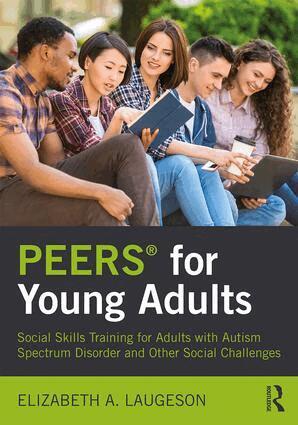
PEERS® for Young Adults
Social Skills Training for Adults with Autism Spectrum Disorder and Other Social Challenges
909 kr
Beställningsvara. Skickas inom 10-15 vardagar. Fri frakt över 249 kr.
Du är på sajten för privatpersoner.
909 kr
Beställningsvara. Skickas inom 10-15 vardagar. Fri frakt över 249 kr.
Dr. Elizabeth A. Laugeson is a licensed clinical psychologist and an assistant clinical professor in the Department of Psychiatry and Biobehavioral Sciences at the UCLA Semel Institute for Neuroscience and Human Behavior. Dr. Laugeson is the director of the Help Group—UCLA Autism Research Alliance, a collaborative research initiative dedicated to developing and expanding applied clinical research in the treatment of children and adolescents with ASD. She is also the training director for the UCLA Tarjan Center for Excellence in Developmental Disabilities (UCEDD), and the founder and director of the UCLA PEERS® Clinic, an outpatient hospital-based program providing parent-assisted social skills training for individuals with ASD, ADHD, depression, anxiety, and other social impairments across the lifespan.
"Many young adults with ASD struggle to make and keep friends and establish romantic relationships. Despite caregivers and relatives best efforts, these individuals are often socially isolated and despondent about their future social life. Dr Elizabeth Laugeson and her team have risen to this challenge by building upon their successful and widely used PEERS program for teenagers to produce The PEERS for Young Adults Manual: an evidence-based group treatment program for able young adults with ASD or other social difficulties. The manual is targeted at clinicians knowledgeable about ASD in adult life and provides a self-contained and comprehensive approach to teaching the ecologically valid social skills necessary for establishing and maintaining meaningful relationships. It is not difficult to see why this CBT approach is so effective: the focus of individual sessions is on key skills and the session formats are predictable and build upon prior learning; the teaching style is Socratean and encourages problem solving and perspective taking; whilst there is a strong emphasis on the logical underpinnings of successful social interactions, much use is also made of humor to reinforce learning; therapists encourage participants to use easily remembered buzzwords and phrases to encapsulate important learning points; clear homework tasks are set to provide opportunities to rehearse newly learnt skills, and, particularly importantly, caregivers attend parallel group sessions where they learn how to provide social coaching to support rehearsal in the individuals’ social environment. Laugeson displays a deep understanding of the nuts and bolts of both social interactions and running therapy groups and gives advice based on extensive experience. She also thoughtfully highlights where adaptions may be necessary to deal with varying social norms. Although not all clinicians will have the resources to provide a group based intervention, I still highly recommend they read this manual: even the most experienced therapists will find helpful knowledge and tips on how to improve the social interactions of their clients."Dr Anthony J. Bailey, chair of Child and Adolescent Psychiatry, UBC, Institute of Mental Health chair
Du är på sajten för privatpersoner.
909 kr
Beställningsvara. Skickas inom 10-15 vardagar. Fri frakt över 249 kr.
Dr. Elizabeth A. Laugeson is a licensed clinical psychologist and an assistant clinical professor in the Department of Psychiatry and Biobehavioral Sciences at the UCLA Semel Institute for Neuroscience and Human Behavior. Dr. Laugeson is the director of the Help Group—UCLA Autism Research Alliance, a collaborative research initiative dedicated to developing and expanding applied clinical research in the treatment of children and adolescents with ASD. She is also the training director for the UCLA Tarjan Center for Excellence in Developmental Disabilities (UCEDD), and the founder and director of the UCLA PEERS® Clinic, an outpatient hospital-based program providing parent-assisted social skills training for individuals with ASD, ADHD, depression, anxiety, and other social impairments across the lifespan.
"Many young adults with ASD struggle to make and keep friends and establish romantic relationships. Despite caregivers and relatives best efforts, these individuals are often socially isolated and despondent about their future social life. Dr Elizabeth Laugeson and her team have risen to this challenge by building upon their successful and widely used PEERS program for teenagers to produce The PEERS for Young Adults Manual: an evidence-based group treatment program for able young adults with ASD or other social difficulties. The manual is targeted at clinicians knowledgeable about ASD in adult life and provides a self-contained and comprehensive approach to teaching the ecologically valid social skills necessary for establishing and maintaining meaningful relationships. It is not difficult to see why this CBT approach is so effective: the focus of individual sessions is on key skills and the session formats are predictable and build upon prior learning; the teaching style is Socratean and encourages problem solving and perspective taking; whilst there is a strong emphasis on the logical underpinnings of successful social interactions, much use is also made of humor to reinforce learning; therapists encourage participants to use easily remembered buzzwords and phrases to encapsulate important learning points; clear homework tasks are set to provide opportunities to rehearse newly learnt skills, and, particularly importantly, caregivers attend parallel group sessions where they learn how to provide social coaching to support rehearsal in the individuals’ social environment. Laugeson displays a deep understanding of the nuts and bolts of both social interactions and running therapy groups and gives advice based on extensive experience. She also thoughtfully highlights where adaptions may be necessary to deal with varying social norms. Although not all clinicians will have the resources to provide a group based intervention, I still highly recommend they read this manual: even the most experienced therapists will find helpful knowledge and tips on how to improve the social interactions of their clients."Dr Anthony J. Bailey, chair of Child and Adolescent Psychiatry, UBC, Institute of Mental Health chair