• Fri frakt över 249 kr
  • •
  • Snabba leveranser
  • •
  • Billiga böcker
Kundservice

Du är på sajten för privatpersoner.

Företag, bibliotek eller offentlig verksamhet?

Du handlar på classic.bokus.com, där alla dina funktioner finns intakta.
Till classic.bokus.com
Bokus logotyp. Gå till startsidan.
  • Erbjudanden
  • Nyheter
  • Student
  • Topplistor
  • Barn & ungdom
  • Bokus Play
  • E-böcker
  • Pocketböcker
  • Spel & pussel

10% rabatt på allt med kod: NYSTART10 →

Sidfot

Mina sidor

    Hjälp

    • Kundservice
    • Vanliga frågor och svar
    • Frakt och leverans
    • Retur vid ångerrätt
    • Reklamera vara
    • Betalning
    • Köpvillkor
    • Allmänna villkor
    • Information om webbplatsens tillgänglighet

    Om Bokus

    • Om oss
    • Pressrum
    • För studenter
    • För företag
    • För bibliotek och offentlig verksamhet
    • För leverantörer
    • Hållbarhet

    Populärt

    • Aktuella erbjudanden
    • Presentkort
    • Studentlitteratur
    • Nya böcker
    • Topplistor
    • Signerade böcker
    • Engelska böcker

    Inspiration

    • Boktips
    • BookTok
    • Populära bokserier
    • Barnbokskaraktärer
    • Populära författare
    Logotyp för Bokus
    Följ oss på Facebook (extern länk)Följ oss på Instagram (extern länk)Följ oss på YouTube (extern länk)Följ oss på TikTok (extern länk)
    bokus @ CookiesAnpassa cookiesIntegritetspolicyKöpvillkor
    Till Citymail hemsida (extern länk)Till Budbee hemsida (extern länk)Till Postnord hemsida (extern länk)Till Schenker hemsida (extern länk)Till Early Bird hemsida (extern länk)Till Walleys hemsida (extern länk)
    1. Psykologi och pedagogik
    2. Pedagogik
    3. Pedagogisk psykologi

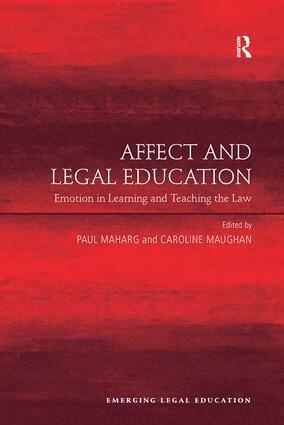
    Affect and Legal Education

    Emotion in Learning and Teaching the Law

    AvCaroline Maughan,Paul Maharg

    Häftad, Engelska, 2017

    Del i serien Emerging Legal Education

    807 kr

    Beställningsvara. Skickas inom 10-15 vardagar. Fri frakt över 249 kr.

    Beskrivning

    The place of emotion in legal education is rarely discussed or analysed, and we do not have to seek far for the reasons. The difficulty of interdisciplinary research, the technicisation of legal education itself, the view that affect is irrational and antithetical to core western ideals of rationality - all this has made the subject of emotion in legal education invisible. Yet the educational literature on emotion proves how essential it is to student learning and to the professional lives of teachers. This text, the first full-length book study of the subject, seeks to make emotion a central topic of research for legal educators, and restore the power of emotion in our teaching and learning. Part 1 focuses on the contribution that neuroscience can make to legal learning, a theme that is carried through other chapters in the book. Part 2 explores the role of emotion in the working lives of academics and clinical staff, while Part 3 analyses the ways in which emotion can be used in learning and teaching. The book, interdisciplinary and wide-ranging in its reference, breaks new ground in its analysis of the educational lifeworld of situations, communities, actors and interactions in legal education.

    Produktinformation

    • Utgivningsdatum:2017-02-27
    • Mått:156 x 234 x 22 mm
    • Vikt:630 g
    • Format:Häftad
    • Språk:Engelska
    • Serie:Emerging Legal Education
    • Antal sidor:338
    • Förlag:Taylor & Francis Ltd
    • ISBN:9781138247154

    Utforska kategorier

    • Pedagogisk psykologi inom Psykologi och pedagogik
    • Undervisning i specifika ämnen inom Psykologi och pedagogik
    • Juristyrken inom Juridik

    Mer om författaren

    Paul Maharg is Professor of Law at the Australian National University, and Professor of Law at Nottingham Law School. He has published extensively in the areas of legal education and legal critique. He has worked with regulators, law firms and law schools in England, Scotland, Canada, USA, Hong Kong and Australia. Caroline Maughan is a Principal Lecturer in Law and Director of Teaching and Learning at Bristol Law School, University of the West of England. She specializes in skills-based legal education. She currently teaches on the Bar Vocational Course and LLB year 3. She is a co-author of the OUP LPC manual 'Lawyers' Skills'. Her research interests are centred around legal education. She has published widely on skills-based, experiential and collaborative learning, and with Julian Webb co-edited Teaching Lawyers' Skills (1996) and co-wrote the student text Lawyering Skills and the Legal Process, (CUP Law in Context series, 2nd ed 2005). She has facilitated a number of workshops at conferences and staff development events across the UK.

    Recensioner i media

    'By throwing light on the ways in which emotions play a significant role in both learning and teaching law, this international collection from some of the leading experts in legal education draws our attention to a much-neglected aspect of the educational process. It deserves to be widely read, seeking to enrich our understanding both of law students and law teachers by revealing just how crucial the affective domain is in relation to the rational thinking that we generally assume lies at the heart of legal education.' Fiona Cownie, Keele University, UK 'This pioneering text devotes long overdue attention to the role of the affective domain in legal education and compels action: at stake is the psychological and ethical wellbeing of our students, their educators and the practicing profession. To accommodate affect is not to oppose cognitive and lawyering excellence, but to enhance it. This volume will be essential reading for those committed to the moral-ethical development of a functioning and humane legal profession.' Sally Kift, Queensland University of Technology, Australia '... intellectually stimulating, wide-ranging, extremely well-written and long overdue... so multi-faceted and multi-layered that a second volume is doubtless warranted...' Hibernian Law Journal

    Innehållsförteckning

    • Contents: Introduction, Paul Maharg and Caroline Maughan; Part I Affect, Legal Education and Neuroscience: Why study emotion?, Caroline Maughan; Learning and the brain - an overview, Richard Roche; Enhancing self-control: insights from neuroscience, Lorraine Boran and David Delany. Part II Affect and Legal Education: Can litigators let go? The role of practitioner-supervisors in clinical legal education programmes, Sara Chandler; Instead of a career: work, art and love in university law schools, Anthony Bradney; What do academics think and feel about quality?, Chris Maguire. Part III Affect and Learning: From Socrates to Damasio, from Langdell to Kandel: the role of emotion in modern legal education, Alan M. Lerner; Legal understanding and the affective imagination, Maksymilian Del Mar; What students care about and why we should care, Graham Ferris and Rebecca Huxley-Binns; The body in (e)motion: thinking through embodiment in legal education, Julian Webb; Developing professional character - trust, values and learning, Karen Barton and Fiona Westwood; Addressing emotions in preparing ethical lawyers, Nigel Duncan; Space, absence, silence: the intimate dimensions of legal learning, Paul Maharg; Index.