• Fri frakt över 249 kr
  • •
  • Snabba leveranser
  • •
  • Billiga böcker
Kundservice

Du är på sajten för privatpersoner.

Företag, bibliotek eller offentlig verksamhet?

Du handlar på classic.bokus.com, där alla dina funktioner finns intakta.
Till classic.bokus.com
Bokus logotyp. Gå till startsidan.
  • Erbjudanden
  • Nyheter
  • Student
  • Topplistor
  • Barn & ungdom
  • Bokus Play
  • E-böcker
  • Pocketböcker
  • Spel & pussel

10% rabatt på allt med kod NYSTART10 →

Sidfot

Mina sidor

    Hjälp

    • Kundservice
    • Vanliga frågor och svar
    • Frakt och leverans
    • Retur vid ångerrätt
    • Reklamera vara
    • Betalning
    • Köpvillkor
    • Allmänna villkor
    • Information om webbplatsens tillgänglighet

    Om Bokus

    • Om oss
    • Pressrum
    • För studenter
    • För företag
    • För bibliotek och offentlig verksamhet
    • För leverantörer
    • Hållbarhet

    Populärt

    • Aktuella erbjudanden
    • Presentkort
    • Studentlitteratur
    • Nya böcker
    • Topplistor
    • Signerade böcker
    • Engelska böcker

    Inspiration

    • Boktips
    • BookTok
    • Populära bokserier
    • Barnbokskaraktärer
    • Populära författare
    Logotyp för Bokus
    Följ oss på Facebook (extern länk)Följ oss på Instagram (extern länk)Följ oss på YouTube (extern länk)Följ oss på TikTok (extern länk)
    bokus @ CookiesAnpassa cookiesIntegritetspolicyKöpvillkor
    Till Citymail hemsida (extern länk)Till Budbee hemsida (extern länk)Till Postnord hemsida (extern länk)Till Schenker hemsida (extern länk)Till Early Bird hemsida (extern länk)Till Walleys hemsida (extern länk)
    1. Data och IT
    2. Informationsteknik: allmänt

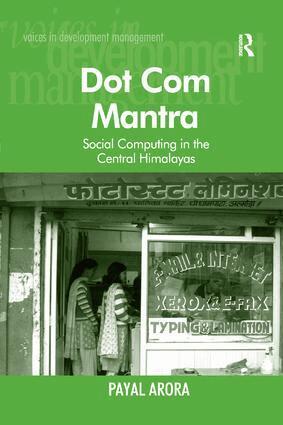
    Dot Com Mantra

    Social Computing in the Central Himalayas

    AvPayal Arora

    Häftad, Engelska, 2016

    879 kr

    Beställningsvara. Skickas inom 10-15 vardagar. Fri frakt över 249 kr.

    Fler format och utgåvor

    E-bok

    1 040 kr

    E-bok

    1 040 kr

    Inbunden

    2 425 kr

    Beskrivning

    Billions of dollars are being spent nationally and globally on providing computing access to digitally disadvantaged groups and cultures with an expectation that computers and the Internet can lead to higher socio-economic mobility. This ethnographic study of social computing in the Central Himalayas, India, investigates alternative social practices with new technologies and media amongst a population that is for the most part undocumented. In doing so, this book offers fresh and critical perspectives in areas of contemporary debate: informal learning with computers, cyberleisure, gender access and empowerment, digital intermediaries, and glocalization of information and media.

    Produktinformation

    • Utgivningsdatum:2016-11-23
    • Mått:156 x 234 x 11 mm
    • Vikt:453 g
    • Format:Häftad
    • Språk:Engelska
    • Antal sidor:208
    • Förlag:Taylor & Francis Ltd
    • ISBN:9781138260597

    Utforska kategorier

    • Informationsteknik: allmänt inom Data och IT
    • Geografi inom Naturvetenskap och teknik

    Mer om författaren

    Payal Arora is Assistant Professor in International Media and Communication in the Department of Media and Communication at Erasmus University Rotterdam, The Netherlands.

    Recensioner i media

    'A towering piece of research and writing, imbued with theoretical and methodological vigor, and sensitively illuminating the intersections of digital media and human ingenuity in the Central Himalayas. A must read.' Arvind Singhal, University of Texas at El Paso, USA, and Clinton School of Public Service, USA 'In every age, innovative technology has been met with an awkward mixture of enthusiasm, indifference, scepticism and hostility. The advent in our time of cheap, mobile computing and cellular telephones has drawn a similar response, especially in the international development community. In Dot Com Mantra, Payal Arora goes beyond the familiar juxtapositions to show how poor individuals and communities actively negotiate their engagement with twenty-first century technology, documenting the conditions under which they use, abuse and reject it in their everyday lives. The result is a book that is fascinating in its own right, but also highly instructive to a new generation of development policymakers, in rich and poor countries alike, caught between an imperative for easy answers and the reality of messy complexity.' Michael Woolcock, World Bank 'Dot Com Mantra is an excellent work by Payal Arora. ... [it] focuses largely on the social, economic, and political aspect of development considered within a global framework. Dr. Arora speaks the language of the area and fully immersed herself in its day-to-day life, moving among farmers' organization, development groups (non-governmental organizations-NGOs), teachers and students, and even volunteering her time working in an Internet café, from all of which she derived deep understandings.' Journal of Education, Community & Values

    Innehållsförteckning

    • Chapter 1 Introduction; Chapter 2 Frogs to Princes: Taking the Leap; Almora; Chapter 3 This is India, Madam!; Chapter 4 New Technology, Old Practices; Computers and Rural Development; Chapter 5 Goodbye to the Patwaris; Chapter 6 1A version of this material has been published as an article in the British Journal of Educational Technology. I would like to thank Colin Latchem, the Asia-Pacific Corresponding Editor of BJET for his tireless effort in shaping this article. Also, I would like to thank David Hawkridge for his insightful comments and the anonymous reviewers for their feedback. I am much indebted to Sugata Mitra for challenging and engaging me in this novel and important arena of informal learning; Computing and Cybercafés; Chapter 7 1Some material from this chapter has been used to produce a case study for educational technology and learning. This case study has been published in S. Marshall and W. Kinuthia (eds) (2010), Cases n places: Global cases in educational and performance technology. Charlotte, NC: Information Age Publishing; Chapter 8 Let’s Go Shopping!; Chapter 9 Leisure, Labor, Learning; Chapter 10 Conclusion;