• Fri frakt över 249 kr
  • •
  • Snabba leveranser
  • •
  • Billiga böcker
Kundservice

Du är på sajten för privatpersoner.

Företag, bibliotek eller offentlig verksamhet?

Du handlar på classic.bokus.com, där alla dina funktioner finns intakta.
Till classic.bokus.com
Bokus logotyp. Gå till startsidan.
  • Erbjudanden
  • Nyheter
  • Student
  • Topplistor
  • Barn & ungdom
  • Bokus Play
  • E-böcker
  • Pocketböcker
  • Spel & pussel

10% rabatt på allt med kod NYSTART10 →

Sidfot

Mina sidor

    Hjälp

    • Kundservice
    • Vanliga frågor och svar
    • Frakt och leverans
    • Retur vid ångerrätt
    • Reklamera vara
    • Betalning
    • Köpvillkor
    • Allmänna villkor
    • Information om webbplatsens tillgänglighet

    Om Bokus

    • Om oss
    • Pressrum
    • För studenter
    • För företag
    • För bibliotek och offentlig verksamhet
    • För leverantörer
    • Hållbarhet

    Populärt

    • Aktuella erbjudanden
    • Presentkort
    • Studentlitteratur
    • Nya böcker
    • Topplistor
    • Signerade böcker
    • Engelska böcker

    Inspiration

    • Boktips
    • BookTok
    • Populära bokserier
    • Barnbokskaraktärer
    • Populära författare
    Logotyp för Bokus
    Följ oss på Facebook (extern länk)Följ oss på Instagram (extern länk)Följ oss på YouTube (extern länk)Följ oss på TikTok (extern länk)
    bokus @ CookiesAnpassa cookiesIntegritetspolicyKöpvillkor
    Till Citymail hemsida (extern länk)Till Budbee hemsida (extern länk)Till Postnord hemsida (extern länk)Till Schenker hemsida (extern länk)Till Early Bird hemsida (extern länk)Till Walleys hemsida (extern länk)
    1. Ekonomi och Ledarskap
    2. Nationalekonomi
    3. Internationell ekonomi

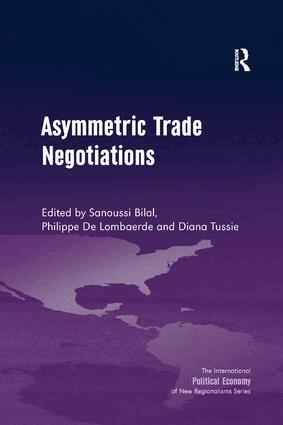
    Asymmetric Trade Negotiations

    AvSanoussi Bilal,Philippe De Lombaerde

    Häftad, Engelska, 2016

    Del i serien New Regionalisms Series

    846 kr

    Beställningsvara. Skickas inom 10-15 vardagar. Fri frakt över 249 kr.

    Fler format och utgåvor

    E-bok

    895 kr

    E-bok

    895 kr

    Inbunden

    2 495 kr

    Beskrivning

    The slow pace of the Doha Round has boosted the proliferation of regional and bilateral trade agreements. Paradoxically, the more powerful actors, the US and the European Union, who at the same time have benefited the most from the multilateral system, have also been engaged in bilateral and regional negotiations in order to sign WTO-plus agreements with developing countries. Combining a clear theoretical exposition with systematic cross-regional analysis, 'Asymmetric Trade Negotiations' offers a coherent picture of strategic, design and political economy aspects of North-South trade negotiation processes, from African, Asian and Latin American perspectives. Skilled area specialists gather to provide negotiators and policy makers in the South with recommendations, best practices, and benchmarks and contribute to the understanding of these recent processes.

    Produktinformation

    • Utgivningsdatum:2016-11-15
    • Mått:156 x 234 x 12 mm
    • Vikt:410 g
    • Format:Häftad
    • Språk:Engelska
    • Serie:New Regionalisms Series
    • Antal sidor:224
    • Förlag:Taylor & Francis Ltd
    • ISBN:9781138261563

    Utforska kategorier

    • Internationell ekonomi inom Ekonomi och Ledarskap
    • Ekonomisk politik inom Ekonomi och Ledarskap

    Mer om författaren

    Philippe De Lombaerde is Associate Director at United Nations University Institute on Comparative Regional Integration Studies (UNU-CRIS) (Bruges, Belgium). Sanoussi Bilal is the Head of the Economic and Trade Cooperation Programme at the European Centre for Development Policy Management (ECDPM) (Maastricht, The Netherlands). Diana Tussie directs the Department of International Relations at the Argentine campus of the Facultad Latinoamericana de Ciencias Sociales (FLACSO), and is founding director of the Latin American Trade Network.

    Recensioner i media

    'Power dynamics and competing interests in international trade negotiations are a vexing problem at the heart of global and regional trade agendas. The multi-regional and comparative cases in the volume allow a nuanced understanding of the intricacies of negotiations among asymmetrical trade partners. It is an important contribution to the debate on the architecture of global economic institutions, as well as the future of the global trade agenda.' José Raúl Perales, The George Washington University, USA 'Given that almost all of New Zealand’s trade negotiations are with larger partners (only Brunei is smaller), this book on asymmetry and how to cope with it is timely... it offers credible examples from the 21st century... A timely reminder of enduring global political-economic imbalances.' New Zealand International Review 'The international political economy framework employed in this book is paired with a trade policy practitioner’s level of detailed knowledge of the world trading regime, making for a book that is both theoretically interesting and empirically satisfying. ... This book is a good contribution to international political economy analyses of the world trade regime.' Political Studies Review

    Innehållsförteckning

    • Chapter 1 The Sweep of Asymmetric Trade Negotiations: Introduction and Overview, Diana Tussie, Marcelo Saguier; Chapter 2 The Scope for Asymmetry in the World Trade Organisation (WTO), Woolcock Stephen; Chapter 3 Asymmetric Trade Negotiations for Development: What Does the Experience from the ACP-EU Economic Partnership Agreements Tell Us?, Bilal Sanoussi; Chapter 4 Comparative Asymmetric Trade Negotiations in the Southern Cone: FTAA and EU-MERCOSUR, Mercedes Botto, Andrea C. Bianculli; Chapter 5 Venezuela in Asymmetric Trade Negotiations: The Cases of Negotiations in the FTAA and with the EU, Rita Giacalone; Chapter 6 Negotiating the Colombia-US FTA: A Colombian Perspective, Luis Jorge Garay, Philippe De Lombaerde, Fernando Barberi; Chapter 7 Negotiating the Thailand-US Free Trade Agreement, Wisarn Pupphavesa, Ludo Cuyvers, Santi Chaisrisawatsuk, Philippe De Lombaerde; Chapter 8 Postscript: Asymmetric Trade Negotiations After the Turn-of-the-decade ‘Global’ Financial Crisis?, Timothy M. Shaw;