• Fri frakt över 249 kr
  • •
  • Snabba leveranser
  • •
  • Billiga böcker
Kundservice

Du är på sajten för privatpersoner.

Företag, bibliotek eller offentlig verksamhet?

Du handlar på classic.bokus.com, där alla dina funktioner finns intakta.
Till classic.bokus.com
Bokus logotyp. Gå till startsidan.
  • Erbjudanden
  • Nyheter
  • Student
  • Topplistor
  • Barn & ungdom
  • Bokus Play
  • E-böcker
  • Pocketböcker
  • Spel & pussel

10% rabatt på allt med kod: NYSTART10 →

Sidfot

Mina sidor

    Hjälp

    • Kundservice
    • Vanliga frågor och svar
    • Frakt och leverans
    • Retur vid ångerrätt
    • Reklamera vara
    • Betalning
    • Köpvillkor
    • Allmänna villkor
    • Information om webbplatsens tillgänglighet

    Om Bokus

    • Om oss
    • Pressrum
    • För studenter
    • För företag
    • För bibliotek och offentlig verksamhet
    • För leverantörer
    • Hållbarhet

    Populärt

    • Aktuella erbjudanden
    • Presentkort
    • Studentlitteratur
    • Nya böcker
    • Topplistor
    • Signerade böcker
    • Engelska böcker

    Inspiration

    • Boktips
    • BookTok
    • Populära bokserier
    • Barnbokskaraktärer
    • Populära författare
    Logotyp för Bokus
    Följ oss på Facebook (extern länk)Följ oss på Instagram (extern länk)Följ oss på YouTube (extern länk)Följ oss på TikTok (extern länk)
    bokus @ CookiesAnpassa cookiesIntegritetspolicyKöpvillkor
    Till Citymail hemsida (extern länk)Till Budbee hemsida (extern länk)Till Postnord hemsida (extern länk)Till Schenker hemsida (extern länk)Till Early Bird hemsida (extern länk)Till Walleys hemsida (extern länk)
    1. Kultur
    2. Musikböcker
    3. Musikvetenskap

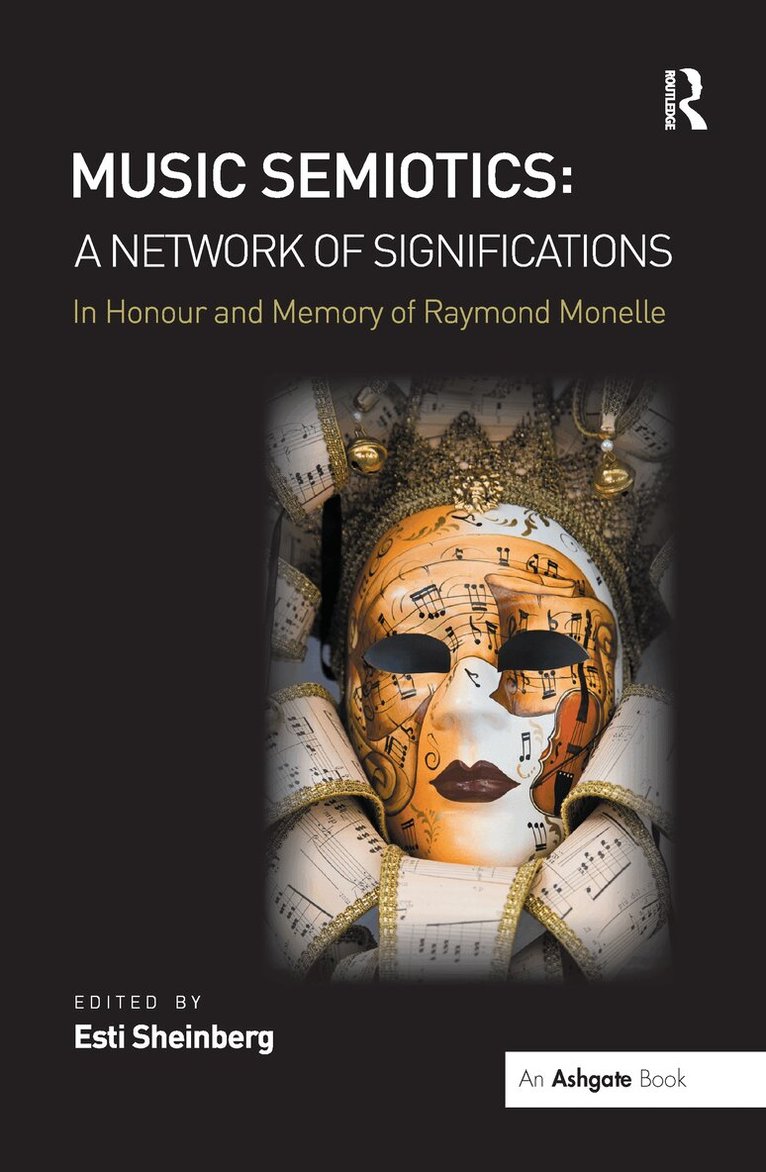
    Music Semiotics: A Network of Significations

    In Honour and Memory of Raymond Monelle

    AvEsti Sheinberg

    Häftad, Engelska, 2016

    860 kr

    Beställningsvara. Skickas inom 10-15 vardagar. Fri frakt över 249 kr.

    Beskrivning

    United in their indebtedness to the scholarship of Raymond Monelle, an international group of contributors, including leading authorities on music and culture, come together in this state of the art volume to investigate different ways in which music signifies. Music semiotics asks what music signifies as well as how the signification process takes place. Looking at the nature of musical texts and music's narrativity, a number of the essays in this collection delve into the relationship between music and philosophy, literature, poetry, folk traditions and the theatre, with opera a genre that particularly lends itself to this mode of investigation. Other contributions look at theories of musical markedness, metaphor and irony, using examples and specific musical texts to serve as case studies to validate their theoretical approaches. Musical works discussed include those by Haydn, Mozart, Beethoven, Schumann, Wagner, Stravinsky, Bartók, Xenakis, Kutavicius and John Adams, offering stimulating discussions of music that attest to its beauty as much as to its intellectual challenge. Taking Monelle's writing as a model, the contributions adhere to a method of logical argumentation presented in a civilized and respectful way, even - and particularly - when controversial issues are at stake, keeping in mind that contemplating the significance of music is a way to contemplate life itself.

    Produktinformation

    • Utgivningsdatum:2016-09-09
    • Mått:156 x 234 x 20 mm
    • Vikt:521 g
    • Format:Häftad
    • Språk:Engelska
    • Antal sidor:368
    • Förlag:Taylor & Francis Ltd
    • ISBN:9781138270749

    Utforska kategorier

    • Musikvetenskap inom Kultur

    Mer om författaren

    Esti Sheinberg is the author of Irony, Satire, Parody and the Grotesque in the Music of Dmitri Shostakovich (Ashgate: 2000). A former student and colleague of Raymond Monelle, Sheinberg's scholarship contributes to the developing field of music signification by combining music analysis and historical research with the semiotics of music.

    Recensioner i media

    'Conceived as a tribute to one of music semiotics' most energetic and versatile thinkers, this fascinating collection tackles questions of musical signification from a variety of perspectives (from aesthetics and psychology to hermeneutics and musicology). Several essays lie at the cutting edge of semiotic research, and will enrich our understanding of what and how music means.' Kofi Agawu, Princeton University, USA The list of contributors to this volume is impressive. New, emergent voices are found alongside the great names in the musicology of meanings. ... Sheinberg‘s prose is sparkling clear, witty, and deeply human. Her presentation, both of Monelle the man and Monelle the researcher, will remain as a reference. ... The book condenses the throbbing experience of Raymond Monelle‘s legacy into a living entity so rich in so many facets that there‘s room for contradiction and paradox. Min-Ad: Israel Studies in Musicology Online Review

    Innehållsförteckning

    • Contents: Foreword, Eero Tarasti; Preface; Introduction, Esti Sheinberg; Part I The Universe of Musical Meaning: The sense of music, Christine Esclapez; How did music rise to philosophical eminence? (And how has it been deprived of it?), Bálint Veres; Between the field and the salon, Marina Ritzarev; The significance of musical rules: a summary of selected principles of organization, Dalia Cohen; Music in Bakhtin's philosophical aesthetics, Anthony Gritten. Part II Texts, Narratives and Intermodalities: Cycling song: the Wilhelm Meister collections, William P. Dougherty; On metaphor and syntactic troping in music, Robert S. Hatten; Fanny Mendelssohn's cantata Hiob: a transpersonal commentary on divine darkness, Edith Zack; The 'preludio' of the Four Orchestral Pieces, Op.12 by Béla Bartók: an intertextual analytical approach, Márta Grabócz; Semiotic analysis and computational modelling: two case studies on works by Debussy and Xenakis, Christina Anagnostopoulou and Emilios Cambouropoulos. Part III Networks: Who Signals What (and How)?: Time, subjectivity and contested signs: developing Monelle's application of Pierce's 1903 typology to music, Ben Curry; Reflections on musical topics and musical character in performance, David Lidov; Against reproduction, Nicholas Cook; Dramatic signification of the Grail Knights' choruses of Parsifal by Richard Wagner, Anne Sivuoja; Realism and Artifice: innovation, Wagner's Ring and theatre practice in the German Democratic Republic, Elaine Kelly. Part IV The Musical Topic: Beyond Conventions: The topic of emotion, Michael Spitzer; Parody of learned style, Tamara Balter; Ironic inflections of topics: Beethoven's Quartet Op.127, Jamie Liddle; Dysphoric states: Stravinsky's topics - huntsmen, soldiers and shepherds, Nicholas McKay; 'Counting down' time: musical topics in John Adams' Doctor Atomic, Yayoi Uno Everett; 'Cet amour si violent...': on some topical motives in contemporary Lithuanian music, Ruta Staneviciute; Tributes;