• Fri frakt över 249 kr
  • •
  • Snabba leveranser
  • •
  • Billiga böcker
Kundservice

Du är på sajten för privatpersoner.

Företag, bibliotek eller offentlig verksamhet?

Du handlar på classic.bokus.com, där alla dina funktioner finns intakta.
Till classic.bokus.com
Bokus logotyp. Gå till startsidan.
  • Erbjudanden
  • Nyheter
  • Student
  • Topplistor
  • Barn & ungdom
  • Bokus Play
  • E-böcker
  • Pocketböcker
  • Spel & pussel

10% studentrabatt med kod TERM26

Sidfot

Mina sidor

    Hjälp

    • Kundservice
    • Vanliga frågor och svar
    • Frakt och leverans
    • Retur vid ångerrätt
    • Reklamera vara
    • Betalning
    • Köpvillkor
    • Allmänna villkor
    • Information om webbplatsens tillgänglighet

    Om Bokus

    • Om oss
    • Pressrum
    • För studenter
    • För företag
    • För bibliotek och offentlig verksamhet
    • För leverantörer
    • Hållbarhet

    Populärt

    • Aktuella erbjudanden
    • Presentkort
    • Studentlitteratur
    • Nya böcker
    • Topplistor
    • Signerade böcker
    • Engelska böcker

    Inspiration

    • Boktips
    • BookTok
    • Populära bokserier
    • Barnbokskaraktärer
    • Populära författare
    Logotyp för Bokus
    Följ oss på Facebook (extern länk)Följ oss på Instagram (extern länk)Följ oss på YouTube (extern länk)Följ oss på TikTok (extern länk)
    bokus @ CookiesAnpassa cookiesIntegritetspolicyKöpvillkor
    Till Citymail hemsida (extern länk)Till Budbee hemsida (extern länk)Till Postnord hemsida (extern länk)Till Schenker hemsida (extern länk)Till Early Bird hemsida (extern länk)Till Walleys hemsida (extern länk)
    1. Skönlitteratur
    2. Litteraturvetenskap

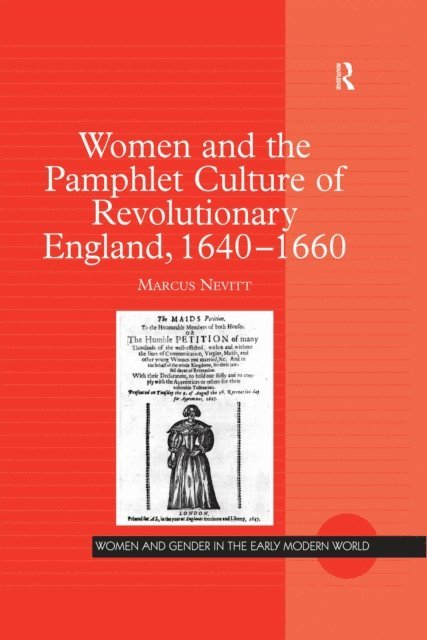
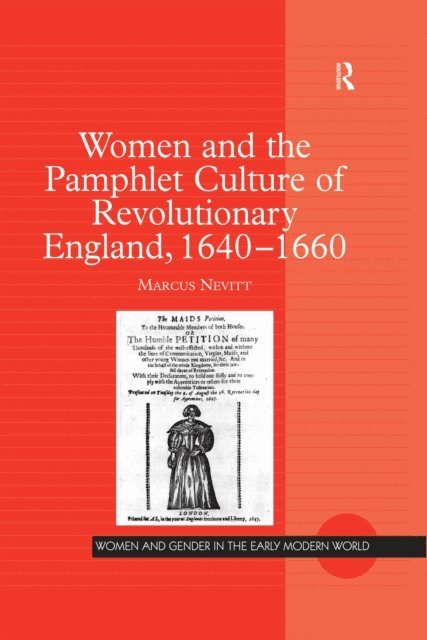
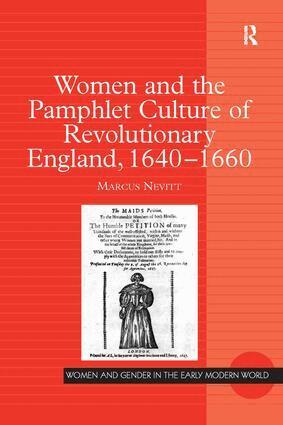
    Women and the Pamphlet Culture of Revolutionary England, 1640-1660

    AvMarcus Nevitt

    Häftad, Engelska, 2016

    Del i serien Women and Gender in the Early Modern World

    965 kr

    Beställningsvara. Skickas inom 10-15 vardagar. Fri frakt över 249 kr.

    Fler format och utgåvor

    Inbunden

    3 651 kr

    E-bok

    1 141 kr

    E-bok

    1 019 kr

    Beskrivning

    Offering an analysis of the ways in which groups of non-aristocratic women circumvented a number of interdictions against female participation in the pamphlet culture of revolutionary England, this book is primarily a study of female agency. Despite the fact that pamphlets, or cheap unbound books, have recently been located among the most inclusive or democratic aspects of the social life of early modern England, this study provides a more gender-sensitive picture. Marcus Nevitt argues instead that throughout the revolutionary decades pamphlet culture was actually constructed around the public silence and exclusion of women. In support of his thesis, he discusses more familiar seventeenth-century authors such as John Milton, John Selden and Thomas Edwards in relation to the less canonical but equally forceful writings of Katherine Chidley, Elizabeth Poole, Mary Pope, 'Parliament Joan' and a large number of Quaker women. This is the first sustained study of the relationship between female agency and cheap print throughout the revolutionary decades 1640 to 1660. It adds to the study of gender in the field of the English Revolution by engaging with recent work in the history of the book, stressing the materiality of texts and the means and physical processes by which women's writing emerged through the printing press and networks of publication and dissemination. It will stimulate welcome debate about the nature and limits of discursive freedom in the early modern period, and for women in particular.

    Produktinformation

    • Utgivningsdatum:2016-10-26
    • Mått:156 x 234 x 12 mm
    • Vikt:360 g
    • Format:Häftad
    • Språk:Engelska
    • Serie:Women and Gender in the Early Modern World
    • Antal sidor:232
    • Förlag:Taylor & Francis Ltd
    • ISBN:9781138278066

    Utforska kategorier

    • Litteraturvetenskap inom Skönlitteratur
    • Litteraturvetenskap inom Skönlitteratur

    Mer om författaren

    Marcus Nevitt is a Lecturer in Renaissance Literature at the University of Sheffield, UK.

    Recensioner i media

    'Nevitt has accomplished a neat trick, joining current feminist theory with materialist scholarship in pamphlets and political culture to construct a nuanced, multivalent account of female agency, addressing both the rhetoric and the material activities of a range of women. With insights about the relation between public acts and printed texts, careful reconstruction of historical moments, and an attention to language and tone, this accomplished study beautifully evokes the anxieties, ambitions, and self-conscious displacements that were the enabling features of women’s utterance in the English Revolution. Nevitt’s stunning book is an authoritative guide to women’s involvement in revolutionary culture and will be a touchstone for further work in the field.' Sharon Achinstein, St Edmund Hall, Oxford University 'Nevitt deftly manoeuvres between history, criticism and theory... (his) story is rich in detail and sophisticated both in its assimilation of theoretical perspectives, and in its exploration of the interrelations between writing, publishing and gender. His book enriches our understanding of the cultures of cheap print both through women's actual participation in it and through the ideologies of exclusion that cut across it.' Times Literary Supplement ’...remarkable study...With its innovative blend of materialists scholarship and rhetorical analysis, Nevitt's study opens a new window on Civil War women writers...With grace and intelligence, Nevitt moves past the gendered dichotomies that have governed our understanding of the English Renaissance and toward a more fluid and amibiguous formulation of female agency in the early modern period.’ Renaissance Quarterly ’This is a rich and fascinating monograph which draws upon recent developments in history, literary criticism and print culture... it is a valuable and sophisticated study which highlights the range of possibilities for engagement in pamphlet culture as well as the ways in which that

    Innehållsförteckning

    • Contents: Introduction: Women's agency and early modern pamphlet culture; 'Justification cannot be self-justification': Katherine Chidley and the discourses of religious toleration; Agency in crisis: women write the regicide; A woman in the business of revolutionary news: Elizabeth Alkin, 'Parliament Joan' and the Commonwealth newsbook; Clothing the naked woman: writing women's agency in revolutionary England; Gender identities and women's agency in early modern tithe dispute; Conclusion; Bibliography; Index.