• Fri frakt över 249 kr
  • •
  • Snabba leveranser
  • •
  • Billiga böcker
Kundservice

Du är på sajten för privatpersoner.

Företag, bibliotek eller offentlig verksamhet?

Du handlar på classic.bokus.com, där alla dina funktioner finns intakta.
Till classic.bokus.com
Bokus logotyp. Gå till startsidan.
  • Erbjudanden
  • Nyheter
  • Student
  • Topplistor
  • Barn & ungdom
  • Bokus Play
  • E-böcker
  • Pocketböcker
  • Spel & pussel

10% rabatt på allt med kod: NYSTART10 →

Sidfot

Mina sidor

    Hjälp

    • Kundservice
    • Vanliga frågor och svar
    • Frakt och leverans
    • Retur vid ångerrätt
    • Reklamera vara
    • Betalning
    • Köpvillkor
    • Allmänna villkor
    • Information om webbplatsens tillgänglighet

    Om Bokus

    • Om oss
    • Pressrum
    • För studenter
    • För företag
    • För bibliotek och offentlig verksamhet
    • För leverantörer
    • Hållbarhet

    Populärt

    • Aktuella erbjudanden
    • Presentkort
    • Studentlitteratur
    • Nya böcker
    • Topplistor
    • Signerade böcker
    • Engelska böcker

    Inspiration

    • Boktips
    • BookTok
    • Populära bokserier
    • Barnbokskaraktärer
    • Populära författare
    Logotyp för Bokus
    Följ oss på Facebook (extern länk)Följ oss på Instagram (extern länk)Följ oss på YouTube (extern länk)Följ oss på TikTok (extern länk)
    bokus @ CookiesAnpassa cookiesIntegritetspolicyKöpvillkor
    Till Citymail hemsida (extern länk)Till Budbee hemsida (extern länk)Till Postnord hemsida (extern länk)Till Schenker hemsida (extern länk)Till Early Bird hemsida (extern länk)Till Walleys hemsida (extern länk)
    1. Ekonomi och Ledarskap
    2. Nationalekonomi
    3. Makroekonomi

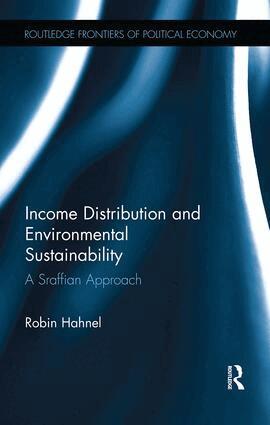
    Income Distribution and Environmental Sustainability

    A Sraffian Approach

    AvRobin Hahnel

    Häftad, Engelska, 2018

    Del i serien Routledge Frontiers of Political Economy

    723 kr

    Beställningsvara. Skickas inom 10-15 vardagar. Fri frakt över 249 kr.

    Fler format och utgåvor

    Inbunden

    2 645 kr

    E-bok

    883 kr

    E-bok

    881 kr

    Beskrivning

    Any economics that does not deal forthrightly with economic inequality is no longer suitable for the twenty-first century. Similarly, any economics which does not provide a coherent way to integrate environmental sustainability into economic analysis will fail to command allegiance in the century ahead. This book demonstrates how the Sraffian framework provides important advantages in both areas.Divided into three chapters, Income Distribution and Environmental Sustainability provides a rigorous exposition of Sraffian theory emphasizing what it means for the economy to be productive, extends Sraffian theory to address environmental sustainability, and adds a normative theory of income distribution to Sraffa’s positive theory. In Chapter 1, a rigorous version of the basic Sraffa model is presented which focuses on what it means for the economy to be capable of producing a physical surplus, explains the origin of profits, and shows how to measure changes in overall labor productivity resulting from any technical change. In Chapter 2, the basic model is extended to incorporate primary inputs from the natural environment, rigorously measure changes in environmental throughput efficiency, and establish sufficient conditions for environmental sustainability. In Chapter 3, an explicit "normative" theory of economic justice is elaborated which is a natural extension of Sraffa’s "positive" theory of income determination and consistent with modern egalitarian literature on distributive justice.This book is of interest to academics and students who study political economy, economic theory, and philosophy, as well as those interested in the work of Piero Sraffa.

    Produktinformation

    • Utgivningsdatum:2018-07-27
    • Mått:138 x 216 x 19 mm
    • Vikt:204 g
    • Format:Häftad
    • Språk:Engelska
    • Serie:Routledge Frontiers of Political Economy
    • Antal sidor:162
    • Förlag:Taylor & Francis Ltd
    • ISBN:9781138335998

    Utforska kategorier

    • Makroekonomi inom Ekonomi och Ledarskap
    • Miljöekonomi inom Ekonomi och Ledarskap
    • Miljövetenskap och miljöpolitik inom Naturvetenskap och teknik

    Mer om författaren

    Robin Hahnel is Professor Emeritus at the Department of Economics at American University Washington DC, USA, as well as the Co-Director of Economics for Equity and the Environment.

    Recensioner i media

    ‘Any economics that does not deal forthrightly with economic inequality is no longer suitable for the twenty-first century. Similarly, any economics which does not provide a coherent way to integrate environmental sustainability into economic analysis will fail to command allegiance in the century ahead. This book demonstrates how the Sraffian framework provides important advantages in both areas.’ — www.urpe.org (February 16, 2017)

    Innehållsförteckning

    • INTRODUCTIONPART 1: SRAFFA AFTER FROBENIUS-PERRON1.0 Introduction to Part One1.1 Mathematical Notation, Definitions, and Theorems1.2 The Dominant Eigenvalue and Right Eigenvector of the Economy1.3 A Subsistence Economy1.4 A Productive Economy1.5 Division of the Net Product1.6 Basic and Non-Basic Industries1.7 Technical Change and the Rate of Profit1.8 Technical Change and Social Efficiency1.9 Resolving a Conundrum1.10 Measuring Increases in Labor ProductivityAppendix A: Proofs of Mathematical Theorems.PART 2: ENVIRONMENTAL SUSTAINABILITY IN A SRAFFA MODEL2.0 Introduction to Part Two2.1 Price and Income Determination with Multiple Primary Inputs2.2 Measuring Environmental Throughput2.3 Measuring Increases in Throughput Efficiency2.4 Defining Environmental Sustainability2.5 Implications for Steady-State and De-Growth Economics2.6 Generalizing to Heterogeneous Nature2.7 When Time MattersPART 3: PRODUCERS AND PARASITES3.0 Introduction to Part Three3.1 It’s the Economy that’s Productive, Stupid!3.2 The Prima Facie Case that Capitalists and Rentiers are Parasites3.3 Arguments in Defense of Profits and Rents3.4 What Counts: Contribution or Sacrifice?3.5 Guilty, as Charged!Appendix B: Reward for Effort and Modern Theories of Distributive Justice.CONCLUSION