• Fri frakt över 249 kr
  • •
  • Snabba leveranser
  • •
  • Billiga böcker
Kundservice

Du är på sajten för privatpersoner.

Företag, bibliotek eller offentlig verksamhet?

Du handlar på classic.bokus.com, där alla dina funktioner finns intakta.
Till classic.bokus.com
Bokus logotyp. Gå till startsidan.
  • Erbjudanden
  • Nyheter
  • Student
  • Topplistor
  • Barn & ungdom
  • Bokus Play
  • E-böcker
  • Pocketböcker
  • Spel & pussel

10% rabatt på allt med kod: NYSTART10 →

Sidfot

Mina sidor

    Hjälp

    • Kundservice
    • Vanliga frågor och svar
    • Frakt och leverans
    • Retur vid ångerrätt
    • Reklamera vara
    • Betalning
    • Köpvillkor
    • Allmänna villkor
    • Information om webbplatsens tillgänglighet

    Om Bokus

    • Om oss
    • Pressrum
    • För studenter
    • För företag
    • För bibliotek och offentlig verksamhet
    • För leverantörer
    • Hållbarhet

    Populärt

    • Aktuella erbjudanden
    • Presentkort
    • Studentlitteratur
    • Nya böcker
    • Topplistor
    • Signerade böcker
    • Engelska böcker

    Inspiration

    • Boktips
    • BookTok
    • Populära bokserier
    • Barnbokskaraktärer
    • Populära författare
    Logotyp för Bokus
    Följ oss på Facebook (extern länk)Följ oss på Instagram (extern länk)Följ oss på YouTube (extern länk)Följ oss på TikTok (extern länk)
    bokus @ CookiesAnpassa cookiesIntegritetspolicyKöpvillkor
    Till Citymail hemsida (extern länk)Till Budbee hemsida (extern länk)Till Postnord hemsida (extern länk)Till Schenker hemsida (extern länk)Till Early Bird hemsida (extern länk)Till Walleys hemsida (extern länk)
    1. Samhälle och politik
    2. Samhälle och kultur
    3. Sociala och etiska frågor

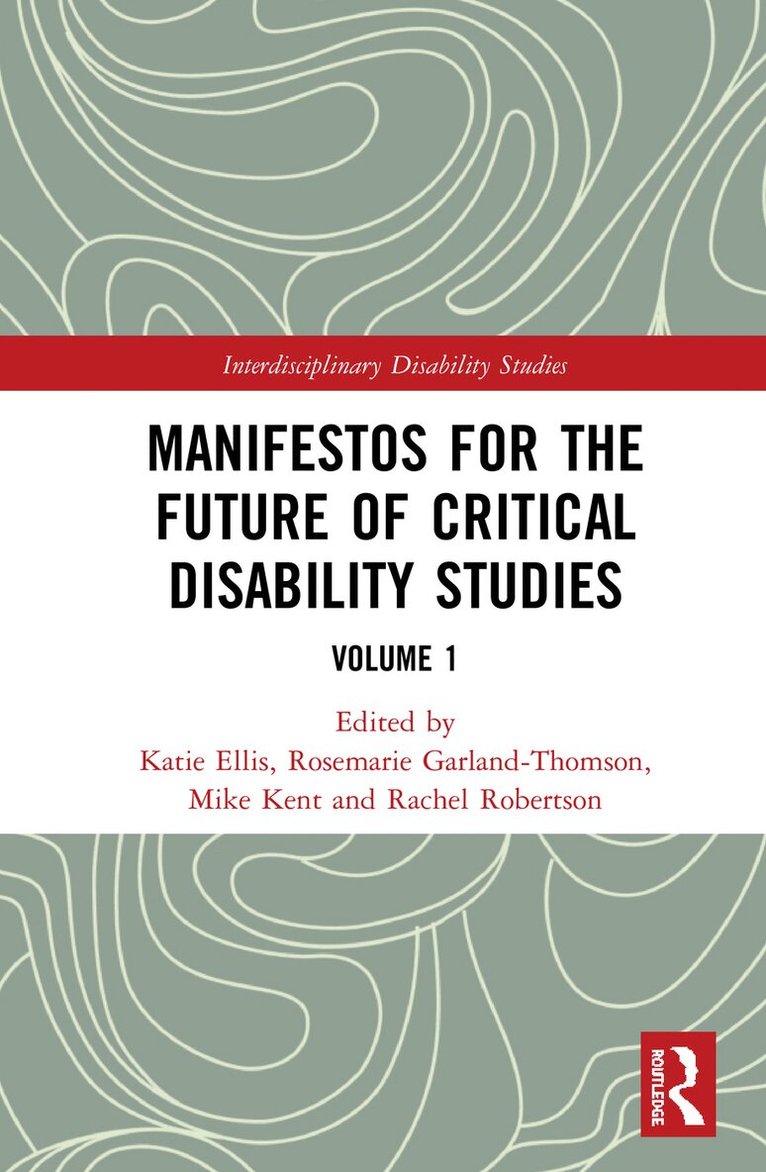
    Manifestos for the Future of Critical Disability Studies

    Volume 1

    AvKatie Ellis,Rosemarie Garland-Thomson

    Inbunden, Engelska, 2018

    Del i serien Interdisciplinary Disability Studies

    2 421 kr

    Beställningsvara. Skickas inom 10-15 vardagar. Fri frakt över 249 kr.

    Beskrivning

    This collection identifies the key tensions and conflicts being debated within the field of critical disability studies and provides both an outline of the field in its current form and offers manifestos for its future direction. Traversing a number of disciplines from science and technology studies to maternal studies, the collection offers a transdisciplinary vision for the future of critical disability studies. Some common thematic concerns emerge across the book such as digital futures, the usefulness of anger, creativity, family as disability allies, intersectionality, ethics, eugenics, accessibility and interdisciplinarity. However, the contributors who write as either disabled people or allies do not proceed from a singular approach to disability, often reflecting different or even opposing positions on these issues. Containing contributions from established and new voices in disability studies outlining their own manifesto for the future of the field, this book will be of interest to all scholars and students working within the fields of disability studies, cultural studies, sociology, law, history and education. The concerns introduced here are further explored in its sister volume Interdisciplinary approaches to disability: looking towards the future.

    Produktinformation

    • Utgivningsdatum:2018-10-25
    • Mått:156 x 234 x 18 mm
    • Vikt:522 g
    • Format:Inbunden
    • Språk:Engelska
    • Serie:Interdisciplinary Disability Studies
    • Antal sidor:280
    • Förlag:Taylor & Francis Ltd
    • ISBN:9781138483910

    Utforska kategorier

    • Sociala och etiska frågor inom Samhälle och politik

    Mer om författaren

    Katie Ellis is associate professor and senior research fellow in Internet studies at Curtin University. She holds an Australian Research Council Discovery Early Career Research award for a project on disability and digital televisions and is series editor of Routledge Research in Disability and Media Studies. Rosemarie Garland-Thomson is professor of English and bioethics at Emory University, where her fields of study are disability studies, American literature and culture, and feminist theory. Her work develops the field of critical disability studies in the health humanities, broadly understood, to bring forward disability access, inclusion and identity to communities inside and outside of the academy.Mike Kent is an associate professor and Head of School of Media, Creative Arts and Social Inquiry at Curtin University. Mike’s research focus is on people with disabilities and their use of, and access to, information technology and the Internet. His edited collection, with Katie Ellis, Disability and social media: global perspectives was published in 2017, as was their four-volume major works collection, Disability and the media: critical concepts in cultural and media studies.Rachel Robertson is a senior lecturer at Curtin University with research interests in critical disability studies, literary and cultural studies, feminist maternal studies and life writing. She is the author of Reaching one thousand: a story of love, motherhood and autism. Her articles on disability and motherhood have been published in journals such as Hecate, Studies in the Maternal and the Australasian Journal of Popular Culture

    Innehållsförteckning

    • List of contributors; Acknowledgements; Glossary; Chapter 1: Introduction (Mike Kent, Katie Ellis, Rachel Robertson and Rosemarie Garland Thomson); Part I Human Variation across Family and Community Life; Chapter 2: Critical Disability Studies: A Knowledge Manifesto (Rosemarie Garland Thomson); Chapter 3: Dear Neurodiversity Movement: Put Your Shoes On (Sonya Freeman Loftis); Chapter 4: Not Now But Right Now: Creating Advocates and Scholars (Washieka Torres); Chapter 5: Bringing maternal studies into critical disability studies (Rachel Robertson and Christina (Tina) Fernandes); Chapter 6: Navigating ‘the system’ to find supports and services for people with developmental disability – how can research help make this a better journey? (Rachel Skoss); Chapter 7: Disabling Militarism: Theorising Anti-Militarism, Dis/ability, and Dis/placement (Mark Anthony Castrodale); Part II Media, Technology and Design; Chapter 8: Technology and Cultural Futures (Gerard Goggin); Chapter 9: A Media Manifesto (Katie Ellis); Chapter 10: Finding the highest common ground: Accessibility and the changing global reach and regulation of digital media (Mike Kent); Chapter 11: Interface Casting: Making the Physical, Digital (Justin Brown and Scott Hollier); Chapter 12: A Web for All: A Manifesto for Critical Disability Studies in Accessibility and User Experience Design (Sarah Lewthwaite, David Sloan and Sarah Horton); Chapter 13: Architectural sites of discrimination – positive to negative (Dianne Smith); Chapter 14: A DisHuman Manifesto, by ProjectDisHuman (Kirsty Liddiard, Katherine Runswick-Cole, Rebecca Lawthom, Dan Goodley); Chapter 15: A Super Normal design manifesto for disability studies (Graham Pullin); Part III Theoretical Work; Chapter 16: Engaging With Aging: The Greying of Critical Disability Studies (Hailee M. Gibbons); Chapter 17: ‘Low Level Agency’: Disability, Oppression and Alternative Genres of the Human (David T. Mitchel and Sharon L. Snyder); Chapter 18: Revisiting the Foundations of (Critical) Disability Studies: A social model manifesto (Kathy Boxall); Chapter 19: Severing Theoretical Work from Political Work in Disability Studies (James Berger); Chapter 20: Disciplining Disability: Intersections between Critical Disability Studies and Cultural Studies (Leanne McRae); Chapter 21: Cultivating and Expanding DisCrit (Disability Critical Race Theory) (Subini Annamm, David J. Connor and Beth A. Ferri); Chapter 22: Critical Disability Praxis (Akemi Nishida); Index