• Fri frakt över 249 kr
  • •
  • Snabba leveranser
  • •
  • Billiga böcker
Kundservice

Du är på sajten för privatpersoner.

Företag, bibliotek eller offentlig verksamhet?

Du handlar på classic.bokus.com, där alla dina funktioner finns intakta.
Till classic.bokus.com
Bokus logotyp. Gå till startsidan.
  • Erbjudanden
  • Nyheter
  • Student
  • Topplistor
  • Barn & ungdom
  • Bokus Play
  • E-böcker
  • Pocketböcker
  • Spel & pussel

10% rabatt på allt med kod: NYSTART10 →

Sidfot

Mina sidor

    Hjälp

    • Kundservice
    • Vanliga frågor och svar
    • Frakt och leverans
    • Retur vid ångerrätt
    • Reklamera vara
    • Betalning
    • Köpvillkor
    • Allmänna villkor
    • Information om webbplatsens tillgänglighet

    Om Bokus

    • Om oss
    • Pressrum
    • För studenter
    • För företag
    • För bibliotek och offentlig verksamhet
    • För leverantörer
    • Hållbarhet

    Populärt

    • Aktuella erbjudanden
    • Presentkort
    • Studentlitteratur
    • Nya böcker
    • Topplistor
    • Signerade böcker
    • Engelska böcker

    Inspiration

    • Boktips
    • BookTok
    • Populära bokserier
    • Barnbokskaraktärer
    • Populära författare
    Logotyp för Bokus
    Följ oss på Facebook (extern länk)Följ oss på Instagram (extern länk)Följ oss på YouTube (extern länk)Följ oss på TikTok (extern länk)
    bokus @ CookiesAnpassa cookiesIntegritetspolicyKöpvillkor
    Till Citymail hemsida (extern länk)Till Budbee hemsida (extern länk)Till Postnord hemsida (extern länk)Till Schenker hemsida (extern länk)Till Early Bird hemsida (extern länk)Till Walleys hemsida (extern länk)
    1. Samhälle och politik
    2. Sociologi och antropologi
    3. Antropologi

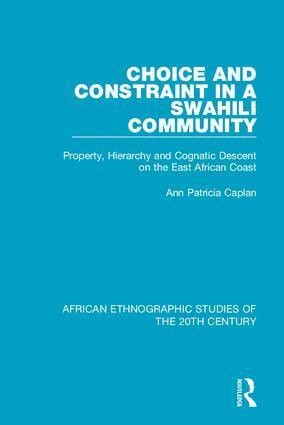
    Choice and Constraint in a Swahili Community

    Property, Hierarchy and Cognatic Descent on the East African Coast

    AvAnn Patricia Caplan

    Inbunden, Engelska, 2018

    Del i serien African Ethnographic Studies of the 20th Century

    1 466 kr

    Beställningsvara. Skickas inom 10-15 vardagar. Fri frakt över 249 kr.

    Fler format och utgåvor

    Häftad

    540 kr

    E-bok

    637 kr

    E-bok

    637 kr

    Beskrivning

    Originally published in 1975, this book examines property and power relations in a Swahili village on Mafia Island off Tanzania. It focuses on the cognatic descent groups which are important in many areas of village life such as land-holding, marriage, residence, Islamic activities and spirit possession cults. Some anthropologists have contended that groups with multiple membership cannot be viable social units, but this book shows that such a system can actually work. In showing how the cognatic descent groups actually operate, both an ideology of descent group membership and also numerical material about patterns of choice are presented. This involves the construction of both mechanical and statistical models, as well as a decision model to discuss the constraints governing choices.

    Produktinformation

    • Utgivningsdatum:2018-08-22
    • Mått:156 x 234 x undefined mm
    • Vikt:490 g
    • Format:Inbunden
    • Språk:Engelska
    • Serie:African Ethnographic Studies of the 20th Century
    • Antal sidor:184
    • Förlag:Taylor & Francis Ltd
    • ISBN:9781138493278

    Utforska kategorier

    • Antropologi inom Samhälle och politik

    Mer om författaren

    Ann Patricia Caplan In 1977, joined Goldsmiths College, University of London as a lecturer in anthropology; she was later promoted to senior lecturer.[1] Goldsmiths did not have an Anthropology Department until the 1980s.[2] In 1989, she was appointed Professor of Social Anthropology. From 1998 to 2000, she was also Director of the Institute of Commonwealth Studies of the School of Advanced Study, University of London. Caplan retired in 2003 and was appointed Emeritus Professor.

    Innehållsförteckning

    • 1. Ecology, Population and Economy 2. Descent Groups and Personal Networks 3. Residence Patterns 4. Land Tenure 5. The Socio-Religious Hierarchy: Islam 6. The Socio-Religious Hierarchy: Spirit Possession 7. The Hierarchy and Village Politics 8. Conclusion