• Fri frakt över 249 kr
  • •
  • Snabba leveranser
  • •
  • Billiga böcker
Kundservice

Du är på sajten för privatpersoner.

Företag, bibliotek eller offentlig verksamhet?

Du handlar på classic.bokus.com, där alla dina funktioner finns intakta.
Till classic.bokus.com
Bokus logotyp. Gå till startsidan.
  • Erbjudanden
  • Nyheter
  • Student
  • Topplistor
  • Barn & ungdom
  • Bokus Play
  • E-böcker
  • Pocketböcker
  • Spel & pussel

10% studentrabatt med kod TERM26

Sidfot

Mina sidor

    Hjälp

    • Kundservice
    • Vanliga frågor och svar
    • Frakt och leverans
    • Retur vid ångerrätt
    • Reklamera vara
    • Betalning
    • Köpvillkor
    • Allmänna villkor
    • Information om webbplatsens tillgänglighet

    Om Bokus

    • Om oss
    • Pressrum
    • För studenter
    • För företag
    • För bibliotek och offentlig verksamhet
    • För leverantörer
    • Hållbarhet

    Populärt

    • Aktuella erbjudanden
    • Presentkort
    • Studentlitteratur
    • Nya böcker
    • Topplistor
    • Signerade böcker
    • Engelska böcker

    Inspiration

    • Boktips
    • BookTok
    • Populära bokserier
    • Barnbokskaraktärer
    • Populära författare
    Logotyp för Bokus
    Följ oss på Facebook (extern länk)Följ oss på Instagram (extern länk)Följ oss på YouTube (extern länk)Följ oss på TikTok (extern länk)
    bokus @ CookiesAnpassa cookiesIntegritetspolicyKöpvillkor
    Till Citymail hemsida (extern länk)Till Budbee hemsida (extern länk)Till Postnord hemsida (extern länk)Till Schenker hemsida (extern länk)Till Early Bird hemsida (extern länk)Till Walleys hemsida (extern länk)
    1. Samhälle och politik
    2. Sociologi och antropologi
    3. Sociologi

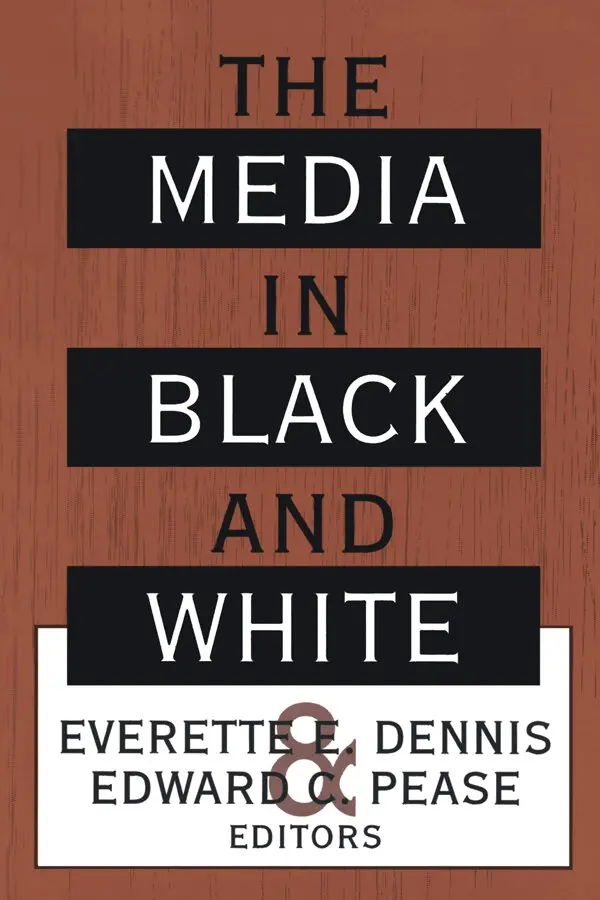
    Media in Black and White

    AvEverette Dennis

    Inbunden, Engelska, 2018

    2 434 kr

    Beställningsvara. Skickas inom 10-15 vardagar. Fri frakt över 249 kr.

    Fler format och utgåvor

    E-bok

    855 kr

    E-bok

    858 kr

    Häftad

    727 kr

    Beskrivning

    The media's treatment of and interaction with race, like race itself, is one of the most sensitive areas hi American society. Whether hi its coverage and treatment of racial matters or racial connections inside media organizations themselves, mass communication is deeply involved with race. The Media in Black and White brings together twenty journalists and scholars, of various racial backgrounds, to grapple with a controversial issue: the role that media industries, from advertising to newspapers to the information superhighway, play in helping Americans understand race.Contributors include Ellis Cose, a contributing editor for Newsweek; Manning Marable, chairman of Columbia University's African-American Research Center; William Wong, a columnist for the Oakland Tribune; Lisa Penaloza, a University of Illinois professor; and Melita Marie Garza, a Chicago Tribune reporter. Among the topics discussed are: the quality of reporting on immigrant issues; how sensationalism may be deepening the chasm of misunderstanding between the races; how the coverage of America's drug wars has been marked by racism; and whether politically correct language is interfering with coverage of vital issues and problems.The contributors of The Media in Black and White hope to broaden the narrow vision of the United States and the world beyond with their contributions to the debate over race and the media. The commentary found hi this important work will be of interest to sociologists, communication specialists, and black studies scholars.

    Produktinformation

    • Utgivningsdatum:2018-01-29
    • Mått:152 x 229 x 13 mm
    • Vikt:453 g
    • Format:Inbunden
    • Språk:Engelska
    • Antal sidor:163
    • Förlag:Taylor & Francis Ltd
    • ISBN:9781138536746

    Utforska kategorier

    • Sociologi inom Samhälle och politik

    Mer om författaren

    Everette E. Dennis. a widely known author and media critic. Is executive director of The Freedom Forum International Consortium of Universities, and senior vice president of The Freedom Forum of Arlington. Virginia. Among his books are Media arid the Environment, Understanding Mass Communication, and Media Debates. From 1984 to 1996 he was founding executive director of The Freedom Forum Media Studies Center at Columbia University. Edward C. Pease Is chairman of the Department of Communication at Utah State University, Logan. and a former editor of the Media Studies Journal. He previously taught at St. Michael’s College In Vermont and at the University of Dayton In Ohio. He Is the author of a number of scholarly articles and co. editor with Everette E. Dennis of Roil to—The Forgotten Medium.

    Innehållsförteckning

    • PrefacePart I Reviewing the American Melting Pot1. Seething in Silence The News in Black and WhiteEllis Cose"For reporters, race can be a treacherous subject, raising questions thatgo to the heart of the journalist's craft," observes the author, a Newsweekcontributing editor and former Media Studies Center fellow. "Today,though we live in a world that is increasingly multicultural, much ofconventional journalism remains fixated on the lives of the white and thewealthy." The result, he says, is tension in the newsroom, the news productand the news consumer.2. Reconciling Race and RealityManning MarableThe 30 years since the zenith of the civil rights movement have broughta "paradox of desegregation," contends the author, chairman of ColumbiaUniversity's African-American research center and author of numerousbooks on race in America. Improvements aside, "U.S. race relationsin the 1990s have been unambiguously negative," he writes. "Media,film and educational institutions have a decisive role to play in overturningAmerica's pervasive images of inequality."Part II Covering America3. Immigration, the Press and the New RacismJohn J. Miller"Immigrants have always made Americans uneasy," as the associate directorof the Center for the New American Community in Washingtonpoints out. That uneasiness is growing in the 1990s as new waves ofillegal immigrants spill over the borders and are accused of a range ofsocial ills. "The media can't do anything about that. What the media cando, however, is exacerbate or ease these worries. It all comes down to thequality of reporting on immigrant issues."4. African Americans According to TV NewsRobert M. Entman"We have all heard that sensationalism and entertainment values are onthe rise in TV news," writes a Northwestern University researcher. "Mystudies indicate these trends aren't simply professional embarrassmentsand frustrations for journalists. They may also be making urban Americaless governable, deepening the chasm of misunderstanding and distrustbetween blacks and whites."5. From Bad to Worse The Media's Framing of Race and RiskOscar H. Gandy Jr.Everyone knows that bad news drives journalism, but the press disproportionatelyframes stories about blacks as bad news, a University ofPennsylvania media scholar finds in a pilot study he conducted. "To theextent that the media emphasize the ways in which the distribution ofsocial and economic risks breaks down along racial lines," he suggests,"they have helped to tear us apart."6. Covering the Invisible "Model Minority"William WongThings are looking up in terms of how the press covers America's diversenew Asian community, writes the author, a former columnist forthe Oakland Tribune. "TV coverage of Asian Americans remains spottyand sensationalized, but print coverage, while retaining some of the oldpolar good-bad images, has become increasingly nuanced, textured andtrue to life."7. In the South Press, Courts and Desegregation RevisitedDale ThornForty years after Brown v. Board of Education, the fight over racialsegregation has flared up again, with an ironic twist back then, blackssued to enter white colleges; today they are fighting to keep black collegesopen. "Amid the gaffes and stereotypes by the media, there hasbeen a real dearth of relatively simple, interpretive, what-it-means reportingon the South's desegregation story," complains a Louisiana StateUniversity journalism professor.8. Coloring the Crack CrisisJimmie L. Reeves and Richard CampbellCoverage of America's "drug wars" has been marked by racism, contendthe authors of a new book on how network television reports oncocaine. "Journalism's discovery of crack in late 1985 signaled the beginningof a period of frenzied coverage in which the race and classcontours of the cocaine problem established in the early 1980s would bealmost completely reconfigured," they find.Part III Issues, Debates and Dilemmas9. Are the Media Really "White"?Andrew HackerIf Ebony is a "black" magazine, is the New Republic "white"? asks aQueens College political scientist and author. White journalists and mediaorganizations don't see race as an essential feature of their identities,but for blacks, as the author points out, "the dominant media are mostcertainly white. To their eyes, the mainstream media speak for a whitenation, which expects all citizens to conform to its ways."10. Warping the World Media's Mangled Images of RaceJannette L. Dates and Edward C. Pease"There is good reason for minorities to think their perspectives are atbest warped by the media or, worse, not heard at all," reflect the actingcommunication dean at Howard University and the co-editor. "In theyear that saw a black man elected president of South Africa, there isirony in the fact that apartheid still rules the information age in America."11. Pop Culture, "Gangsta Rap" and the "New Vaudeville"Paul DelaneyAmerica's image of blacks and their own self-image is closely tied tohow they are portrayed in news and entertainment, writes the author, aformer New York Times editor who now heads the journalism departmentat the University of Alabama. "There is strong objection to many of theroles and images transmitted including the clown image of televisionsitcoms''new vaudevillians,' but particularly the messages of gangstarappers about women as'bitches' and'hos,' and about guns and violenceand cops."12. Racial NamingEverette E. DennisTo paraphrase the poet, What's in a name? In theory, substance shouldbe vastly more important than labeling, but, as the co-editor points out,language questions are intensely sensitive in the arena of race in America."Black" or "African American"? "Native American" or "Indian"? "Tothe extent that nit-picking over language interferes with coverage of vitalracial and ethnic issues and problems, this debate may be counterproductive,"he concludes. But it refuses to go away.Part IV A Media Industry Status Report13. On-Ramps to the Information SuperhighwayAdam Clayton Powell IIISo far, at least, the electronic world of tomorrow looks pretty white,reflects a former broadcaster and technology expert. "Future archaeologists,studying the documentary record of the present, would have reasonto conclude that people of color were bypassed by the information superhighway,"he says. "Maybe it just passed over black and Latino communities,much as Manhattan's West Side Highway passes overhead on itsway through Harlem neighborhoods."14. Newspapers' Quest for Racial CandorSig Gissler"Race it is America's rawest nerve and most enduring dilemma," reflectsthe author, a former newspaper editor and journalism professor atColumbia University. "From birth to death, race is with us, defining,dividing, distorting." Few social institutions are as tormented by thisdilemma day in and day out as are newspapers, he says, reporting onefforts by two metropolitan dailies to come to grips with the issue.15. !Ya Viene Atzlan! Latinos in U.S. AdvertisingLisa Penaloza"In the advertising world, the representation of minorities has been a topicof interest that has waxed and waned since the civil rights movement,"writes a University of Illinois advertising professor. "Yet, so much haschanged in the last 20 years that to view minorities in advertising solely interms of inclusions in'mainstream' media is to miss much of it."16. (Re)Imagining AmericaJohn Phillip Santos"As the United States m