• Fri frakt över 249 kr
  • •
  • Snabba leveranser
  • •
  • Billiga böcker
Kundservice

Du är på sajten för privatpersoner.

Företag, bibliotek eller offentlig verksamhet?

Du handlar på classic.bokus.com, där alla dina funktioner finns intakta.
Till classic.bokus.com
Bokus logotyp. Gå till startsidan.
  • Erbjudanden
  • Student
  • Topplistor
  • Barn & ungdom
  • Bokus Play
  • E-böcker
  • Ljudböcker
  • Pocketböcker
  • Spel & pussel

10% rabatt på allt med kod NYSTART10 →

Sidfot

Mina sidor

    Hjälp

    • Kundservice
    • Vanliga frågor och svar
    • Frakt och leverans
    • Retur vid ångerrätt
    • Reklamera vara
    • Betalning
    • Köpvillkor
    • Allmänna villkor
    • Information om webbplatsens tillgänglighet

    Om Bokus

    • Om oss
    • Pressrum
    • För studenter
    • För företag
    • För bibliotek och offentlig verksamhet
    • För leverantörer
    • Hållbarhet

    Populärt

    • Aktuella erbjudanden
    • Presentkort
    • Studentlitteratur
    • Nya böcker
    • Topplistor
    • Signerade böcker
    • Engelska böcker

    Inspiration

    • Boktips
    • BookTok
    • Populära bokserier
    • Barnbokskaraktärer
    • Populära författare
    Logotyp för Bokus
    Följ oss på Facebook (extern länk)Följ oss på Instagram (extern länk)Följ oss på YouTube (extern länk)Följ oss på TikTok (extern länk)
    bokus @ CookiesAnpassa cookiesIntegritetspolicyKöpvillkor
    Till Citymail hemsida (extern länk)Till Budbee hemsida (extern länk)Till Postnord hemsida (extern länk)Till Schenker hemsida (extern länk)Till Early Bird hemsida (extern länk)Till Walleys hemsida (extern länk)
    1. Ekonomi och Ledarskap
    2. Nationalekonomi
    3. Internationell ekonomi

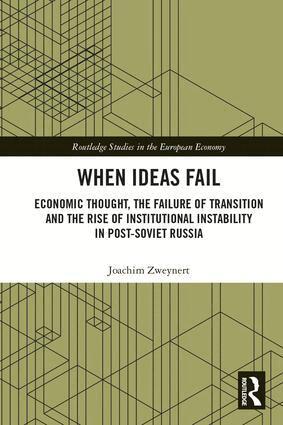
    When Ideas Fail

    Economic Thought, the Failure of Transition and the Rise of Institutional Instability in Post-Soviet Russia

    AvJoachim Zweynert

    Inbunden, Engelska, 2017

    Del i serien Routledge Studies in the European Economy

    2 418 kr

    Beställningsvara. Skickas inom 10-15 vardagar. Fri frakt över 249 kr.

    Fler format och utgåvor

    Häftad

    694 kr

    E-bok

    846 kr

    E-bok

    849 kr

    Beskrivning

    In the history of Russian economic ideas, a peculiar mix of anthropocentrism and holism provided fertile breeding ground for patterns of thought that were in potential conflict with the market. These patterns, did not render the emergence of capitalism in Russia impossible. But they entailed a deep intellectual division between adherents and opponents of Russia’s capitalist transformation that made Russia’s social evolution unstable and vulnerable to external shocks. This study offers an ideational explanation of Russia’s relative failure to establish a functioning market economy and thus sets up a new and original perspective for discussion. In post-Soviet Russia, a clash between imported foreground ideas and deep domestic background ideas has led to an ideational division among the elite of the country. Within economic science, this led to the emergence of two thought collectives, (in the sense of Ludvik Fleck), with entirely different understandings of social reality. This ideational division translated into incoherent policy measures, the emergence of institutional hybrids and thus, all in all, into institutional instability. Empirically, the book is based on a systematic, qualitative analysis of the writings of Soviet/Russian economists between 1987 and 2012. This groundbreaking book makes an important contribution to Central Eastern and Eastern European area studies and to the current debate on ideas and institutions in the social sciences.

    Produktinformation

    • Utgivningsdatum:2017-11-02
    • Mått:156 x 234 x 18 mm
    • Vikt:440 g
    • Format:Inbunden
    • Språk:Engelska
    • Serie:Routledge Studies in the European Economy
    • Antal sidor:154
    • Förlag:Taylor & Francis Ltd
    • ISBN:9781138559271

    Utforska kategorier

    • Internationell ekonomi inom Ekonomi och Ledarskap
    • Ekonomiska system inom Ekonomi och Ledarskap
    • Geografi inom Naturvetenskap och teknik

    Mer om författaren

    Joachim Zweynert is Professor of International Political Economy at Witten/ Herdecke University, Germany. He studied economics and political science at Hamburg University, Germany.

    Innehållsförteckning

    • Table of Contents1 Introduction 2 The Role of Ideas in Great TransformationsTransition as functional differentiationConstructivist institutionalism and the structure/agency-problemWhat is special about RussiaWhat is special about Russia I: Lack of liberal underground discoursesWhat is specific about Russia II: The struggle between two thought collectivesWhat is Specific about Russia III: Deep ideational backgrounds3 The Legacy of the Brezhnev Period: 1971-1986Why deal with the Brezhnev period? Self-organization versus mobilizationThe economics of developed socialismThe origins of the conceptThe economic mechanismBase and superstructureCommodity-money relationsConclusion4 Cracking the Protective Belt: 1987-1992Back to the 1960s and taking it furtherWhat was Soviet ideology? Perestroika and the Soviet telosEarly debates in Voprosy ekonomiki, and the new textbook on political economyThe inflow of Western liberal ideasThe MEiMO debate on Western reformsThe Debates in the general interest pressThe decline of Soviet ideologyParadigm shift or continuity? 5 Towards a Precarious Consensus: 1993-1998Western textbooks, Russian realityThe intellectual background to shock therapyPost-industrial society and the comeback of slavophile ideasRegulation, economic security, and the "Russian economic school" The rise of Russian institutionalismA new consensus? 6 In Search of a "Russian Way": 1999-2006Taking stock of post-socialist reformsThe discussion about the stabilization fundThe nationalist turnReappraisal of the planned economyIndicative planning and mobilisation versus structural reformsLiberal Reactions to increasing state intereferenceEconomics or political economy? Russian economic science on the retreat from international discourse7 A New Transition Debate: 2007-20122007 as a turning pointConflicting concepts of innovation and modernizationModernization and innovation in economics and in sociologyThe "coalitions for modernization" debateDiscussions within the liberal campThe position of the gosudarstvennikiThe political dimension of the debateConservative modernization versus innovationInnovation and modernization in presidential speechesA "fear of perestroika"?8 ConclusionBiographical Appendix References