• Fri frakt över 249 kr
  • •
  • Snabba leveranser
  • •
  • Billiga böcker
Kundservice

Du är på sajten för privatpersoner.

Företag, bibliotek eller offentlig verksamhet?

Du handlar på classic.bokus.com, där alla dina funktioner finns intakta.
Till classic.bokus.com
Bokus logotyp. Gå till startsidan.
  • Erbjudanden
  • Student
  • Topplistor
  • Barn & ungdom
  • Bokus Play
  • E-böcker
  • Ljudböcker
  • Pocketböcker
  • Spel och pussel

Pocketfynda! Hundratals böcker för 49 kr/st →

Sidfot

Mina sidor

    Hjälp

    • Kundservice
    • Vanliga frågor och svar
    • Frakt och leverans
    • Retur vid ångerrätt
    • Reklamera vara
    • Betalning
    • Köpvillkor
    • Allmänna villkor
    • Information om webbplatsens tillgänglighet

    Om Bokus

    • Om oss
    • Pressrum
    • För studenter
    • För företag
    • För bibliotek och offentlig verksamhet
    • För leverantörer
    • Hållbarhet

    Populärt

    • Aktuella erbjudanden
    • Presentkort
    • Studentlitteratur
    • Nya böcker
    • Topplistor
    • Signerade böcker
    • Engelska böcker

    Inspiration

    • Boktips
    • BookTok
    • Barnbokskaraktärer
    • Populära författare
    Logotyp för Bokus
    Följ oss på Facebook (extern länk)Följ oss på Instagram (extern länk)Följ oss på YouTube (extern länk)Följ oss på TikTok (extern länk)
    bokus @ CookiesAnpassa cookiesIntegritetspolicyKöpvillkor
    Till Citymail hemsida (extern länk)Till Budbee hemsida (extern länk)Till Postnord hemsida (extern länk)Till Schenker hemsida (extern länk)Till Early Bird hemsida (extern länk)Till Walleys hemsida (extern länk)
    1. Psykologi och pedagogik
    2. Pedagogik
    3. Utbildningsstrategier och utbildningspolitik

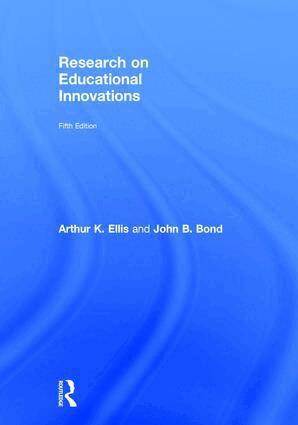
    Research on Educational Innovations

    AvArthur K. Ellis,John B. Bond

    Inbunden, Engelska, 2016

    1 990 kr

    Beställningsvara. Skickas inom 10-15 vardagar. Fri frakt över 249 kr.

    Fler format och utgåvor

    Häftad

    659 kr

    Inbunden

    2 343 kr

    Häftad

    645 kr

    Inbunden

    Tillf. slut

    Beskrivning

    For more than twenty years, Research on Educational Innovations has helped readers draw distinctions between truly innovative educational programs backed by sound empirical research and faddish policy trends of the day. Using a variety of current and emerging topics as practical case studies, this book offers a clear theoretical framework for program evaluation and for ways to delve into the research base behind any educational innovation. From examining the theoretical basis of a proposed program to understanding the nature of the research done to document the validity of the proposed program, it highlights the importance of differentiating opinions from results before implementing educational policies of any size or scope.Features and Updates to the New Edition include:Framework provides clarity to the research process, helping both experts and novices in the field make reasonable assessments as consumersA fully revised and updated chapter on brain research provides an overview of the unfolding research applications of neuroscience to educationSnapshots features offer brief summaries of highly current topics such as problem-based learning, flipped classrooms, reflective assessment, and curriculum integration

    Produktinformation

    • Utgivningsdatum:2016-06-16
    • Mått:178 x 254 x 16 mm
    • Vikt:550 g
    • Format:Inbunden
    • Språk:Engelska
    • Antal sidor:200
    • Upplaga:5
    • Förlag:Taylor & Francis Ltd
    • ISBN:9781138671201

    Utforska kategorier

    • Utbildningsstrategier och utbildningspolitik inom Psykologi och pedagogik

    Mer om författaren

    Arthur K. Ellis is Professor of Education and Director of the Center for Global Curriculum Studies at Seattle Pacific University. Previously, he taught in public schools in Oregon and Washington and as a Full Professor at the University of Minnesota. He is the author or coauthor of 21 published books and numerous journal articles, book chapters, and scholarly papers. He consults to numerous government and private agencies and foundations and to various school systems in the United States and abroad. He holds academic appointments as Corresponding Professor at universities in Europe and Asia. John B. Bond is Associate Professor of Educational Leadership at Seattle Pacific University where he teaches in the principal and superintendent certification programs. He served as a public school principal and central office administrator for over 25 years prior to moving to higher education in 2008. His scholarly publications have primarily been in the area of formative assessment.

    Innehållsförteckning

    • Table of Contents1. Innovation Defined and Described2. What Research is of Most Worth?-Scientifically-Based, Evidence-Based, or What?-The Current Scene-Conclusion3. Nature of Educational Innovation-What is Innovation?-Where are They Now?-Research Based?-How Educational Theories Develop-Level I-Level II-Level III-Conclusion4. The Structure of Educational Innovation-Reaping the Whirlwind- The Hunter Model: ''One More Such Victory and We Are Undone"-In Retrospect5. "The Research Says…"-What "Kind" of Research?-Level I Research-Level II Research-Level III Research-Summary-The Following Chapters6. Setting Standards: The Age of Common Core -What Standards?-It Was Better in the Old Days, or Was It?-Plus ca Change, Plus C’est la Meme Chose-The Movement Gathers Steam-Accountability and Standards-Points of Origin: Level I-Essentialist Goals, Progressive Means-Research at Levels II and III-The Critics’ Corner-Where Does This Leave Us?7. Innovations From Brain Research-Collaboration Between Educators and Neuroscientists-The Pendulum is Well Into Its Swing-Neuromyths in Education-Examples of Neuromyths-Research-based or Faddism?-Brain-based Learning-Research on Education and the Brain-MRIs and the ‘Black Box’-Concepts and Implications-IQ & Testing-Pressure of Funding-Conclusion8. Assessment-Alternative Assessment-Traditional Measures-Authentic Assessment-Alternative Assessment Strategies-Levels II and III Research-Conclusion9. Self-Esteem and Self-Efficacy-What is Self-Esteem?-The Claims and the Programs-A New Vaccine or a Fad?-Research on Self-esteem and Self-efficacy-Level I Research-Level II Research-Level III Research-Conclusion10. Direct Instruction-What is Direct Instruction?-The Critics-The Research Base for Direct Instruction-Level I Research-Levels II and III Research-Conclusion11. Cooperative Learning-Cooperative Learning Models-Learning Together-Student Team Learning -Other Models-Forming the Groups-The Research Base for Cooperative Learning-Theory Building-Empirical Studies-Application to Higher Education-International-Variety of Content Areas-Quasi-experimental-Program Evaluation-ConclusionSnapshot One: Mastery Learning-Reductionism at Work-What About the Research?-ConclusionSnapshot Two: Curriculum Integration-What is Curriculum Integration-History-Theory-Level I-Research—Bold Claims, Little Evidence-ConclusionSnapshot Three: Teaching for Intelligence-What is Intelligence?-Charles Spearman-L.L. Thurstone-Richard Hernstein and Charles Murray-Daniel Goleman-Reuven Feuerstein-Howard Gardner-Robert Sternberg -ConclusionSnapshot Four: Instructional Time-Research on Instructional Time-Elena Silva-Tom Loveless-ConclusionSnapshot Five: Reflective Assessment-"I Learned" Statements-Think Aloud Strategy-Clear & Unclear Windows-Journaling-Theory-Research II & III-Black and Wiliam-Wang, Haertel, and Walberg-Dignath and Büttner-Michalsky, Mevarech, and Haibi-ConclusionSnapshot Six: Project Based Learning-Level I Theory-Level II and III Research-Walter and Leary (2009)-Koparan & Guven (2015)-Finkelstein and colleagues (2011)-White and Frederiksen (1998)-ConclusionSnapshot Seven: The Call for Free Preschool-Level I: The Theory-Level II: Longitudinal Studies-Perry Preschool Project-Carolina Abecedarian Project-The Long Shadow-Level III Research-Janicki and Banicky-Greenberg and Domitrovich-Slaby, Loucks, and Stelwagon-ConclusionSnapshot Eight: Engaging Parents-Level I-Level II-Castro and colleagues-William H. Jeynes-University of New Hampshire-Anne Henderson-Level III-ConclusionSnapshot Nine: Teacher Evaluation and Student Achievement-The Theory—Level I-The Research-American Statistical Association (2014)-Polikoff & Porter (2014)-Edward Haertel (2013)-Concluding Thoughts Snapshot Ten: The Flipped Classroom-What is Flipped Learning?-Level I Theory-Level II Research-Bishop and Verleger (2013)-Jensen, Kummer, & Godoy (2015)-Langdon, Sturges, & Scholte (2015)-McEvoy and colleagues (2014)-Shu (2015)-Level III Research-ConclusionEpilogue-The Graveyard of Lost Ships-Beyond Empiricism-Research Questions to Ask-A Closing Thought