• Fri frakt över 249 kr
  • •
  • Snabba leveranser
  • •
  • Billiga böcker
Kundservice

Du är på sajten för privatpersoner.

Företag, bibliotek eller offentlig verksamhet?

Du handlar på classic.bokus.com, där alla dina funktioner finns intakta.
Till classic.bokus.com
Bokus logotyp. Gå till startsidan.
  • Erbjudanden
  • Nyheter
  • Student
  • Topplistor
  • Barn & ungdom
  • Bokus Play
  • E-böcker
  • Pocketböcker
  • Spel & pussel

10% rabatt på allt med kod: NYSTART10 →

Sidfot

Mina sidor

    Hjälp

    • Kundservice
    • Vanliga frågor och svar
    • Frakt och leverans
    • Retur vid ångerrätt
    • Reklamera vara
    • Betalning
    • Köpvillkor
    • Allmänna villkor
    • Information om webbplatsens tillgänglighet

    Om Bokus

    • Om oss
    • Pressrum
    • För studenter
    • För företag
    • För bibliotek och offentlig verksamhet
    • För leverantörer
    • Hållbarhet

    Populärt

    • Aktuella erbjudanden
    • Presentkort
    • Studentlitteratur
    • Nya böcker
    • Topplistor
    • Signerade böcker
    • Engelska böcker

    Inspiration

    • Boktips
    • BookTok
    • Populära bokserier
    • Barnbokskaraktärer
    • Populära författare
    Logotyp för Bokus
    Följ oss på Facebook (extern länk)Följ oss på Instagram (extern länk)Följ oss på YouTube (extern länk)Följ oss på TikTok (extern länk)
    bokus @ CookiesAnpassa cookiesIntegritetspolicyKöpvillkor
    Till Citymail hemsida (extern länk)Till Budbee hemsida (extern länk)Till Postnord hemsida (extern länk)Till Schenker hemsida (extern länk)Till Early Bird hemsida (extern länk)Till Walleys hemsida (extern länk)
    1. Samhälle och politik
    2. Politik och statsskick
    3. Statsvetenskap och politisk teori

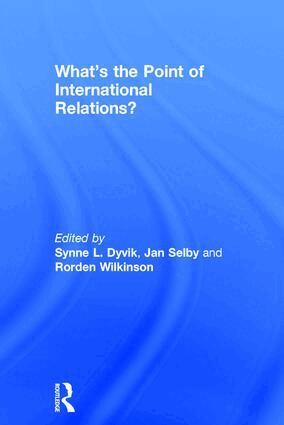
    What's the Point of International Relations?

    AvSynne L. Dyvik,Jan Selby

    Inbunden, Engelska, 2017

    2 645 kr

    Beställningsvara. Skickas inom 10-15 vardagar. Fri frakt över 249 kr.

    Beskrivning

    What’s the Point of International Relations casts a critical eye on what it is that we think we are doing when we study and teach international relations (IR). It brings together many of IR’s leading thinkers to challenge conventional understandings of the discipline’s origins, history, and composition. It sees IR as a discipline that has much to learn from others, which has not yet lived up to its ambitions or potential, and where much work remains to be done. At the same time, it finds much that is worth celebrating in the discipline’s growing pluralism and views IR as a deeply political, critical, and normative pursuit. The volume is divided into five parts:• What is the point of IR?• The origins of a discipline• Policing the boundaries• Engaging the world• Imagining the futureAlthough each chapter alludes to and/or discusses central aspects of all of these components, each part is designed to capture the central thrust of the concerns of the contributors. Moving beyond western debate, orthodox perspectives, and uncritical histories this volume is essential reading for all scholars and advanced level students concerned with the history, development, and future of international relations.

    Produktinformation

    • Utgivningsdatum:2017-02-14
    • Mått:156 x 234 x 20 mm
    • Vikt:690 g
    • Format:Inbunden
    • Språk:Engelska
    • Antal sidor:288
    • Förlag:Taylor & Francis Ltd
    • ISBN:9781138707306

    Utforska kategorier

    • Statsvetenskap och politisk teori inom Samhälle och politik
    • Internationella relationer inom Samhälle och politik

    Mer om författaren

    Synne L. Dyvik is Lecturer in International Relations at the University of Sussex, UK.Jan Selby is Professor of International Relations at the University of Sussex, UK.Rorden Wilkinson is Professor and Chair of the Department of International Relations at the University of Sussex, UK.

    Recensioner i media

    ‘Enlightening self-reflection without unhelpful narcissism or drama! These are twenty smart, thoughtful, and really productive chapters. I learned things I will use in my classes and in my own work.’ - Robert A. Denemark, University of Delaware, USA ‘Through a collection of consistently excellent (and valuably divergent) chapters, this timely and provocative volume calls for – and succeeds in modelling – a ‘pluralist’, ‘dialogical’, and ‘political’ discipline of IR. This is essential reading for anyone interested in the purposes of IR and how these relate to its contested past, current dynamism, and yet-uncertain future.’ - Toni Erskine, Professor of International Politics, UNSW, Australia‘A wonderful collection of insightful essays that reveal why international relations has become one of the most exciting areas of academic work, one that has not only absorbed innovative perspectives from economics, politics, and political economy but is also becoming an influential source of ideas for these disciplines.’ - Walden Bello, State University of New York at Binghamton, USA‘We’ve needed this superb volume sorely for some time – a collection of fresh and invigorating essays, all responding to the editors’ call for a newly ‘open, political and humble’ approach to our discipline. IR emerges through this fresh look not as irrelevant or hamstrung by disciplinary limitations, but as vibrant, diverse and important, and, most of all, as having a very bright future.’ - Nicola Phillips, University of Sheffield, UK'This is an excellent collection of essays on the current state of the field – and, fortunately, much more oriented towards real-world problems than its title would suggest.' - Chris Brown, London School of Economics, UK

    Innehållsförteckning

    • Introduction – Asking questions of, and about, IR[Synne L. Dyvik, Jan Selby and Rorden Wilkinson]Part one—What’s the point of IR?Chapter 1 – What’s the point of IR? The international in the invention of humanity[Ken Booth]Chapter 2 – Insecurity redux: The perennial problem of "the point of IR"[Patrick Thaddeus Jackson]Chapter 3 – What’s the point of IR? Or, we’re so paranoid, we probably think this question is about us[Cynthia Weber]Chapter 4 – In defense of IR[Beate Jahn]Part two—The origins of a disciplineChapter 5 – Relocating the point of IR in understanding industrial-age global problems[Craig N. Murphy]Chapter 6 – Past as prefigurative prelude: Feminist peace activists and IR[Catia C. Confortini]Chapter 7 – Beyond practitioner histories of international relations: Or, the stories that professors like to tell (about) themselves[Robert Vitalis]Chapter 8 – How elite networks shape the contours of the discipline and what we might do about it[Inderjeet Parmar]Part three—Policing the boundariesChapter 9 – Be careful what you wish for: Positivism and the desire for relevance in the American study of IR[Jennifer Sterling-Folker]Chapter 10 – Don’t flatter yourself: World politics as we know it is changing and so must disciplinary IR[L. H. M. Ling]Chapter 11 – Indian IR: Older and newer orientations[Achin Vanaik]Chapter 12 – Undisciplined IR: Thinking without a net[Laura Sjoberg]Part four—Engaging the worldChapter 13 – Mind the gap: Defining and measuring policy engagement in IR[Catherine Weaver]Chapter 14 – IR theory in the Anthropocene: Time for a reality check?[Stephanie Lawson]Chapter 15 – UN studies and IR: History, ideas, and problem-solving[Thomas G. Weiss]Chapter 16 – Beyond the "ivory tower?" IR in the world[Peter Newell and Anna Stavrianakis]Part five—Imagining the futureChapter 17 – Escaping from the prison of Political Science: What IR offers that other disciplines do not[Justin Rosenberg]Chapter 18 – The future of feminist international relations[Adrienne Roberts]Chapter 19 – A methodological turn long overdue: Or, why it is time for critical scholars to cut their losses[Samuel Knafo]Chapter 20 – Subverting the "international:" Imagining future as past[Yongjin Zhang]