• Fri frakt över 249 kr
  • •
  • Snabba leveranser
  • •
  • Billiga böcker
Kundservice

Du är på sajten för privatpersoner.

Företag, bibliotek eller offentlig verksamhet?

Du handlar på classic.bokus.com, där alla dina funktioner finns intakta.
Till classic.bokus.com
Bokus logotyp. Gå till startsidan.
  • Erbjudanden
  • Nyheter
  • Student
  • Topplistor
  • Barn & ungdom
  • Bokus Play
  • E-böcker
  • Pocketböcker
  • Spel & pussel

10% rabatt på allt med kod: NYSTART10 →

Sidfot

Mina sidor

    Hjälp

    • Kundservice
    • Vanliga frågor och svar
    • Frakt och leverans
    • Retur vid ångerrätt
    • Reklamera vara
    • Betalning
    • Köpvillkor
    • Allmänna villkor
    • Information om webbplatsens tillgänglighet

    Om Bokus

    • Om oss
    • Pressrum
    • För studenter
    • För företag
    • För bibliotek och offentlig verksamhet
    • För leverantörer
    • Hållbarhet

    Populärt

    • Aktuella erbjudanden
    • Presentkort
    • Studentlitteratur
    • Nya böcker
    • Topplistor
    • Signerade böcker
    • Engelska böcker

    Inspiration

    • Boktips
    • BookTok
    • Populära bokserier
    • Barnbokskaraktärer
    • Populära författare
    Logotyp för Bokus
    Följ oss på Facebook (extern länk)Följ oss på Instagram (extern länk)Följ oss på YouTube (extern länk)Följ oss på TikTok (extern länk)
    bokus @ CookiesAnpassa cookiesIntegritetspolicyKöpvillkor
    Till Citymail hemsida (extern länk)Till Budbee hemsida (extern länk)Till Postnord hemsida (extern länk)Till Schenker hemsida (extern länk)Till Early Bird hemsida (extern länk)Till Walleys hemsida (extern länk)
    1. Ande, kropp och själ
    2. Ande, kropp och själ
    3. Alternativa terapier, healing och hälsa

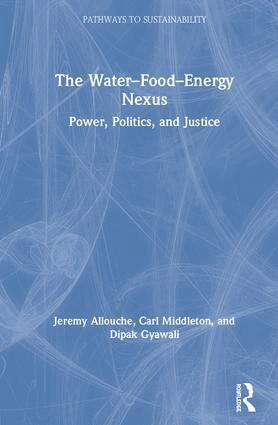
    Water–Food–Energy Nexus

    Power, Politics, and Justice

    AvJeremy Allouche,Carl Middleton

    Inbunden, Engelska, 2019

    Del i serien Pathways to Sustainability

    2 421 kr

    Beställningsvara. Skickas inom 10-15 vardagar. Fri frakt över 249 kr.

    Fler format och utgåvor

    Häftad

    540 kr

    Beskrivning

    The world of development thinkers and practitioners is abuzz with a new lexicon: the idea of "the nexus" between water, food, and energy which is intuitively compelling. It promises better integration of multiple sectoral elements, a better transition to greener economies, and sustainable development. However, there appears to be little agreement on its precise meaning, whether it only complements existing environmental governance approaches or how it can be enhanced in national contexts. One current approach to the nexus treats it as a risk and security matter while another treats it within economic rationality addressing externalities across sector. A third perspective acknowledges it as a fundamentally political process requiring negotiation amongst different actors with distinct perceptions, interests, and practices. This perspective highlights the fact that technical solutions for improving coherence within the nexus may have unintended and negative impacts in other policy areas, such as poverty alleviation and education. The Water–Food–Energy Nexus: Power, Politics and Justice lays out the managerial-technical definitions of the nexus and challenges these conceptions by bringing to the forefront the politics of the nexus, around two key dimensions – a dynamic understanding of water–food–energy systems, and a normative positioning around nexus debates, in particular around social justice. The authors argue that a shift in nexus governance is required towards approaches where limits to control are acknowledged, and more reflexive/plural strategies adopted. This book will be of interest to academic researchers, policy makers, and practitioners in the fields of international development studies, environmental politics, and science and technology studies, as well as international relations.

    Produktinformation

    • Utgivningsdatum:2019-04-25
    • Mått:156 x 234 x 16 mm
    • Vikt:320 g
    • Format:Inbunden
    • Språk:Engelska
    • Serie:Pathways to Sustainability
    • Antal sidor:140
    • Förlag:Taylor & Francis Ltd
    • ISBN:9781138714274

    Utforska kategorier

    • Alternativa terapier, healing och hälsa inom Ande, kropp och själ
    • Kemi inom Naturvetenskap och teknik

    Mer om författaren

    Jeremy Allouche is a Research Fellow at the Institute of Development Studies at the University of Sussex, UK, and a member of the ESRC-funded STEPS Centre.Carl Middleton is Director of the Center of Excellence in Resource Politics for Social Development in the Center for Social Development Studies (CSDS) at the Faculty of Political Science, Chulalongkorn University, Thailand.Dipak Gyawali is Pragya (Academician) of the Nepal Academy of Science and Technology and was Nepal’s Minister of Water Resources in 2002/2003. He conducts interdisciplinary research at the interface of technology and society, mostly from the perspectives of Cultural Theory.

    Recensioner i media

    "Beyond the commonplace recognition that the 'nexus' conceptual basis is not new and that integrative imperatives already featured in IWRM, this book further examines the underbelly of the beast and convincingly exposes the political underpinnings of a concept presented as a-political and 'manageable' through integrative tools, expert modeling, bureaucratic reforms and rational efficiency-driven thinking. It reveals the underlying business imperatives and green economy logics, traces the global diffusion of the concept, and emphasizes that issues of distributional justice, knowledge production and democratization of governance need to take center stage if the concept is to be transformative rather than supporting the status quo. An excellent reading for all water students and scholars interested in deciphering the word of water concepts and the interests and values that undergird them." — Francois Molle, Editor of Water Alternatives"We frequently hear of the nexus - but what does this mean, what does it entail, and where to begin? To such questions, Allouche offers a critical guide. Careful to consider complexities and uncertainties, the theoretical discussion coupled with multi-sited case studies, offers a compelling treatment. Readers wanting to know more of the concept, including political economic and equity implications, will find reading the book to be time well spent." — Leila M Harris, University of British Columbia, Canada"Skilfully delving into the nuances of the nexus approach, the authors trace and explain the emergence of the ‘new’ concepts of nexus – between water, food, energy, environment and more. Unravelling the tangle of nexus-invoking discourses, motivations and practices yields a valuable, sense-making analysis." — John Dore, Australia’s Department of Foreign Affairs and Trade"The book does a great job at showing how a water-energy-food nexus approach emphasises demand-led technological and market solutions, downplays supply-side limits, promotes a technical and supposedly apolitical treatment of trade-offs, and largely ignores the political dimensions that shape control over, and access to, resources." — Molle, F. 2019. Review of "The water-food-energy nexus. Power, politics and Justice", Earthscan, 2018, by Allouche, J.; Middleton, C. and Gyawali, D., Water Alternatives, http://www.water-alternatives.org/index.php/boh/item/19-nexus

    Innehållsförteckning

    • 1. Introduction: Nexus and nexuses 2. A critique of the global hegemonic nexus narratives 3. Integration for whom? Learning from the past4. The knowledge nexus and transdisciplinarity5. Hybrid governance and grounding the nexus6. Nexus rights and justice7. Ethics and the nexus8. Conclusion: ‘Democratising’ the nexus