• Fri frakt över 249 kr
  • •
  • Snabba leveranser
  • •
  • Billiga böcker
Kundservice

Du är på sajten för privatpersoner.

Företag, bibliotek eller offentlig verksamhet?

Du handlar på classic.bokus.com, där alla dina funktioner finns intakta.
Till classic.bokus.com
Bokus logotyp. Gå till startsidan.
  • Erbjudanden
  • Nyheter
  • Student
  • Topplistor
  • Barn & ungdom
  • Bokus Play
  • E-böcker
  • Pocketböcker
  • Spel & pussel

10% rabatt på allt med kod: NYSTART10 →

Sidfot

Mina sidor

    Hjälp

    • Kundservice
    • Vanliga frågor och svar
    • Frakt och leverans
    • Retur vid ångerrätt
    • Reklamera vara
    • Betalning
    • Köpvillkor
    • Allmänna villkor
    • Information om webbplatsens tillgänglighet

    Om Bokus

    • Om oss
    • Pressrum
    • För studenter
    • För företag
    • För bibliotek och offentlig verksamhet
    • För leverantörer
    • Hållbarhet

    Populärt

    • Aktuella erbjudanden
    • Presentkort
    • Studentlitteratur
    • Nya böcker
    • Topplistor
    • Signerade böcker
    • Engelska böcker

    Inspiration

    • Boktips
    • BookTok
    • Populära bokserier
    • Barnbokskaraktärer
    • Populära författare
    Logotyp för Bokus
    Följ oss på Facebook (extern länk)Följ oss på Instagram (extern länk)Följ oss på YouTube (extern länk)Följ oss på TikTok (extern länk)
    bokus @ CookiesAnpassa cookiesIntegritetspolicyKöpvillkor
    Till Citymail hemsida (extern länk)Till Budbee hemsida (extern länk)Till Postnord hemsida (extern länk)Till Schenker hemsida (extern länk)Till Early Bird hemsida (extern länk)Till Walleys hemsida (extern länk)
    1. Kultur
    2. Arkitektur

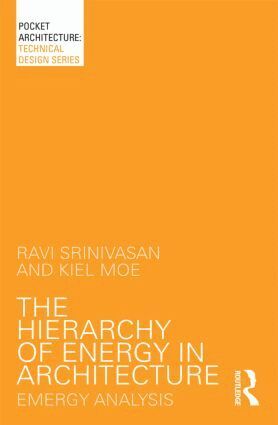
    Hierarchy of Energy in Architecture

    Emergy Analysis

    AvRavi Srinivasan,Kiel Moe

    Inbunden, Engelska, 2015

    Del i serien PocketArchitecture

    2 493 kr

    Beställningsvara. Skickas inom 10-15 vardagar. Fri frakt över 249 kr.

    Fler format och utgåvor

    Häftad

    556 kr

    Beskrivning

    The laws of thermodynamics—and their implications for architecture—have not been fully integrated into architectural design. Architecture and building science too often remain constrained by linear concepts and methodologies regarding energy that occlude significant quantities and qualities of energy. The Hierarchy of Energy in Architecture addresses this situation by providing a clear overview of what energy is and what architects can do with it. Building on the emergy method pioneered by systems ecologist Howard T. Odum, the authors situate the energy practices of architecture within the hierarchies of energy and the thermodynamics of the large, non-equilibrium, non-linear energy systems that drive buildings, cities, the planet and universe.Part of the PocketArchitecture series, the book is divided into a fundamentals section, which introduces key topics and the emergy methodology, and an applications section, which features case studies applying emergy to various architectural systems. The book provides a concise but rigorous exposure to the system boundaries of the energy systems related to buildings and as such will appeal to professional architects and architecture students.

    Produktinformation

    • Utgivningsdatum:2015-07-06
    • Mått:129 x 198 x undefined mm
    • Vikt:272 g
    • Format:Inbunden
    • Språk:Engelska
    • Serie:PocketArchitecture
    • Antal sidor:168
    • Förlag:Taylor & Francis Ltd
    • ISBN:9781138803527

    Utforska kategorier

    • Arkitektur inom Kultur

    Mer om författaren

    Ravi Srinivasan is Assistant Professor of Low / Net Zero Energy Buildings at the College of Design, Construction and Planning at the University of Florida, USA. He develops and teaches new courses related to low and net zero energy buildings in both the undergraduate and graduate programs, enhancing the school’s internationally recognized sustainable construction management program, researching and establishing net zero and low energy building frameworks, and organizing student competitions. He has more than 50 technical publications in peer-reviewed journals, refereed conference papers, and research reports.Kiel Moe is Associate Professor of Architecture and Energy at the Graduate School of Design at Harvard University, USA, where he is Co-Director of the MDes program, Co-Coordinator of the Energy & Environments MDes concentration, and Co-Director of the Energy, Environments, and Design Research Unit. He is author of Insulating Modernism: Isolated and non-isolated thermodynamics in architecture (2014), Convergence: An architectural agenda for energy (2013), Thermally Active Surfaces in Architecture (2010), and Integrated Design in Contemporary Architecture (2008). He was co-editor, with Ryan Smith, of Building Systems: Design technology & society (2012).

    Recensioner i media

    'The full transition to a renewable economy will only become possible when architects understand the different qualities of the materials, power sources, and settlement patterns with which they work. In The Hierarchy of Energy, Srinivasan and Moe explain the concepts and tools needed for environmental building design, and situate architecture within the self-organization of human and natural ecosystems.' - Dr. William W. Braham, FAIA, Director, Master of Environmental Building Design, University of Pennsylvania, USA

    Innehållsförteckning

    • List of Figures and Tables Series Editor’s Preface Preface Acknowledgments Part 1: Fundamentals 1. Energy, Entropy, Exergy, & Emergy 2. Emergy Analysis Methodology 3. Comparing Emergy Analysis with Life Cycle Assessment Tools Part 2: Applications 4. Emergy Evaluation of Mobile Kiosk 5. Emergy Evaluation of Rinker Hall Appendices 6. Glossary of Terms 7. Annotated References 8. Comprehensive List of Solar Transformities