

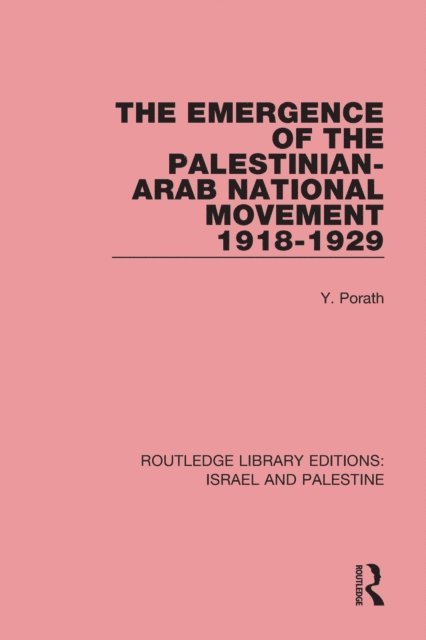
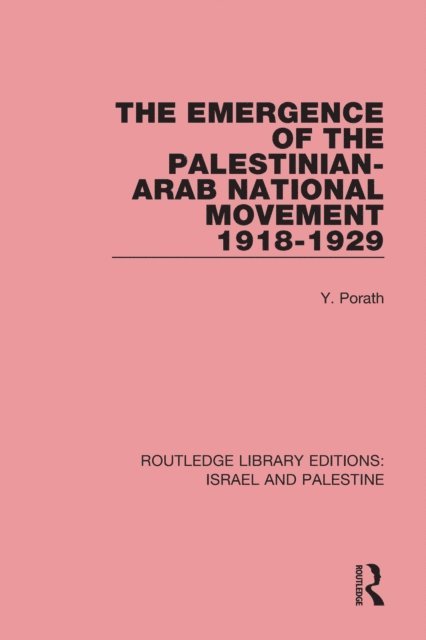
Emergence of the Palestinian-Arab National Movement, 1918-1929 (RLE Israel and Palestine)
Inbunden, Engelska, 2015
3 011 kr
Beställningsvara. Skickas inom 10-15 vardagar. Fri frakt över 249 kr.
Fler format och utgåvor
Beskrivning
The resurgence of Palestinian nationalism in the wake of the 1967 Arab-Israeli war tended to overshadow the fact that Palestinian national consciousness is not a new phenomenon, but traces its origins back to the time when the first stirrings of nationalism were being felt in many parts of the under-developed world. This work, first published in 1974, is based on both Arabic and Hebrew primary sources as well as English and French official and unofficial documents, and was the first detailed study of the infancy period of Palestinian nationalism. The book begins by establishing the position of Palestine and Jerusalem in Islamic history and their significance within the concepts of Islam, and outlines the social and political features of the Palestinian population at the beginning of the First World War. The author then charts in detail the development of Palestinian nationalism over the decade after the War. Two major forces influenced this development and reacted with it: Zionism, with its ambitious schemes for settling Jews in Palestine and creating a National Home for them there, and Arab nationalism on a wider scale, which was emerging spontaneously with the disintegration of the Ottoman Empire and the spreading of ideas of self-determination. The growing threat posed by Zionism awoke the Palestinian population to the need for organization and the establishment of their own identity to oppose it, while the focus of their national aspirations widened or narrowed according to the ability which they felt at any given time to confront Zionism and achieve self-expression within a Palestinian rather than an all-Syrian national framework. The events of these turbulent years – the confrontations with the British, delegations, boycotts, proposals and rejections, the emergence of al-Hajj Amin al-Husayni, the Wailing Wall conflict and its repercussions – are all described within the context of these wider considerations, which also include Britain’s own role as holder of the Mandate over Palestine.
Produktinformation
Utforska kategorier
Mer om författaren
Recensioner i media
Innehållsförteckning
Hoppa över listan



Mer från samma författare
Palestinian Arab National Movement, Volume 2: 1929-1939 (RLE Israel and Palestine)
Yehoshua Porath
E-bok
2023820 kr
Palestinian Arab National Movement, Volume 2: 1929-1939 (RLE Israel and Palestine)
Yehoshua Porath
E-bok
2023820 kr
Palestinian Arab National Movement, Volume 2: 1929-1939 (RLE Israel and Palestine)
Yehoshua Porath
Inbunden, 2015
3 011 kr
Palestinian Arab National Movement, Volume 2: 1929-1939 (RLE Israel and Palestine)
Yehoshua Porath
Häftad, 2016
699 kr
Hoppa över listan

Du kanske också är intresserad av
- 10% rabatt på allt
Emergence of the Palestinian-Arab National Movement, 1918-1929 (RLE Israel and Palestine)
Yehoshua Porath
Häftad, 2016
699 kr
Emergence of the Palestinian-Arab National Movement, 1918-1929 (RLE Israel and Palestine)
Yehoshua Porath
E-bok
2020796 kr
Emergence of the Palestinian-Arab National Movement, 1918-1929 (RLE Israel and Palestine)
Yehoshua Porath
E-bok
2020820 kr
Palestinian Arab National Movement, Volume 2: 1929-1939 (RLE Israel and Palestine)
Yehoshua Porath
Inbunden, 2015
3 011 kr
Palestinian Arab National Movement, Volume 2: 1929-1939 (RLE Israel and Palestine)
Yehoshua Porath
E-bok
2023820 kr
Palestinian Arab National Movement, Volume 2: 1929-1939 (RLE Israel and Palestine)
Yehoshua Porath
E-bok
2023820 kr
Palestinian Arab National Movement, Volume 2: 1929-1939 (RLE Israel and Palestine)
Yehoshua Porath
Häftad, 2016
699 kr