• Fri frakt över 249 kr
  • •
  • Snabba leveranser
  • •
  • Billiga böcker
Kundservice

Du är på sajten för privatpersoner.

Företag, bibliotek eller offentlig verksamhet?

Du handlar på classic.bokus.com, där alla dina funktioner finns intakta.
Till classic.bokus.com
Bokus logotyp. Gå till startsidan.
  • Erbjudanden
  • Nyheter
  • Student
  • Topplistor
  • Barn & ungdom
  • Bokus Play
  • E-böcker
  • Pocketböcker
  • Spel & pussel

10% rabatt på allt med kod: NYSTART10 →

Sidfot

Mina sidor

    Hjälp

    • Kundservice
    • Vanliga frågor och svar
    • Frakt och leverans
    • Retur vid ångerrätt
    • Reklamera vara
    • Betalning
    • Köpvillkor
    • Allmänna villkor
    • Information om webbplatsens tillgänglighet

    Om Bokus

    • Om oss
    • Pressrum
    • För studenter
    • För företag
    • För bibliotek och offentlig verksamhet
    • För leverantörer
    • Hållbarhet

    Populärt

    • Aktuella erbjudanden
    • Presentkort
    • Studentlitteratur
    • Nya böcker
    • Topplistor
    • Signerade böcker
    • Engelska böcker

    Inspiration

    • Boktips
    • BookTok
    • Populära bokserier
    • Barnbokskaraktärer
    • Populära författare
    Logotyp för Bokus
    Följ oss på Facebook (extern länk)Följ oss på Instagram (extern länk)Följ oss på YouTube (extern länk)Följ oss på TikTok (extern länk)
    bokus @ CookiesAnpassa cookiesIntegritetspolicyKöpvillkor
    Till Citymail hemsida (extern länk)Till Budbee hemsida (extern länk)Till Postnord hemsida (extern länk)Till Schenker hemsida (extern länk)Till Early Bird hemsida (extern länk)Till Walleys hemsida (extern länk)
    1. Naturvetenskap och teknik
    2. Teknik och industri
    3. Elektronik och kommunikationer

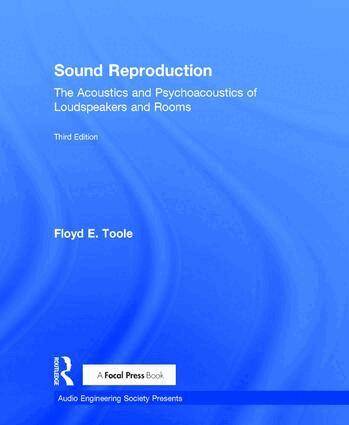
    Sound Reproduction

    The Acoustics and Psychoacoustics of Loudspeakers and Rooms

    AvFloyd E. Toole

    Inbunden, Engelska, 2017

    Del i serien Audio Engineering Society Presents

    1 789 kr

    Tillfälligt slut

    Fler format och utgåvor

    Häftad

    906 kr

    Inbunden

    2 405 kr

    Häftad

    Tillf. slut

    Beskrivning

    Sound Reproduction: The Acoustics and Psychoacoustics of Loudspeakers and Rooms, Third Edition explains the physical and perceptual processes that are involved in sound reproduction and demonstrates how to use the processes to create high-quality listening experiences in stereo and multichannel formats. Understanding the principles of sound production is necessary to achieve the goals of sound reproduction in spaces ranging from recording control rooms and home listening rooms to large cinemas. This revision brings new science-based perspectives on the performance of loudspeakers, room acoustics, measurements and equalization, all of which need to be appropriately used to ensure the accurate delivery of music and movie sound tracks from creators to listeners. The robust website (www.routledge.com/cw/toole) is the perfect companion to this necessary resource.

    Produktinformation

    • Utgivningsdatum:2017-08-14
    • Mått:191 x 235 x 27 mm
    • Vikt:1 120 g
    • Format:Inbunden
    • Språk:Engelska
    • Serie:Audio Engineering Society Presents
    • Antal sidor:490
    • Upplaga:3
    • Förlag:Taylor & Francis Ltd
    • ISBN:9781138921375

    Utforska kategorier

    • Elektronik och kommunikationer inom Naturvetenskap och teknik
    • Övrig teknik och tillämpad vetenskap inom Naturvetenskap och teknik
    • Systemvetenskap och AI inom Data och IT

    Mer om författaren

    Floyd E. Toole is a consultant for Harman and a Fellow of the AES, the Acoustical Society of America and CEDIA, and is in the Consumer Technology Hall of Fame.

    Recensioner i media

    "An excellent exploration of the topics and complexity involved in presenting recorded audio in a room to the human ear. [This book] is also an essential stepping stone into additional topics through the extensive references section provided from the research done by Toole and the industry community at large." - Brian Long, Journal of the Audio Engineering Society

    Innehållsförteckning

    • AcknowledgementsIntroductionChapter 1: Sound Production vs. Sound Reproduction Live Classical Musical Performances Live Popular Music Performances Reproduced Sound – The Audio Industry Preserving the Art – The Circle of Confusion Music and Movies – the State of Affairs The Role of Loudspeakers and Rooms Human Adaptation, a Reality the Cannot be Ignored Human Suggestibility Chapter 2: A Scientific Perspective on Audio Requirements for Scientific Investigations Chapter 3: Subjective Measurements – Turning Opinion into Fact Is Blind Listening Necessary? Hearing Ability and Listener Performance Stress and Strain How Many Channels? Controlling the Variables in Subjective Evaluations Controlling the Physical Variables The Listening Room – Making Tests Blind Real-time Loudspeaker Comparison Methods Binaural Record/Replay Loudspeaker Comparisons Listener Position and Seating Relative Loudness Absolute Loudness – Playback Sound Levels Choosing Program Material Power Amplifiers, Wire and So Forth Controlling the Psychological Variables How to do the Test Is it preference or accuracy that is evaluated? Chapter 4: The Perceptual and Physical Dimensions of Sound The Frequency Domain The Amplitude Domain Amplitude and Frequency Together: Frequency Response Amplitude and Frequency Together: Equal-Loudness Contours Loudness Controls and Tone Controls – Do They Work, Are They necessary? The Boundaries of What We Can Hear What Is Acceptable Background Noise? Linear Distortions: Amplitute and Phase vs. Frequency Spectral Tilt Resonances Viewed in Frequency and Time Finding and Fixing Resonances A Persistent Problem: Differentiating Between Evidence of Resonances and Acoustical Interference Critical bands, ERBNs, and the "resolution" of the hearing system Amplitude, Frequency and Time Together: Waterfall Diagrams Phase and Polarity – Do We Hear Waveforms? The Audibility of Phase Shift and Group Delay Phase Shift at Low Frequencies: a Special Case The Audibility of Absolute Polarity Non-Linear Distortions Wavelength, the Key to Understanding Much in Audio Loudspeaker Directivity Room Resonance Basics Resistive/Porous Absorbers and Membrane/Diaphragmatic Absorbers Diffusers and Other Sound Scattering Devices Chapter 5: Characterizing Loudspeakers – Can We Describe What is Good? The Wisdom of the Ancients Identifying the Important Variables – What do we Measure? Anechoic Measurements – the Spinorama Evolves Total Sound Power as a Measured Parameter Why do we measure what we do? Are there better ways? Predicting Room curves From Anechoic Data – An Exercise in curve Matching. A Message About Sound Absorption and Scattering Why Do We Care About Room Curves? Closing the Loop − Predicting Listener Preferences From Measurements The Olive Experiments – Part One The Olive Experiments – Part Two The Olive Experiments – Part Three Loudspeaker Resonances – Detection and Remedies Summary and Discussion Chapter 6: Loudspeaker/Room Systems – an Introduction One Room, Two Sound Fields – The Transition Frequency A Brief History of Loudspeaker/Room Interactions Timbral and Spatial Effects Attributable to Rooms Chapter 7: Above the Transition Frequency: Acoustical Events and Perceptions The Physical Variables: Early Reflections Problems with the Stereo Phantom Center Image The Physical Variables: Loudspeaker Directivity The Physical Variables: Acoustical Surface Treatments Absorbers Engineered Surfaces and Other Sound Scattering/Diffusing Devices Subjective Evaluations of Physical Variations Side Wall Treatment: Reflecting or Absorbing –Kishinaga et al. (1979) The Effect of Loudspeaker Directivity – Toole (1985) Loudspeaker Directivity and Wall Treatment Together – Choisel (2005) The Nature of the Sound Field – Klippel (1990) Observations of an Audio Enthusiast – Linkwitz (2007) Observations of an Audio Enthusiast – Toole (2016) Floor Reflections: A Special Case? Professional vs. Recreational Listening Hearing Loss is a Major Concern Discussion Perceptual Effects of Room Reflections Adaptation and Perceptual Streaming The Effect of Rooms on Loudspeaker Sound Quality The Effect of Rooms on Speech Intelligibility Sound Localization in Reflective Spaces − The Precedence (Haas) Effect Bringing the Precedence Effect into the Real Acoustical World Ceiling vs. Wall Reflections Real vs. Phantom Images Speech vs. Various Musical Sounds Meaningful Measurements of Reflection Amplitudes Chapter 8: Below the Transition Frequency: Acoustical Events and Perceptions The Basics of Room Resonances and Standing Waves Optimizing Room Dimensions – Does an "Ideal" Room Exist? Are Non-Rectangular Rooms the Answer? Solutions for the Real World Deliver Energy to the Modes and Dissipate Some of That Energy with Absorbers Deliver Energy to the Modes and Reduce the Coupling of That Energy to the Listener By Optimizing the Listening Location – "Positional" Equalization Reduce the Energy Delivered to a Bothersome Mode by Optimizing the Loudspeaker/Subwoofer Location Reduce the Energy Delivered to a Bothersome Mode by Using Parametric Equalization Reduce the Energy Delivered to a Bothersome Mode by Using Simple Mode-Manipulation Techniques Selective Mode Activation in Rectangular Rooms Using Passive Multiple-Subwoofer Mode Manipulation Mode Manipulation for Rectangular Rooms Using Multiple Subwoofers and Signal Processing Mode Manipulation For Any Room Using Multiple Subwoofers and Signal Processing: Sound Field Management (SFM). Revisiting Room Resonances in Time and Space Do we Hear the Spectral Bump, the Temporal Ringing, or Both? Stereo Bass: Little Ado About Even Less Bass Management Makes it all Possible. Summary and discussion Chapter 9: Adjacent boundary and loudspeaker mounting effects The effects of solid angles on the radiation of sound by omnidirectional sources Classic adjacent-boundary effects Alleviating adjacent-boundary effects Loudspeaker mounting options and effects An example of adjacent-boundary interference "Boundary-friendly" loudspeaker designs Array loudspeakers – other ways to manipulate boundary interactions Listeners also have boundaries Chapter 10: The Sound Fields in Sound Reproduction Spaces Reverberation Measuring reverberation time Calculating reverberation time Is there a more useful metric for our purposes? Diffusion Direct sound and early reflections Near and far fields of rooms − sound level vs. distance Near and far fields of sound sources Point sources and real loudspeakers Line sources Air absorption at high frequencies Screen loss in home theaters and cinemas The directivities of common sound sources Chapter 11: Sound in cinemas The closed loop of cinema sound Sound fields in cinemas A loudspeaker in a cinema Adding a screen and applying the X-curve The origins of the X-curve A recent study adds confirmation and clarity Flat, direct sound is an enduring favorite Alternative targets – is it time to move on? Compatibility with the rest of the audio worldCompatability with the cinema world The effects of room size and seats Cinema sound – where to next Chapter 12: Sound in home listening rooms, home theaters and recording control rooms Good sound starts with good loudspeakers Typical loudspeaker specifications – part of the problem Loudspeakers in small rooms: the meaning of room curves The effect of loudspeaker directional configuration Looking back 42 years: the Møller/Brüel and Kjaer experiments Room curves and equalization Subjective preferences for sound spectra in listening rooms Dialog intelligibility in home theaters Recording control rooms Old-school monitoring Modern monitoring Chapter 13: A rational approach to designing, measuring and calibrating sound reproducing systems Low frequencies – the universal problem Sound above the transition frequency Thirty years – some things change, some don’t The wrong room curve target? "Room correction" and "room equalization" are misnomers. Automotive audio Headphones Cinemas Is there a common factor – a generalizable target? Chapter 14: Measurement methods Alternative views of frequency response Prediction of the direct sound and room curves from anechoic data In-situ measurement of the direct sound The steady-state room curve Measures of loudness and system level calibrations. Evaluating relative program loudness levels Multichannel system level calibration The effect of propagation distance – a side-channel challenge Measurement microphones Chapter 15: Multichannel Audio A few definitions The birth of multichannel audio Stereo – an important beginning Loudspeakers as stereo image stabilizers Quadraphonics – stereo times two Multichannel audio – cinema to the rescue Multichannel comes home THX embellishments How many loudspeakers and where? Optimizing the delivery of "envelopment" Summary Surround system layouts Loudspeaker directivity requirements Mission oriented acoustical treatments Surround loudspeaker options The Ambisonics alternative Upmixer manipulations: creative instincts at work Multichannel audio goes digital, discrete and compressed Three-dimensional sound – immersive audio The perception of elevation Chapter 16: Loudspeakers and Power AmplifiersConsequence of Loudspeaker Impedance VariationsThe Damping Factor DeceptionLoudspeaker Sensitivity Ratings and Power AmplifiersThe Audibility of Clipping Chapter 17: Hearing loss and hearing conservation Occupational noise exposure limits Non-occupational noise exposure Binaural hearing is also affected Some obsession can be a good thing Chapter 18: Fifty years of progress in loudspeaker design My introduction to the real world Two decades of domestic loudspeakers Some early professional monitor loudspeakers A "Toole" monitor loudspeaker Looking around and looking ahead The end ReferencesIndex