• Fri frakt över 249 kr
  • •
  • Snabba leveranser
  • •
  • Billiga böcker
Kundservice

Du är på sajten för privatpersoner.

Företag, bibliotek eller offentlig verksamhet?

Du handlar på classic.bokus.com, där alla dina funktioner finns intakta.
Till classic.bokus.com
Bokus logotyp. Gå till startsidan.
  • Erbjudanden
  • Nyheter
  • Student
  • Topplistor
  • Barn & ungdom
  • Bokus Play
  • E-böcker
  • Pocketböcker
  • Spel & pussel

10% rabatt på allt med kod: NYSTART10 →

Sidfot

Mina sidor

    Hjälp

    • Kundservice
    • Vanliga frågor och svar
    • Frakt och leverans
    • Retur vid ångerrätt
    • Reklamera vara
    • Betalning
    • Köpvillkor
    • Allmänna villkor
    • Information om webbplatsens tillgänglighet

    Om Bokus

    • Om oss
    • Pressrum
    • För studenter
    • För företag
    • För bibliotek och offentlig verksamhet
    • För leverantörer
    • Hållbarhet

    Populärt

    • Aktuella erbjudanden
    • Presentkort
    • Studentlitteratur
    • Nya böcker
    • Topplistor
    • Signerade böcker
    • Engelska böcker

    Inspiration

    • Boktips
    • BookTok
    • Populära bokserier
    • Barnbokskaraktärer
    • Populära författare
    Logotyp för Bokus
    Följ oss på Facebook (extern länk)Följ oss på Instagram (extern länk)Följ oss på YouTube (extern länk)Följ oss på TikTok (extern länk)
    bokus @ CookiesAnpassa cookiesIntegritetspolicyKöpvillkor
    Till Citymail hemsida (extern länk)Till Budbee hemsida (extern länk)Till Postnord hemsida (extern länk)Till Schenker hemsida (extern länk)Till Early Bird hemsida (extern länk)Till Walleys hemsida (extern länk)
    1. Naturvetenskap och teknik
    2. Geovetenskap
    3. Regional planering

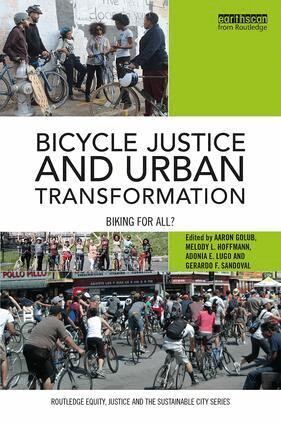
    Bicycle Justice and Urban Transformation

    Biking for all?

    AvAaron Golub,Melody Hoffmann

    Inbunden, Engelska, 2016

    Del i serien Routledge Equity, Justice and the Sustainable City series

    2 421 kr

    Beställningsvara. Skickas inom 10-15 vardagar. Fri frakt över 249 kr.

    Beskrivning

    As bicycle commuting grows in the United States, the profile of the white, middle-class cyclist has emerged. This stereotype evolves just as investments in cycling play an increasingly important role in neighborhood transformations. However, despite stereotypes, the cycling public is actually quite diverse, with the greatest share falling into the lowest income categories.Bicycle Justice and Urban Transformation demonstrates that for those with privilege, bicycling can be liberatory, a lifestyle choice, whereas for those surviving at the margins, cycling is not a choice, but an often oppressive necessity. Ignoring these "invisible" cyclists skews bicycle improvements towards those with choices. This book argues that it is vital to contextualize bicycling within a broader social justice framework if investments are to serve all street users equitably. "Bicycle justice" is an inclusionary social movement based on furthering material equity and the recognition that qualitative differences matter. This book illustrates equitable bicycle advocacy, policy and planning. In synthesizing the projects of critical cultural studies, transportation justice and planning, the book reveals the relevance of social justice to public and community-driven investments in cycling. This book will interest professionals, advocates, academics and students in the fields of transportation planning, urban planning, community development, urban geography, sociology and policy.

    Produktinformation

    • Utgivningsdatum:2016-07-04
    • Mått:156 x 234 x 22 mm
    • Vikt:544 g
    • Format:Inbunden
    • Språk:Engelska
    • Serie:Routledge Equity, Justice and the Sustainable City series
    • Antal sidor:294
    • Förlag:Taylor & Francis Ltd
    • ISBN:9781138950245

    Utforska kategorier

    • Regional planering inom Naturvetenskap och teknik

    Mer om författaren

    Aaron Golub is Associate Professor in the Nohad A. Toulan School of Urban Studies and Planning at Portland State University, Oregon, USA.Melody L. Hoffmann is a mass communication instructor at Anoka Ramsey Community College near Minneapolis, Minnesota, USA.Adonia E. Lugo is an urban anthropologist and co-founder of the Bicicultures network, USA.Gerardo F. Sandoval is Associate Professor at the Department of Planning, Public Policy and Management and the Co-Director of the Center for Latino/a and Latin American Studies at the University of Oregon, USA.

    Recensioner i media

    "Bicycle justice has become a major concern in the US. This group of authors provides an impressive array of case studies on bicycle justice and the overlooked or invisible riders creating bicycle advocacy and planning. These bike advocates promote more transportation choices for everyone while the transportation justice advocates demand that bicycling and all forms of transportation be understood as a civil rights issue." – Glenn S. Johnson, Associate Dean for Research and Graduate Studies, Texas Southern University, Barbara Jordan Mickey Leland School of Public Affairs, Houston, Texas, USA"This book may indeed help start a movement for inclusive, equitable bicycle justice. Grounded in clear thinking and strong examples, this unique collection offers a probing assessment of both the tendency to stereotype "deserving" bicyclists, marginalizing others, and the patently inequitable distribution of public investments in bicycle infrastructure." – June M. Thomas, Centennial Professor, Taubman College of Architecture and Urban Planning, The University of Michigan, USA"Postgraduates and academics will find this book rich and informative. This book would also serve as an excellent source for a course on urban transport justice".Cyrille Médard de Chardona,Université du Luxembourg, Local Environment The International Journal of Justice and Sustainability

    Innehållsförteckning

    • 1. Introduction: Creating an Inclusionary Bicycle Justice Movement 2. Is the right to bicycle a civil right? Synergies and tensions between the transportation justice movement and planning for bicycling 3. Is Portland’s Bicycle Success Story a Celebration of Gentrification? A theoretical and statistical analysis of bicycle use and demographic change 4. Freedom of movement / Freedom of choice: An enquiry into utility cycling and social justice in post-apartheid Cape Town, 1994-2015 5. Advocating Through Data: Community Visibilities in Crowdsourced Cycling Data 6. Advancing discussions of cycling interventions based on social justice 7. Theorizing Bicycle Justice Using Social Psychology: Examining the Intersection of Mode and Race with the Conceptual Model of Roadway Interactions 8. Delivering (in)Justice: Food Delivery Cyclists in New York City 9. Rascuache Cycling Justice 10. No Choice But to Bike: Undocumented and bike-dependent in rust belt America 11. Aburrido! Cycling on the U.S./Mexican Border with Doble Rueda Bicycle Collective in Matamoros, Tamaulipas 12. Civil Bikes: Embracing Atlanta’s racialized history through bicycle tours 13. Decentering Whiteness in Organized Bicycling: Notes from Inside 14. Community Bicycle Workshops and "Invisible Cyclists" in Brussels 15. Community Disengagement: The Greatest Barrier to Equitable Bike Share 16. No Hay Peor Lucha Que La Que No Se Hace: Re-negotiating cycling in a Latino community 17. Collectively Subverting the Status Quo at the Youth Bike Summit 18. Mediating the ‘White Lanes of Gentrification’ in Humboldt Park: Community-Led economic development and the struggle over public space