• Fri frakt över 249 kr
  • •
  • Snabba leveranser
  • •
  • Billiga böcker
Kundservice

Du är på sajten för privatpersoner.

Företag, bibliotek eller offentlig verksamhet?

Du handlar på classic.bokus.com, där alla dina funktioner finns intakta.
Till classic.bokus.com
Bokus logotyp. Gå till startsidan.
  • Erbjudanden
  • Nyheter
  • Student
  • Topplistor
  • Barn & ungdom
  • Bokus Play
  • E-böcker
  • Pocketböcker
  • Spel & pussel

10% rabatt på allt med kod: NYSTART10 →

Sidfot

Mina sidor

    Hjälp

    • Kundservice
    • Vanliga frågor och svar
    • Frakt och leverans
    • Retur vid ångerrätt
    • Reklamera vara
    • Betalning
    • Köpvillkor
    • Allmänna villkor
    • Information om webbplatsens tillgänglighet

    Om Bokus

    • Om oss
    • Pressrum
    • För studenter
    • För företag
    • För bibliotek och offentlig verksamhet
    • För leverantörer
    • Hållbarhet

    Populärt

    • Aktuella erbjudanden
    • Presentkort
    • Studentlitteratur
    • Nya böcker
    • Topplistor
    • Signerade böcker
    • Engelska böcker

    Inspiration

    • Boktips
    • BookTok
    • Populära bokserier
    • Barnbokskaraktärer
    • Populära författare
    Logotyp för Bokus
    Följ oss på Facebook (extern länk)Följ oss på Instagram (extern länk)Följ oss på YouTube (extern länk)Följ oss på TikTok (extern länk)
    bokus @ CookiesAnpassa cookiesIntegritetspolicyKöpvillkor
    Till Citymail hemsida (extern länk)Till Budbee hemsida (extern länk)Till Postnord hemsida (extern länk)Till Schenker hemsida (extern länk)Till Early Bird hemsida (extern länk)Till Walleys hemsida (extern länk)
    1. Ekonomi och Ledarskap
    2. Ledarskapsböcker
    3. Ledarskap och motivation

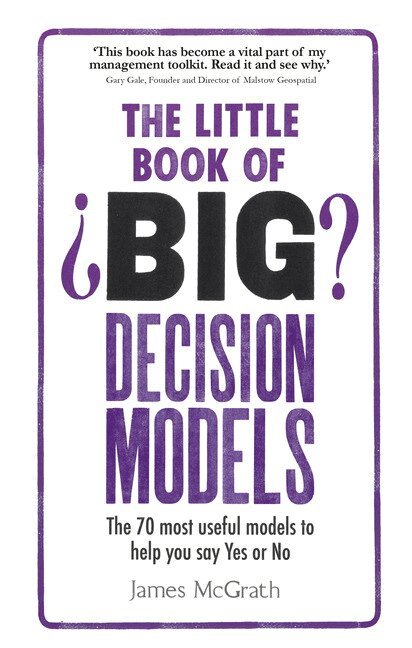
    Little Book of Big Decision Models, The

    The 70 most useful models to help you say Yes or No

    AvJames McGrath

    Häftad, Engelska, 2015

    122 kr

    Beställningsvara. Skickas inom 7-10 vardagar. Fri frakt över 249 kr.

    Beskrivning

    Leaders and Managers want quick answers, quick ways to reach solutions, ways and means to access knowledge that won’t eat into their precious time and quick ideas that deliver a big result.  The Little Book of Big Decision Models cuts through all the noise and gives managers access to the very best decision-making models that they need to to keep things moving forward. Every model is quick and easy to read and delivers the essential information and know-how quickly, efficiently and memorably.

    Produktinformation

    • Utgivningsdatum:2015-11-05
    • Mått:140 x 210 x 10 mm
    • Vikt:340 g
    • Format:Häftad
    • Språk:Engelska
    • Antal sidor:224
    • Upplaga:1
    • Förlag:Pearson Education
    • ISBN:9781292098364

    Utforska kategorier

    • Ledarskap och motivation inom Ekonomi och Ledarskap
    • Företagsekonomi inom Ekonomi och Ledarskap
    • Affärsstrategi inom Ekonomi och Ledarskap

    Mer om författaren

    James McGrath worked as an accountant and senior manager in industry, local government and as a self-employed management consultant before becoming Course Director for the MA in Education and Professional Development at the City of Birmingham University.

    Innehållsförteckning

    • Chapter 1 - The principles of decision making Introduction Model 1: Townsend’s rules of decision making Model 2: The McNamara fallacy - The vital information that decision makers ignore Model 3: Using quantitative (hard) and qualitative (soft) data in decision making Model 4: Kreiner and Christensen the consequence model Model 5: Tenenbaum and Schmid’s decision making spectrum Model 6: Roger and Blenko’s rapid decision making model Model 7: Cognitive mapping - understanding how your colleagues think Model 8: Tacit knowledge and decision making Model 9: The standard decision making model Conclusion Chapter 2 - Using data in decision making Introduction Model 10: The Pareto principle and the important vital few Model 11: Lewin’s force field analysis of the support and opposition to a decision Model 12: Scenario analysis and charting possible futures Model 13: Delphic forecasting and how to firm up predictions Model 14: Johnson, Scholes and Wittingham mapping stakeholder’s reactions Model 15: Egan’s shadow side model - dealing with the politics of decisions Model 16: The SCAMPER model and finding creative solutions Model 17: De Bono’s six thinking hats - generating different perspectives Conclusions Chapter 3 - Enhancing your decision making skills Intrduction Model 18: The Eisenhower principle and the delegation of decisions Model 19: The feedback and criticism grid Model 20: Learning to think outside the box Model 21: Goleman: Using emotional intelligence to make better decisions Model 22: Sumantra and Bruch reclaiming your job Conclusion Chapter 4 - Decisions models about you Introduction Model 23: Christensen’s strategy for a happy life Model 24: The making – of you model and how your past influences the present Model 25: The rubber band model - what holds you back and pulls you forward? Model 26: The crossroads model and which road to follow next Model 27: The personal performance model and job satisfaction Model 28: Csikzenmihalyi’s flow model and the joy of working in ‘the zone’ Model 29: Maslow’s Pyramids - what you want and what you need Model 30: The Euffe Elbaek model - a guide to your personality Model 31: Johari windows - a guide to your personality Model 32: The personal potential trap and how to avoid becoming a prisoner of other peoples’ expectations Model 33: Your attitude to risk Conclusion Chapter 5 - Decision Models about other people Introduction Model 34: Goffee and Jones - why should anyone be led by you? Model 35: Hersey and Blanchard’s situational leadership model Model 36: Manzoni and Barsoux - how managers set staff up to fail Model 37: Denseraeu, Graen and Haga - how managers set staff up to succeed Model 38: Herzberg’s motivation and hygiene theory - choosing the right carrots Model 39: The feedback sandwich - delivering negative feedback Model 40: McGregor’s features of effective and ineffective teams Model 41: The team model - building a well balanced team Conclusion Cha