• Fri frakt över 249 kr
  • •
  • Snabba leveranser
  • •
  • Billiga böcker
Kundservice

Du är på sajten för privatpersoner.

Företag, bibliotek eller offentlig verksamhet?

Du handlar på classic.bokus.com, där alla dina funktioner finns intakta.
Till classic.bokus.com
Bokus logotyp. Gå till startsidan.
  • Erbjudanden
  • Nyheter
  • Student
  • Topplistor
  • Barn & ungdom
  • Bokus Play
  • E-böcker
  • Pocketböcker
  • Spel & pussel

10% rabatt på allt med kod NYSTART10 →

Sidfot

Mina sidor

    Hjälp

    • Kundservice
    • Vanliga frågor och svar
    • Frakt och leverans
    • Retur vid ångerrätt
    • Reklamera vara
    • Betalning
    • Köpvillkor
    • Allmänna villkor
    • Information om webbplatsens tillgänglighet

    Om Bokus

    • Om oss
    • Pressrum
    • För studenter
    • För företag
    • För bibliotek och offentlig verksamhet
    • För leverantörer
    • Hållbarhet

    Populärt

    • Aktuella erbjudanden
    • Presentkort
    • Studentlitteratur
    • Nya böcker
    • Topplistor
    • Signerade böcker
    • Engelska böcker

    Inspiration

    • Boktips
    • BookTok
    • Populära bokserier
    • Barnbokskaraktärer
    • Populära författare
    Logotyp för Bokus
    Följ oss på Facebook (extern länk)Följ oss på Instagram (extern länk)Följ oss på YouTube (extern länk)Följ oss på TikTok (extern länk)
    bokus @ CookiesAnpassa cookiesIntegritetspolicyKöpvillkor
    Till Citymail hemsida (extern länk)Till Budbee hemsida (extern länk)Till Postnord hemsida (extern länk)Till Schenker hemsida (extern länk)Till Early Bird hemsida (extern länk)Till Walleys hemsida (extern länk)
    1. Data och IT
    2. Systemvetenskap och AI

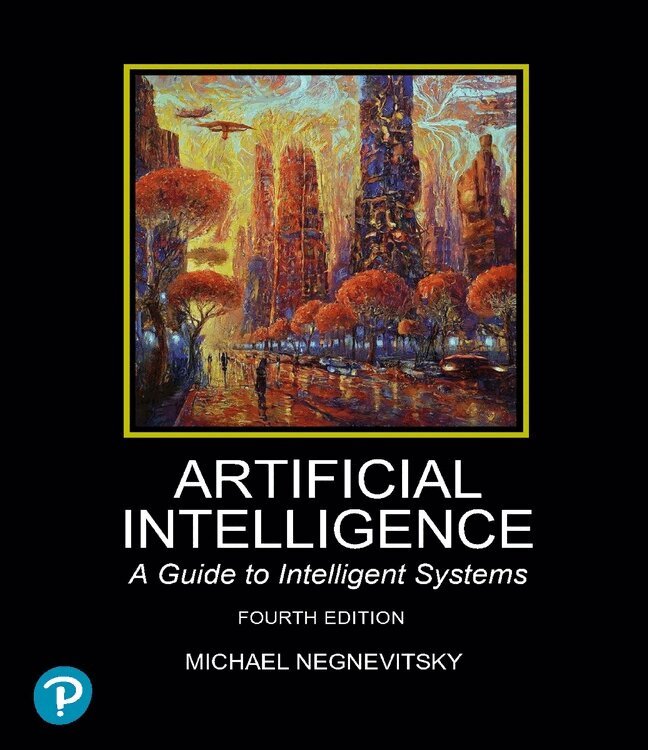
    Artificial Intelligence: A Guide to Intelligent Systems

    AvMichael Negnevitsky

    Häftad, Engelska, 2024

    979 kr

    Beställningsvara. Skickas inom 7-10 vardagar. Fri frakt över 249 kr.

    Beskrivning

    What are the principles behind intelligent systems? How are they built? What are intelligent systems useful for? How do we choose the right tool for the job? These questions are answered by Michael Negnevitsky’s Artificial Intelligence: A Guide to Intelligent Systems.

    Unlike many books on computer intelligence, which use complex computer science terminology and are crowded with complex matrix algebra and differential equations, this text demonstrates that the ideas behind intelligent systems are simple and straightforward. This text assumes little or no programming experience as it tackles topics like expert systems, fuzzy systems, artificial neural networks, evolutionary computation, knowledge engineering, and data mining. 

    Produktinformation

    • Utgivningsdatum:2024-09-24
    • Mått:230 x 24 x 153 mm
    • Vikt:784 g
    • Format:Häftad
    • Språk:Engelska
    • Antal sidor:600
    • Upplaga:4
    • Förlag:Pearson Education
    • ISBN:9781292730851

    Utforska kategorier

    • Systemvetenskap och AI inom Data och IT
    • Artificiell intelligens inom Data och IT

    Innehållsförteckning

    • Introduction to Intelligent Systems 1.1 Intelligent Machines, or What Machines Can Do1.2 The History of Artificial Intelligence, or From the ‘Dark Ages’ to Knowledge-based Systems1.3 Generative AI1.4 SummaryQuestions for ReviewReferences Expert Systems 2.1 Introduction, or Knowledge Representation Using Rules2.2 The Main Players in the Expert System Development Team2.3 Structure of a Rule-based Expert System2.4 Fundamental characteristics of an expert system2.5 Forward Chaining and Backward Chaining Inference Techniques2.6 MEDIA ADVISOR: A Demonstration Rule-based Expert System2.7 Conflict Resolution2.8 Uncertainty Management in Rule-based Expert Systems2.9 Advantages and Disadvantages of Rule-based Expert systems2.10 SummaryQuestions for ReviewReferences Fuzzy Systems 3.1 Introduction, or What Is Fuzzy Thinking?3.2 Fuzzy Sets3.3 Linguistic Variables and Hedges3.4 Operations of Fuzzy Sets3.6 Fuzzy Inference3.7 Building a Fuzzy Expert System3.8 SummaryQuestions for ReviewReferences Frame-based Systems and Semantic Networks 4.1 Introduction, or What Is a Frame?4.2 Frames as a Knowledge Representation Technique4.3 Inheritance in Frame-based Systems4.4 Methods and Demons4.5 Interaction of Frames and Rules4.6 Buy Smart: A Frame-based Expert System4.7 The Web of Data4.8 RDF – Resource Description Framework and RDF Triples4.9 Turtle, RDF Schema and OWL4.10 Querying the Semantic Web with SPARQL4.11 SummaryQuestions for ReviewReferences Artificial Neural Networks 5.1 Introduction, or How the Brain Works5.2 The Neuron as a Simple Computing Element5.3 The Perceptron5.4 Multilayer Neural Networks5.5 Accelerated Learning in Multilayer Neural Networks5.6 The Hopfield Network5.7 Bidirectional Associative Memory5.8 Self-organising Neural Networks5.9 Reinforcement Learning5.10 SummaryQuestions for ReviewReferences Deep Learning and Convolutional Neural Networks 6.1 Introduction, or How “Deep” Is a Deep Neural Network?6.2 Image Recognition or How Machines See the World6.3 Convolution in Machine Learning6.4 Activation Functions in Deep Neural Networks6.5 Convolutional Neural Networks6.6 Back-propagation Learning in Convolutional Networks6.7 Batch Normalisation6.8 SummaryQuestions for ReviewReferences Evolutionary Computation 7.1 Introduction, or Can Evolution Be Intelligent?7.2 Simulation of Natural Evolution7.3 Genetic Algorithms7.4 Why Genetic Algorithms Work7.5 Maintenance Scheduling with Genetic Algorithms7.6 Genetic Programming7.7 Evolution Strategies7.8 Ant Colony Optimisation7.9 Particle Swarm Optimisation7.10 SummaryQuestions for ReviewReferences Hybrid Intelligent Systems 8.1 Introduction, or How to Combine German Mechanics with Italian Love8.2 Neural Expert Systems8.3 Neuro-Fuzzy Systems8.4 ANFIS: Adaptive Neuro-Fuzzy Inference System8.5 Evolutionary Neural Networks8.6 Fuzzy Evolutionary Systems8.7 SummaryQuestions for ReviewReferences Knowledge Engineering 9.1 Introduction, or What Is Knowledge Engineering?9.2 Will an Expert System Work for My Problem?9.3 Will a Fuzzy Expert System Work for My Problem?9.4 Will a Neural Network Work for My Problem?9.5 Will a Deep Neural Network Work for My Problem?9.6 Will Genetic Algorithms Work for My Problem?9.7 Will Particle Swarm Optimisation Work for My Problem?9.8 Will a Hybrid Intelligent System Work for My Problem?9.9 SummaryQuestions for ReviewReferences Data Mining and Knowledge Discovery 10.1 Introduction, or What Is Data Mining?10.2 Statistical Methods and Data Visualisation10.3 Principal Components Analysis10.4 Relational Databases and Database Queries10.5 The Data Warehouse and Multidimensional Data Analysis10.6 Decision Trees10.7 Association Rules and Market Basket Analysis10.8 SummaryQuestions for ReviewReferences GlossaryIndex