• Fri frakt över 249 kr
  • •
  • Snabba leveranser
  • •
  • Billiga böcker
Kundservice

Du är på sajten för privatpersoner.

Företag, bibliotek eller offentlig verksamhet?

Du handlar på classic.bokus.com, där alla dina funktioner finns intakta.
Till classic.bokus.com
Bokus logotyp. Gå till startsidan.
  • Erbjudanden
  • Student
  • Topplistor
  • Barn & ungdom
  • Bokus Play
  • E-böcker
  • Ljudböcker
  • Pocketböcker
  • Spel och pussel

Pocketfynda! Hundratals böcker för 49 kr/st →

Sidfot

Mina sidor

    Hjälp

    • Kundservice
    • Vanliga frågor och svar
    • Frakt och leverans
    • Retur vid ångerrätt
    • Reklamera vara
    • Betalning
    • Köpvillkor
    • Allmänna villkor
    • Information om webbplatsens tillgänglighet

    Om Bokus

    • Om oss
    • Pressrum
    • För studenter
    • För företag
    • För bibliotek och offentlig verksamhet
    • För leverantörer
    • Hållbarhet

    Populärt

    • Aktuella erbjudanden
    • Presentkort
    • Studentlitteratur
    • Nya böcker
    • Topplistor
    • Signerade böcker
    • Engelska böcker

    Inspiration

    • Boktips
    • BookTok
    • Barnbokskaraktärer
    • Populära författare
    Logotyp för Bokus
    Följ oss på Facebook (extern länk)Följ oss på Instagram (extern länk)Följ oss på YouTube (extern länk)Följ oss på TikTok (extern länk)
    bokus @ CookiesAnpassa cookiesIntegritetspolicyKöpvillkor
    Till Citymail hemsida (extern länk)Till Budbee hemsida (extern länk)Till Postnord hemsida (extern länk)Till Schenker hemsida (extern länk)Till Early Bird hemsida (extern länk)Till Walleys hemsida (extern länk)
    1. Ekonomi och Ledarskap
    2. Nationalekonomi
    3. Mikroekonomi

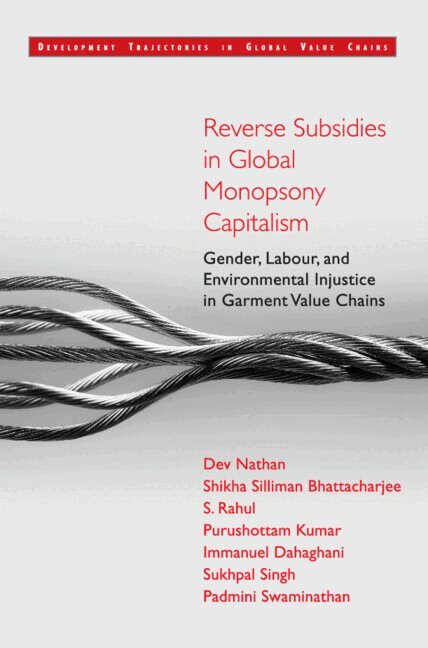
    Reverse Subsidies in Global Monopsony Capitalism

    Gender, Labour, and Environmental Injustice in Garment Value Chains

    AvDev Nathan,Shikha Silliman Bhattacharjee

    Inbunden, Engelska, 2022

    Del i serien Development Trajectories in Global Value Chains

    1 282 kr

    Beställningsvara. Skickas inom 7-10 vardagar. Fri frakt över 249 kr.

    Beskrivning

    This book provides a firm analytical base to discussions about injustice and the unequal distribution of gains from global production in the form of global monopsony capitalism. It utilizes the concept of reverse subsidies as the purchase of gendered labour and environmental services below their costs of production in garment value chains in India and other garment producing countries, such as Bangladesh and Cambodia. Environmental services, such as freshwater for garment manufacture and land for cotton production, are degraded by overuse and untreated waste disposal. The resulting higher profits from the low prices of garments are captured by global brands, using their monopsony position, with few buyers and myriad sellers, in the market. This book links the concept of reverse subsidies with those of injustice, inequality and sustainability in global production.

    Produktinformation

    • Utgivningsdatum:2022-05-26
    • Mått:158 x 235 x 23 mm
    • Vikt:550 g
    • Format:Inbunden
    • Språk:Engelska
    • Serie:Development Trajectories in Global Value Chains
    • Antal sidor:312
    • Förlag:Cambridge University Press
    • ISBN:9781316512272

    Utforska kategorier

    • Mikroekonomi inom Ekonomi och Ledarskap

    Mer om författaren

    Dev Nathan is Visiting Professor at the Institute for Human Development, New Delhi; and Research Director at the GenDev Centre for Research and Innovation, Haryana, India. His research interests range from the nature of global production to development issues of indigenous peoples and gender relations. He co-authored the book Witch Hunts: Culture, Patriarchy and Structural Transformation (2020). Shikha Silliman Bhattacharjee is a lawyer and researcher focused on migration, supply chains, gender, caste and race in the global economy. She has conducted research and advocacy in collaboration with global institutions like Human Rights Watch, the International Labour Organization and Global Labour Justice-International Labor Rights Forum. S. Rahul teaches at the School of Management and Labour Studies of the Tata Institute of Social Sciences, Mumbai. His professional interests are aligned in social analytics and research especially in the areas of developmental research, labour market and global value chains. Purushottam Kumar is a researcher and currently working as a senior program manager with Society for Labour and Development, New Delhi. His research focuses on labour rights in the global value chains of the leather, garment and seafood processing industries. Immanuel Dahaghani is a research consultant from Chennai whose work is focused on labour rights and labour welfare in garments, leather and automobile sectors. He has worked with the Society for Labour and Development (SLD) and the Asia Floor Wage Alliance (AFWA). Sukhpal Singh is Professor and Former Chairperson, Centre for Management in Agriculture, Indian Institute of Management, Ahmedabad. His research interests lie in small producer and worker livelihoods and collectivization of stakeholders in the context of agribusiness value chains and deregulation of agricultural markets in India and the developing world. Padmini Swaminathan is former Director of the Madras Institute of Development Studies, Chennai, where she also held the post of the Reserve Bank of India Chair in Regional Economics. Her research work covers the areas of industrial organization, labour, occupational health and skill development.

    Recensioner i media

    'Reverse Subsidies in Global Production is an important book and one that brings together telling evidence in a compelling way. The authors analyze the injustices in global value chains and, by extension, the global capitalist economy by interrogating the nature of the interactions of the different segments of the chains: from the producers of inputs of the production workers to the suppliers and brand name buyers. They introduce a concept of critical important to understanding these interactions: the concept of 'reverse subsidies'. Subsidies are widely understood as amounts of funding provided by the state to allow goods and services to be provided or consumed below their cost of production. Reverse subsidies, by contrast, are below-cost provision of goods and services by workers to the profit of suppliers and, more so, brand name companies. This happens because brand name companies download so many costs and risks onto workers – through irregular work orders, low wages or piece rates, delayed payments and rejected goods – that the workers often operate at a loss.' Marty Chen, Lecturer in Public Policy, Harvard Kennedy School

    Innehållsförteckning

    • 1. Introduction; Part I. Framework: 2. Gender, labour and environmental justice in GVCs; 3. Knowledge, global monopsony capitalism and labour; Part II. Factory: 4. Living wages and labour subsidies; 5. Extractive labour subsidies: The overuse and discard of women's labour in garment production; 6. Gender based violence as supervision; Part III. Household: 7. Rural subsidies; 8. The household as production site: Homeworkers and child labour; Part IV. Environment: 9. Tiruppur: The environmental costs of success; 10. Externalized costs of cotton production; Part V. Value Capture: 11. Value capture in global monopsony capitalism; 12. Conclusion.