• Fri frakt över 249 kr
  • •
  • Snabba leveranser
  • •
  • Billiga böcker
Kundservice

Du är på sajten för privatpersoner.

Företag, bibliotek eller offentlig verksamhet?

Du handlar på classic.bokus.com, där alla dina funktioner finns intakta.
Till classic.bokus.com
Bokus logotyp. Gå till startsidan.
  • Erbjudanden
  • Nyheter
  • Student
  • Topplistor
  • Barn & ungdom
  • Bokus Play
  • E-böcker
  • Pocketböcker
  • Spel & pussel

10% rabatt på allt med kod NYSTART10 →

Sidfot

Mina sidor

    Hjälp

    • Kundservice
    • Vanliga frågor och svar
    • Frakt och leverans
    • Retur vid ångerrätt
    • Reklamera vara
    • Betalning
    • Köpvillkor
    • Allmänna villkor
    • Information om webbplatsens tillgänglighet

    Om Bokus

    • Om oss
    • Pressrum
    • För studenter
    • För företag
    • För bibliotek och offentlig verksamhet
    • För leverantörer
    • Hållbarhet

    Populärt

    • Aktuella erbjudanden
    • Presentkort
    • Studentlitteratur
    • Nya böcker
    • Topplistor
    • Signerade böcker
    • Engelska böcker

    Inspiration

    • Boktips
    • BookTok
    • Populära bokserier
    • Barnbokskaraktärer
    • Populära författare
    Logotyp för Bokus
    Följ oss på Facebook (extern länk)Följ oss på Instagram (extern länk)Följ oss på YouTube (extern länk)Följ oss på TikTok (extern länk)
    bokus @ CookiesAnpassa cookiesIntegritetspolicyKöpvillkor
    Till Citymail hemsida (extern länk)Till Budbee hemsida (extern länk)Till Postnord hemsida (extern länk)Till Schenker hemsida (extern länk)Till Early Bird hemsida (extern länk)Till Walleys hemsida (extern länk)
    1. Naturvetenskap och teknik
    2. Geovetenskap
    3. Miljövetenskap och miljöpolitik

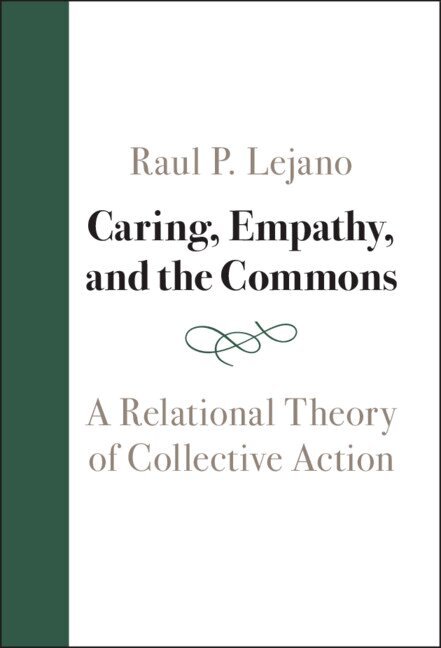
    Caring, Empathy, and the Commons

    A Relational Theory of Collective Action

    AvRaul P. Lejano

    Inbunden, Engelska, 2023

    1 201 kr

    Beställningsvara. Skickas inom 10-15 vardagar. Fri frakt över 249 kr.

    Fler format och utgåvor

    E-bok

    1 405 kr

    E-bok

    1 405 kr

    Beskrivning

    People are not autonomous individuals but connected beings. Curae ergo sum - we care, therefore we are. Relationality - which refers to the ethic and manner by which relational considerations govern decisions and institutional arrangements can take advantage of the power of connection - uncovers how social connection, across divides, moves people to act for the other. Drawing from research on empathy, social networks, and determinants of pro-social behavior, Caring, Empathy, and the Commons builds on Ostrom's Governing the Commons. It offers a different mechanism by which collective action is induced, arguing that, sometimes, the individual thinks not in terms of individual gain but in terms of the other. Developing this concept of relationality, this book explores various strands of literature and examines how this idea might be used to foster collective action around climate, species protection, fair trade, and other dilemmas of the commons.

    Produktinformation

    • Utgivningsdatum:2023-08-31
    • Mått:159 x 236 x 17 mm
    • Vikt:410 g
    • Format:Inbunden
    • Språk:Engelska
    • Antal sidor:178
    • Förlag:Cambridge University Press
    • ISBN:9781316518779

    Utforska kategorier

    • Miljövetenskap och miljöpolitik inom Naturvetenskap och teknik
    • Miljöekonomi inom Ekonomi och Ledarskap
    • Statsvetenskap och politisk teori inom Samhälle och politik

    Mer om författaren

    Raul P. Lejano is Professor of environmental education at New York University. His research revolves around two sides of relationality: how connectedness fosters collective action and disconnectedness increases vulnerability. He is a coauthor, with Wing Shan Kan, of a book entitled Relationality: The Inner Life of Public Policy (Cambridge University Press).

    Innehållsförteckning

    • 1. Introduction: Caring for the commons; 2. Constructing a relational theory of collective action; 3. Further justifications of the relational theory; 4. Illustrations: Pro-Social/Pro-Environmental behavior; 5. Illustrations: Governing the commons; 6. Institutional considerations; 7. Prospects of relationality.